
Lawn Care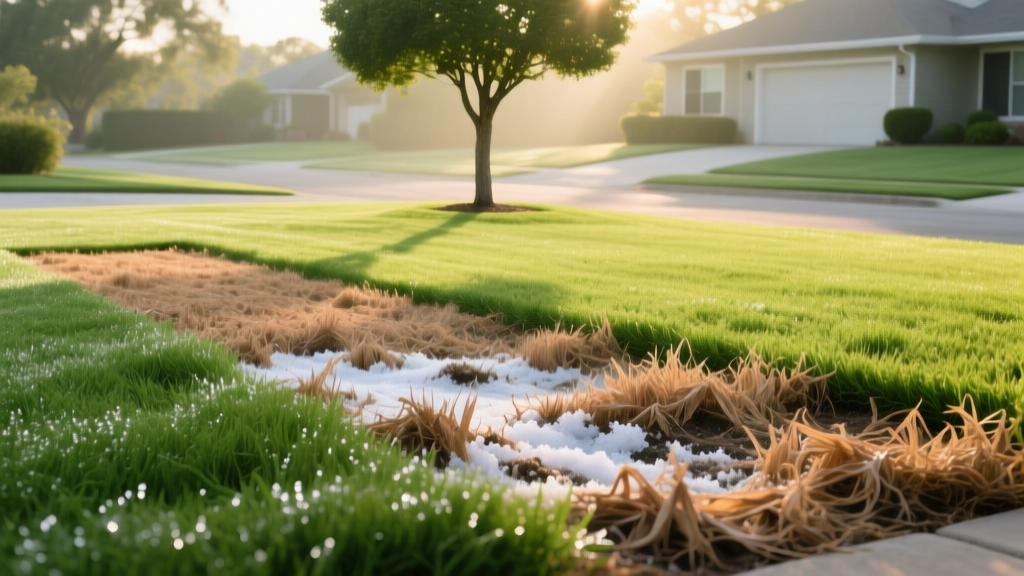
Does Salt Kill Grass? The Science of Salinity and Lawn Recovery
The Short Answer: Yes, But It Depends on the Salt Type
When homeowners ask, 'does salt kill grass?', the direct answer is yes—specifically when referring to sodium chloride (NaCl), commonly known as rock salt. However, not all salts are created equal. While sodium chloride is highly toxic to turfgrass and destroys soil structure, other compounds like calcium chloride or magnesium acetate have drastically lower toxicity profiles. Furthermore, salts like magnesium sulfate (Epsom salt) are actually used as micronutrient fertilizers in turf management. Understanding the chemical distinction between these compounds is the first step in protecting your lawn from winter hardscape runoff and coastal salinity.
The Science of Salinity: Osmotic Stress and Ion Toxicity
Sodium chloride kills grass through two distinct physiological mechanisms. According to the USGA Green Section, turfgrass injury from de-icing salts is rarely a simple case of 'burning'; it is a complex disruption of soil chemistry and plant hydration.
1. Physiological Drought (Osmotic Stress)
Plant roots absorb water through osmosis, moving from an area of low solute concentration (the soil) to high solute concentration (the root cells). When sodium chloride dissolves in soil moisture, it drastically lowers the osmotic potential of the soil water. Even if the soil is physically wet, the salt creates a 'physiological drought.' The grass roots cannot extract the water, leading to desiccation, wilting, and eventual cell death, mimicking the symptoms of severe drought stress despite the presence of moisture.
2. Sodium Toxicity and Soil Structure Collapse
Beyond water deprivation, the sodium (Na+) ions in rock salt actively displace essential nutrients like calcium (Ca2+), magnesium (Mg2+), and potassium (K+) on the soil's cation exchange complex. As sodium saturates the soil, it causes clay particles to repel one another, leading to soil dispersion. This destroys soil aggregation, collapsing pore spaces, and creating a hard, impermeable crust that prevents oxygen and water from reaching the root zone. Simultaneously, the accumulation of chloride (Cl-) ions in plant tissues reaches toxic levels, disrupting photosynthesis and causing severe leaf tip necrosis.
Diagnosis Matrix: Salt Damage vs. Other Winter Kill
Identifying salt damage requires distinguishing it from common winter ailments. Salt injury almost always correlates with proximity to hardscapes where de-icers are applied or where snowplows deposit treated snow.
| Symptom Profile | Salt Toxicity (NaCl) | Snow Mold (Typhula/Microdochium) | Winter Desiccation |
|---|---|---|---|
| Location | Within 12-36 inches of driveways, walkways, and streets. | Random patches across the lawn, often where snow drifted deeply. | Exposed areas, hilltops, and windy zones without snow cover. |
| Visual Cues | Leaf tips turn yellow/brown first; soil surface may show a white, crusty efflorescence. | Matted, straw-colored grass with a pinkish or grayish web-like mycelium. | Uniform bleaching or browning of the entire plant; leaves feel brittle and dry. |
| Soil Condition | Hard, compacted, slow to drain; high pH and high Electrical Conductivity (EC). | Moist, spongy, high organic matter thatch layer. | Dry, frozen, or wind-scoured topsoil. |
| Recovery | Will not recover without soil leaching and gypsum amendment. | Often recovers naturally in spring; may need light raking and fungicide. | Recovers if crown is alive; requires spring nitrogen and hydration. |
De-Icer Comparison: Which Melts Ice Without Melting Your Lawn?
If you must use chemical de-icers, selecting the right compound minimizes turf loss. The University of Minnesota Extension notes that while no chemical is 100% safe for vegetation in high concentrations, alternatives to NaCl significantly reduce long-term soil degradation.
| De-Icing Compound | Chemical Formula | Lawn Toxicity | Effective Temp | Approx. Cost (50lb bag) |
|---|---|---|---|---|
| Rock Salt | NaCl (Sodium Chloride) | Extreme (Causes severe osmotic stress and soil crusting) | Down to 20°F (-6°C) | $10 - $15 |
| Calcium Chloride | CaCl2 | Moderate (Less toxic than NaCl, but still causes chloride burn in high doses) | Down to -25°F (-32°C) | $25 - $35 |
| Magnesium Chloride | MgCl2 | Low-Moderate (Safer for plants, but high chloride content still poses risks) | Down to -13°F (-25°C) | $30 - $40 |
| Calcium Magnesium Acetate (CMA) | CaMg2(C2H3O2)6 | Very Low (Biodegradable, no chloride ions, safe for turf and concrete) | Down to 20°F (-6°C) | $40 - $60 |
| Urea / Fertilizer Blends | CH4N2O | Low (Acts as nitrogen fertilizer, but runoff causes aquatic eutrophication) | Down to 20°F (-6°C) | $20 - $30 |
The 4-Step Remediation Protocol for Saline Soil
If your lawn has suffered NaCl exposure, springtime fertilization will not fix the problem. You must physically alter the soil chemistry. Follow this agronomic protocol to reclaim saline soil:
Step 1: Deep Leaching (The Flush)
Before applying amendments, you must dissolve and push existing salts below the root zone. Calculate the leaching fraction: you need to apply approximately 6 to 12 inches of water over the affected area to push sodium below a 6-inch root profile. Do this in early spring when the soil thaws but before the grass breaks dormancy. Use a sprinkler to apply 1 inch of water per day over consecutive days to prevent surface runoff, allowing gravity to pull the saline solution deep into the subsoil.
Step 2: Gypsum Application (Cation Exchange)
Leaching alone cannot remove sodium bound to clay particles. You must apply pelletized gypsum (Calcium Sulfate, CaSO4). The calcium ions in gypsum are stronger than sodium ions on the soil's cation exchange complex. The calcium displaces the sodium, allowing the freed sodium to pair with sulfate to form sodium sulfate, which is highly water-soluble and easily leached away.
- Application Rate: Apply 20 to 30 lbs of pelletized gypsum per 1,000 square feet for moderate salt damage. For severe damage (heavy snowplow berms), increase to 50 lbs per 1,000 sq ft.
- Timing: Apply immediately after the leaching phase, water it in heavily, and repeat the application in late fall if the area will receive salt again.
Step 3: Soil Testing and pH Adjustment
Send a soil sample to a local university extension lab and specifically request an Electrical Conductivity (EC) and Exchangeable Sodium Percentage (ESP) test.
A healthy lawn requires an EC reading below 2.0 dS/m (decisiemens per meter) and an ESP below 10%. If your ESP remains above 15%, the soil is classified as 'sodic' and requires additional gypsum and organic matter integration.Note that rock salt does not significantly alter soil pH, so do not apply lime unless the pH test specifically indicates acidity. Adding lime (calcium carbonate) to high-sodium soil without gypsum can actually worsen soil crusting.
Step 4: Core Aeration and Topdressing
Sodium destroys soil structure, leaving the ground compacted. Once the soil is dry enough to bear weight, perform deep core aeration (removing 3-inch plugs). Topdress the aerated area with a high-quality, compost-rich topsoil (no more than 1/4 inch deep). The organic matter will help rebuild soil aggregates and improve microbial activity, which is often decimated by high salinity.
Warning: The Epsom Salt Myth
Do not confuse sodium chloride (rock salt) with magnesium sulfate (Epsom salt). Epsom salt does not kill grass; in fact, it is frequently used in liquid turf fertilizers to correct magnesium deficiencies and deepen the green color of chlorotic turf. Never use Epsom salt as a winter de-icer, as it is highly expensive and ineffective at melting ice compared to chloride-based salts.
Do not confuse sodium chloride (rock salt) with magnesium sulfate (Epsom salt). Epsom salt does not kill grass; in fact, it is frequently used in liquid turf fertilizers to correct magnesium deficiencies and deepen the green color of chlorotic turf. Never use Epsom salt as a winter de-icer, as it is highly expensive and ineffective at melting ice compared to chloride-based salts.
Selecting Salt-Tolerant Turfgrass Cultivars
If your property borders a heavily salted municipal road or is located in a coastal spray zone, remediating the soil every spring is a losing battle. Instead, transition to salt-tolerant turfgrass species. According to NC State Turfgrass Pathology, genetic tolerance varies wildly between species:
- Alkaligrass (Puccinellia distans): The undisputed champion of cool-season salt tolerance. Cultivars like 'Fulturf' thrive in EC levels up to 10.0 dS/m, making them ideal for highway medians and driveway margins.
- Tall Fescue (Festuca arundinacea): Modern turf-type tall fescues (e.g., 'RTF', 'Titan Ultra') possess deep root systems that allow them to bypass shallow saline topsoil and access cleaner water below.
- Seashore Paspalum (Paspalum vaginatum): For warm-season climates, this grass can tolerate salinity levels equivalent to half-strength seawater. It is widely used on coastal golf courses in the Southeast and Hawaii.
- Bermudagrass (Cynodon dactylon): Exhibits moderate to high salt tolerance, provided the soil has adequate drainage to prevent standing saline water.
Managing salt damage requires moving beyond simple reseeding. By understanding the osmotic mechanics of sodium toxicity, utilizing calcium sulfate to rebuild soil structure, and selecting genetically resilient cultivars, you can maintain a dense, healthy lawn even in high-salinity environments.

