
Lawn Care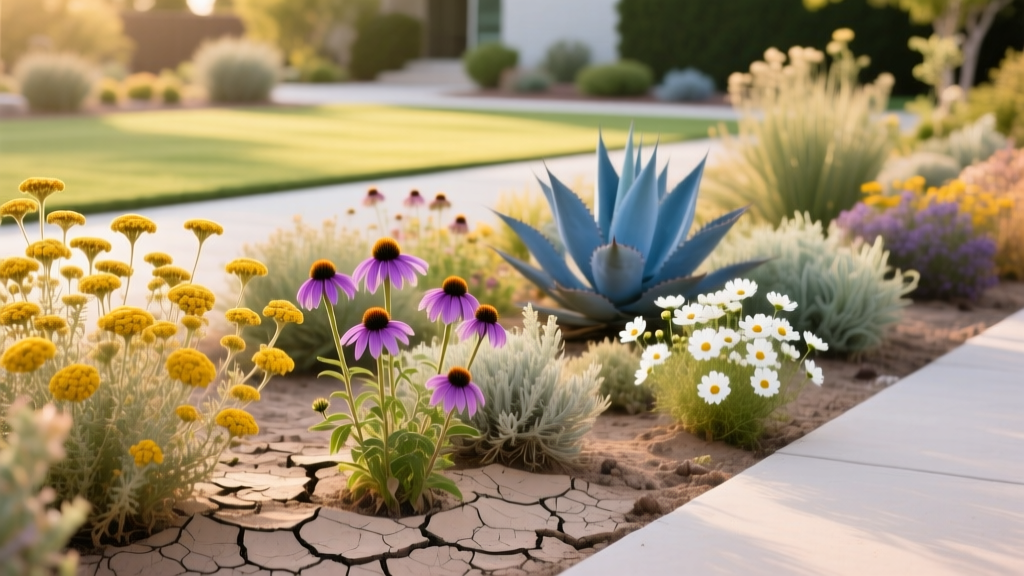
Top Drought Tolerant Flowers to Fix Dry Lawn Borders
Lawns frequently fail at their perimeters. The outermost 18 to 24 inches of turf often turn brown, thin out, or succumb to weed invasion due to a combination of sprinkler blind spots, radiant heat from adjacent hardscapes, and poor soil grading. Instead of fighting the site with extra irrigation or constant overseeding, the most effective site-condition solution is to transition these dead zones into dedicated beds using drought tolerant flowers. By matching specific plant cultivars to the exact microclimate of your lawn border, you eliminate water waste, reduce mowing edging time, and introduce deep-rooted perennials that thrive where shallow-rooted turfgrass fails.
Diagnosing the Dry Zone: Why Your Lawn Borders Fail
Before selecting plants, you must identify the specific environmental stressor killing your turf. Dry lawn borders rarely suffer from a simple lack of water; they suffer from compounding site conditions:
- Radiant Heat Amplification: Concrete driveways and south-facing brick walls absorb solar radiation and re-emit it, increasing the local evapotranspiration rate of adjacent grass by up to 30%. Cool-season grasses like Kentucky Bluegrass will scorch when root-zone temperatures exceed 85°F.
- The Clay Bathtub Effect: Heavy clay soils common in new developments compact heavily near hardscape edges. When watered, the clay holds moisture too long, then bakes into a hydrophobic brick during summer droughts, preventing turf roots from penetrating.
- Tree Root Monopolization: Mature shade trees (especially oaks and maples) have dense feeder roots in the top 12 inches of soil. They outcompete lawn grass for both water and nutrients, creating dry shade zones where turf cannot survive.
Problem-Solver Plant Matrix: Matching Flowers to Site Conditions
Not all drought tolerant flowers perform equally across different soil profiles. According to research from the University of Minnesota Extension, selecting plants based on native soil adaptation rather than just hardiness zone is the primary factor in long-term survival. Below is a decision matrix for the three most common lawn border failures.
| Site Problem | Recommended Cultivar | Mature Height | Bloom Window | Water Need (Post-Establishment) |
|---|---|---|---|---|
| Heavy Clay + Full Sun | Echinacea purpurea 'Magnus' | 36-40 inches | July - Sept | 0.5 inches / week (survives 0) |
| Sandy Soil + Rapid Drainage | Achillea millefolium 'Moonshine' | 18-24 inches | June - Aug | 0.25 inches / week |
| Hardscape Radiant Heat | Salvia nemorosa 'Caradonna' | 20-24 inches | June - Sept | 0.5 inches / week |
| Dry Shade + Root Competition | Helleborus orientalis (Lenten Rose) | 12-18 inches | Feb - April | 1 inch / week (moderate drought) |
Deep Dive: Hardscape Radiant Heat Solutions
For borders directly adjacent to asphalt or concrete, Salvia nemorosa 'Caradonna' is the superior choice. Its rigid, dark purple stems and deep taproot allow it to withstand soil temperatures that would instantly wilt shallow-rooted annuals. Plant 'Caradonna' exactly 14 inches on center to create a dense canopy that shades the soil surface, further reducing evaporation near the hardscape edge.
Soil Preparation: Avoiding the Amendment Trap
A common and fatal mistake when planting drought tolerant flowers in dry lawn zones is amending the planting hole with peat moss or rich compost. In heavy clay soils, this creates a "bathtub effect." The loose, organic-rich hole holds water like a sponge, while the surrounding dense clay acts as an impermeable wall. The plant roots circle inside the hole, rot during heavy rains, and fail to establish the deep taproots required for drought tolerance.
Expert Protocol for Clay Soil Borders:
Do not amend the backfill. Instead, use a broadfork to fracture the compacted clay to a depth of 10 inches. Plant the perennial using the native soil you just dug out. Top-dress the bed surface with 2 inches of expanded shale or 1/4-inch crushed gravel mulch. This prevents surface evaporation and allows water to percolate without suffocating the crown. For detailed soil profiles, consult the Texas A&M AgriLife Water-Wise guidelines.
Do not amend the backfill. Instead, use a broadfork to fracture the compacted clay to a depth of 10 inches. Plant the perennial using the native soil you just dug out. Top-dress the bed surface with 2 inches of expanded shale or 1/4-inch crushed gravel mulch. This prevents surface evaporation and allows water to percolate without suffocating the crown. For detailed soil profiles, consult the Texas A&M AgriLife Water-Wise guidelines.
The 6-Week Establishment Protocol
The term "drought tolerant" is highly misleading for retail consumers. It describes a plant's mature physiology, not its establishment phase. A newly planted Echinacea or Salvia has a severely restricted root ball and will die in three days without water, regardless of its drought rating. Follow this exact 6-week volumetric watering schedule to force roots into the native soil:
- Weeks 1 & 2 (Root Hydration): Apply 1 gallon of water directly to the root zone of each plant every 48 hours. Do not use sprinklers; use a watering wand or drip emitter.
- Weeks 3 & 4 (Root Expansion): Reduce frequency to 1 gallon every 72 hours. This slight moisture deficit signals the roots to push outward into the native soil searching for water.
- Weeks 5 & 6 (Deep Forcing): Apply 1.5 gallons once per week. Use a soil probe to verify moisture penetration at the 6-inch depth mark.
- Week 7 Onward (Drought Mode): Cease supplemental watering entirely, relying only on natural rainfall. Monitor for wilting in the late afternoon; if the plant recovers by morning, it is properly acclimated.
Sourcing and Cost Breakdown: Plugs vs. Gallons
When renovating a 50-foot lawn border, material costs vary drastically based on the plant format you purchase. Here is the 2026 pricing reality for sourcing high-quality, true-to-name cultivars from specialized native nurseries rather than big-box garden centers.
- Deep-Root Plugs (72-cell trays): Cost ranges from $3.50 to $5.50 per plant. Pros: Minimal transplant shock, easier to plant in hard soil using a dibber. Cons: Requires aggressive weed control for the first year as they are easily outcompeted.
- 1-Gallon Pots: Cost ranges from $14.00 to $22.00 per plant. Pros: Instant visual impact, larger root mass tolerates minor watering errors. Cons: Heavier to transport, requires digging wider holes in compacted sites.
- 2-Gallon / 3-Gallon Containers: Cost ranges from $35.00 to $55.00 per plant. Recommendation: Avoid these for dry border renovations. The massive root balls are often pot-bound and require severe root-pruning before planting, which delays drought establishment.
Long-Term Maintenance and Edge Control
Integrating flower beds into a lawn requires strict physical boundaries. Turfgrasses like Bermudagrass and Zoysia spread via aggressive rhizomes that will quickly invade a newly loosened flower bed. Install 6-inch deep Corten steel edging along the trench line between the lawn and the new drought tolerant flowers. The steel rusts to a stable patina, creates an impermeable rhizome barrier, and provides a clean line for string trimming.
For winter maintenance, abandon the traditional "fall cleanup" mindset. Leave the spent stalks of coneflowers and salvias standing at a height of 12 to 18 inches throughout the winter. According to the NC State Extension plant database, these hollow stems provide critical overwintering habitat for native solitary bees. Cut the stalks down to 4 inches in early March, just as new basal rosettes begin to emerge from the soil surface. This single practice bridges the gap between high-performance landscaping and local ecological support.

