
Lawn Care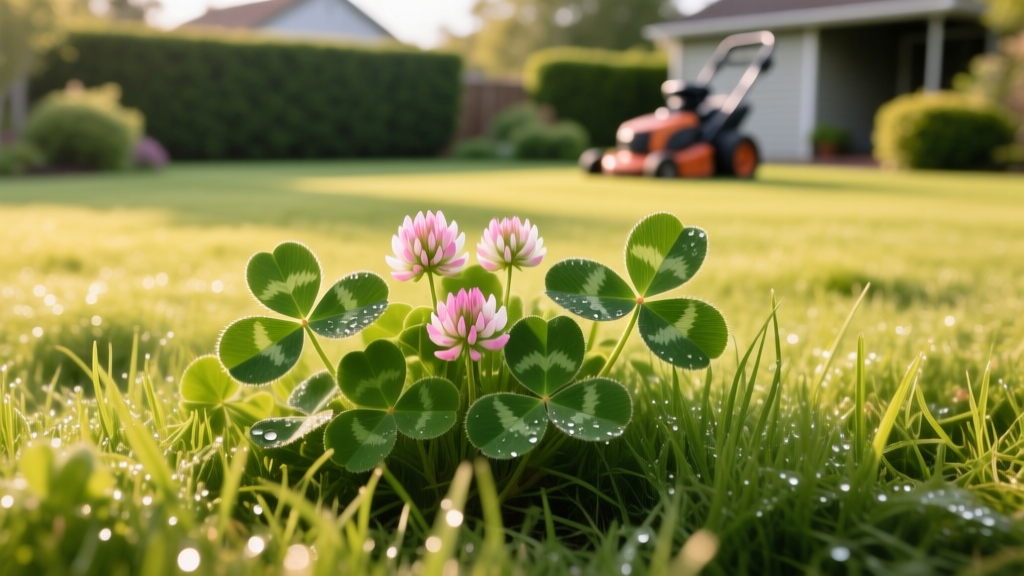
Dutch Clover Spot-Treatment: Identification & Control
Dutch clover (Trifolium repens var. hollandicum), commonly referred to as white clover, is a low-growing, perennial broadleaf weed that aggressively colonizes nutrient-deficient lawns. Because it possesses the ability to fix atmospheric nitrogen through symbiotic root bacteria, it thrives in soils where turfgrass starves. Broadcast spraying entire lawns for isolated patches is an inefficient use of chemicals and money. Targeted spot-treatment, combined with precise cultural corrections, offers a higher success rate while minimizing herbicide load on your soil.
Identifying Dutch Clover in Your Turf
Dutch clover is characterized by its creeping stolons (above-ground stems) that root at the nodes, allowing it to form dense, mat-like patches that choke out surrounding grass. The leaves are trifoliate, featuring three distinct leaflets that typically display a white or pale green "V-shaped" chevron marking. In late spring through early fall, it produces small, globe-shaped flower heads ranging from white to pale pink. According to the University of Minnesota Extension, these flowers are a primary reason some homeowners tolerate the plant, as they provide early-season forage for pollinators. However, for those seeking a uniform turf canopy, identification is the first step toward eradication.
Botanical Distinction: Do not confuse Dutch clover with Oxalis (wood sorrel). While both have three leaflets, Oxalis features heart-shaped leaves and produces yellow, pink, or purple flowers. Oxalis requires different chemical controls, as it is highly resistant to standard 2,4-D formulations that easily burn down clover.
The Biology of Resistance: Why Clover Survives Standard Sprays
Homeowners frequently report failure when using cheap, ready-to-use consumer weed killers on Dutch clover. This failure stems from two biological defenses:
- The Waxy Cuticle: Clover leaves are coated in a thick, hydrophobic epicuticular wax. Standard aqueous herbicide solutions bead up and roll off the leaf surface before the active ingredient can penetrate the stomata.
- The Stolon Network: Clover stores energy in its extensive stolon and root network. If a contact herbicide only burns off the top growth without translocating down to the roots, the plant will regenerate from the nodes within 14 to 21 days.
Selective Herbicide Chemistry & Product Matrix
To effectively spot-treat Dutch clover without harming your surrounding cool- or warm-season grass, you must use a selective broadleaf herbicide. Single-active-ingredient products are rarely sufficient. A multi-way herbicide combining synthetic auxins (hormone mimics) with a rapid burn-down agent provides the highest efficacy. Below is a comparison of professional and prosumer-grade chemistries available in 2026.
| Active Ingredients | Example Product | Est. Cost | Mode of Action |
|---|---|---|---|
| 2,4-D, MCPP, Dicamba, Carfentrazone | SpeedZone Lawn Weed Killer | ~$45 / gallon | Systemic auxin mimic + PPO inhibitor (rapid burn) |
| Quinclorac | Drive XLR8 | ~$130 / gallon | Systemic synthetic auxin (highly effective on mature stolons) |
| Fluroxypyr | Vista XRT | ~$95 / gallon | Systemic auxin mimic (excellent for warm-season turf safety) |
For most residential spot-treatments, a 3-way or 4-way ester-based formulation like SpeedZone offers the best balance of cost and efficacy. Esters penetrate the waxy clover cuticle significantly better than amine-based formulations, especially when temperatures are below 70°F (21°C).
Step-by-Step Spot-Treatment Protocol
Proper mixing and application technique are non-negotiable for translocated herbicides. Follow this protocol to ensure the chemical reaches the root system.
Step 1: Preparation and Timing
Do not mow for 48 hours before application; larger leaf surface area maximizes herbicide uptake. Ensure no rain is forecast for at least 24 hours post-application. Optimal treatment occurs when daytime temperatures are between 65°F and 80°F. Above 85°F, volatile herbicides like 2,4-D can vaporize and drift, causing phytotoxic damage to nearby desirable plants.
Step 2: Mixing with a Surfactant
The University of Wisconsin-Madison Extension notes that adjuvants are critical for waxy broadleaves. Fill a 1-gallon pump sprayer halfway with water. Add 2 to 3 fluid ounces of your chosen selective herbicide (check the specific label for spot-treatment rates, as they differ from broadcast rates). Finally, add 1/3 fluid ounce (approx. 2 teaspoons) of a non-ionic surfactant (NIS) or methylated seed oil (MSO). Agitate the sprayer thoroughly.
Step 3: Targeted Application
Adjust the sprayer nozzle to a fine mist, not a heavy stream. Spray the Dutch clover patch until the leaves are uniformly wet, but stop before the liquid begins to drip or run off onto the soil. Soil contact renders these specific foliar herbicides useless.
Step 4: Post-Application Care
Allow the herbicide to dry and translocate for 24 hours before irrigating or experiencing rainfall. Do not mow the treated area for another 48 hours. You should observe leaf curling and epinasty (twisting) within 48 hours, with complete necrosis of the stolon network occurring within 14 to 21 days.
Cultural Prevention: Correcting the Soil Matrix
Chemical spot-treatment only removes the existing weed; it does not prevent the next generation of seeds from germinating. Dutch clover is an indicator weed. Its presence almost universally signals a nitrogen-deficient soil profile and compacted subsoil.
- Nitrogen Fertilization: Clover cannot compete with turfgrass when adequate nitrogen is present. Apply 1.0 to 1.5 pounds of actual nitrogen per 1,000 square feet annually, split between early spring and late fall applications. Use a slow-release methylene urea or sulfur-coated urea source to provide steady feeding without excessive top-growth flushes.
- Mowing Height Adjustment: Clover requires high light penetration to establish stolons. Raise your mower deck to 3.5 inches for Tall Fescue or 2.5 inches for Kentucky Bluegrass. This taller canopy shades the soil surface, inhibiting clover seed germination and starving existing stolons of photosynthetic light.
- Core Aeration: If the clover is colonizing compacted, high-traffic areas, perform core aeration in the fall to relieve soil bulk density and improve oxygen flow to turfgrass roots.
Troubleshooting Edge Cases & Failures
Failure Mode: Clover turns brown but returns in 3 weeks.
Cause: Inadequate translocation. This happens if you applied a contact-only herbicide (like Carfentrazone alone) or if you mowed too soon after spraying a systemic product, severing the phloem pathways before the chemical reached the roots.
Fix: Wait for regrowth, ensure you are using a systemic multi-way product (like 2,4-D + Dicamba + MCPP), add a surfactant, and strictly observe the 48-hour pre- and post-mowing windows.
Cause: Inadequate translocation. This happens if you applied a contact-only herbicide (like Carfentrazone alone) or if you mowed too soon after spraying a systemic product, severing the phloem pathways before the chemical reached the roots.
Fix: Wait for regrowth, ensure you are using a systemic multi-way product (like 2,4-D + Dicamba + MCPP), add a surfactant, and strictly observe the 48-hour pre- and post-mowing windows.
Another common edge case involves mature, thickly matted clover patches that have been established for several years. In these scenarios, the stolon network is so dense that the turfgrass underneath has entirely died. Spot-treating the clover will leave a bare dirt patch that will quickly be colonized by crabgrass or goosegrass. For patches larger than 3 feet in diameter, it is often more practical to use a non-selective glyphosate spot-treatment to kill both the clover and the dead thatch, followed by raking, topdressing with compost, and overseeding with a turf-type tall fescue or perennial ryegrass blend.

