
Lawn Care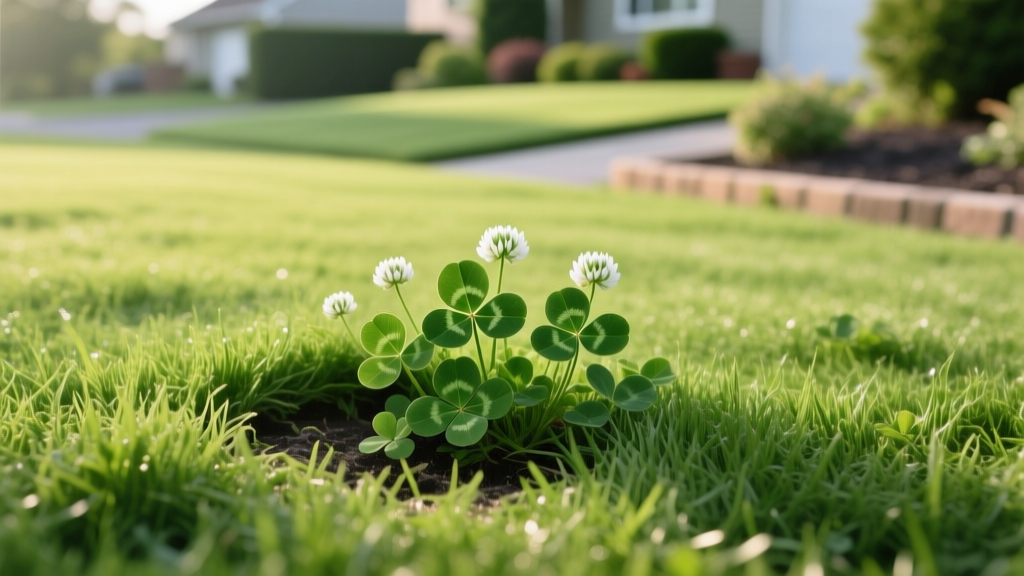
How to Spot-Treat Dutch Clover (Trifolium repens) in Lawns
The Biology of Trifolium repens: Why It Invades Your Lawn
Dutch clover, scientifically classified as Trifolium repens (often used interchangeably with white clover), is a low-growing, perennial broadleaf weed that aggressively colonizes thinning turf. Unlike annual weeds that die off in winter, Trifolium repens survives via a network of above-ground creeping stems called stolons. These stolons root at the nodes, allowing a single plant to expand outward by up to 12 inches per year, forming dense, mat-like patches that choke out desirable grass species.
The primary reason Dutch clover thrives in residential lawns is its unique symbiotic relationship with Rhizobium leguminosarum bacteria. This bacteria colonizes the clover's root nodules, fixing atmospheric nitrogen into a usable form. Consequently, Trifolium repens does not rely on soil nitrogen reserves. If your lawn is under-fertilized and soil nitrogen levels drop below 2 lbs per 1,000 square feet annually, the clover gains a massive competitive advantage over nitrogen-dependent turfgrasses like Kentucky bluegrass or tall fescue.
Quick Identification Checklist
- Leaves: Trifoliate (three leaflets per stem), teardrop-shaped, often featuring a distinct pale green or white "chevron" (V-shape) watermark.
- Growth Habit: Prostrate, creeping stolons that root at nodes; rarely grows taller than 4 inches unless competing for light.
- Flowers: Spherical, globular heads containing 20-40 tiny florets, typically white but occasionally tinged with pale pink, blooming heavily from late spring through early autumn.
- Root System: Shallow taproot with extensive lateral stolon rooting; highly tolerant of compacted, poorly drained soils.
Spot-Treatment Decision Matrix: Chemical vs. Organic
Selecting the right spot-treatment depends on your turf type, environmental preferences, and the severity of the infestation. Because Dutch clover leaves feature a dense, waxy cuticle and fine microscopic hairs, water-based sprays often bead up and roll off. Regardless of the active ingredient chosen, the inclusion of a surfactant is non-negotiable for effective control.
| Active Ingredient | Product Example | Avg. Cost | Efficacy & Notes |
|---|---|---|---|
| 3-Way Mix (2,4-D + MCPP + Dicamba) | Trimec 992 / Ortho WeedClear | $35-$45 / gal | High. Standard for cool-season lawns. May require two applications 14 days apart. |
| Triclopyr + 2,4-D | Bayer Advanced Southern | $25-$30 / 32oz | Very High. Triclopyr specifically targets the tough waxy cuticle of legumes like clover. |
| FeHEDTA (Chelated Iron) | Natria Lawn Weed Control / Fiesta | $40-$50 / gal | Moderate-High. Organic option. Causes iron toxicity in broadleaves. Requires strict temperature management. |
Pro Chemical Spot-Treatment Protocol
For the fastest and most complete eradication of established Trifolium repens patches, a three-way broadleaf herbicide containing Triclopyr or Dicamba is the industry standard. According to Penn State Extension, single-active-ingredient herbicides like 2,4-D alone are largely ineffective against mature clover due to rapid metabolic breakdown within the plant.
- Timing: Apply in early fall or mid-spring when daytime temperatures are consistently between 65°F and 80°F. Avoid applications during summer heat stress, as the clover's metabolism slows, and herbicide translocation to the roots is severely restricted.
- Mixing Rates: For a standard 1-gallon pump sprayer, mix 1.5 to 2.0 fluid ounces of a concentrated 3-way herbicide (like Trimec 992).
- The Surfactant Rule: Add 1 teaspoon (approx. 0.25% v/v) of a Non-Ionic Surfactant (NIS) or Methylated Seed Oil (MSO) to your tank mix. This breaks the surface tension of the water, allowing the chemical to penetrate the clover's waxy leaf cuticle rather than rolling onto the soil.
- Application Technique: Use a fine mist nozzle. Spray the clover patch until the leaves are uniformly wet but not dripping. Extend the spray margin 6 inches beyond the visible clover patch to treat creeping stolons hidden in the thatch layer.
- Follow-Up: Inspect the area 14 days later. If the clover leaves are curled and browning, the treatment is working. If green growth persists at the stolon nodes, apply a second, lighter spot treatment.
Organic and Iron-Based Alternatives
For homeowners managing lawns near sensitive waterways or those strictly avoiding synthetic auxin herbicides, FeHEDTA (Iron HEDTA) is the most viable organic spot-treatment. Products like Fiesta Turf Weeder utilize chelated iron to induce fatal oxidative stress and iron toxicity in broadleaf weeds, while monocot grasses (your turf) can safely metabolize the excess iron.
Crucial Application Constraints: FeHEDTA must be mixed at a higher rate—typically 3 to 4 fluid ounces per gallon of water. Unlike synthetic herbicides, iron-based treatments only kill the foliage they contact; they do not translocate effectively to the roots. Therefore, you must plan for two applications spaced 21 days apart. Furthermore, FeHEDTA will temporarily blacken and burn your surrounding turfgrass if applied when ambient temperatures exceed 80°F. Always apply organic iron treatments in the early morning or late evening.
Addressing the Root Cause: Soil Nitrogen and Mowing Height
Spot-treating Trifolium repens without correcting the underlying environmental deficiencies guarantees the weed will return within a single growing season. As noted by turf researchers at the University of Minnesota, clover is primarily an indicator plant signaling low soil fertility and inadequate canopy density.
"White clover is a classic symptom of nitrogen-deficient turf. By maintaining a consistent nitrogen fertility program that delivers 3 to 4 pounds of actual nitrogen per 1,000 square feet annually, you naturally suppress clover establishment without relying solely on herbicides."
The Post-Treatment Recovery Plan
Once the clover is dead and the stolons have decayed, you will be left with circular bare spots in your lawn. If left untreated, these voids will quickly be colonized by crabgrass or spurge in the summer, or new clover seeds in the fall.
- Fertilization: Apply a high-nitrogen, zero-phosphorus fertilizer (such as a 24-0-6 or 30-0-0 N-P-K ratio) at a rate of 1 lb of nitrogen per 1,000 sq ft immediately after the clover has fully browned. This fuels the surrounding turf to spread laterally and fill the voids.
- Overseeding: For patches larger than 6 inches in diameter, rake out the dead clover thatch, expose the topsoil, and overseed with a turf-type tall fescue or Kentucky bluegrass blend that matches your existing lawn. Keep the seed consistently moist for 14 days.
- Mowing Height Adjustment: Raise your mower deck to 3.5 or 4 inches. Trifolium repens requires high light intensity at the soil level to trigger stolon rooting. A taller turf canopy creates deep shade at the soil line, biologically preventing clover seeds from germinating and stolons from establishing.
Frequently Asked Spot-Treatment Questions
Can I just pull Dutch clover out by hand?
Hand-pulling is highly ineffective for established Trifolium repens. The plant's stolons snap easily at the nodes, leaving behind rooted segments hidden in the thatch and soil. Within 2 to 3 weeks, these remaining nodes will generate new shoots, often resulting in a denser, more fragmented clover patch than before you started pulling.
Will treating clover harm my lawn's bees and pollinators?
Dutch clover is a valuable nectar source for honeybees and native pollinators. If your lawn is currently in heavy bloom, mow the lawn and bag the clippings to remove the flower heads 24 hours before applying any chemical or organic spot-treatment. This removes the attractant and prevents pollinators from contacting wet herbicide residues on the blossoms. For more integrated pest management strategies regarding pollinators, refer to the University of California IPM guidelines.
Does clover kill grass, or just compete with it?
Clover does not secrete allelopathic chemicals that actively kill turfgrass roots (unlike weeds such as nutsedge or quackgrass). However, its dense, mat-forming stolon network physically blocks sunlight, water, and oxygen from reaching the soil surface and the crown of your turfgrass. Over time, the grass beneath a thick clover mat will thin out and die from light deprivation and resource competition, not chemical warfare.

