
Lawn Care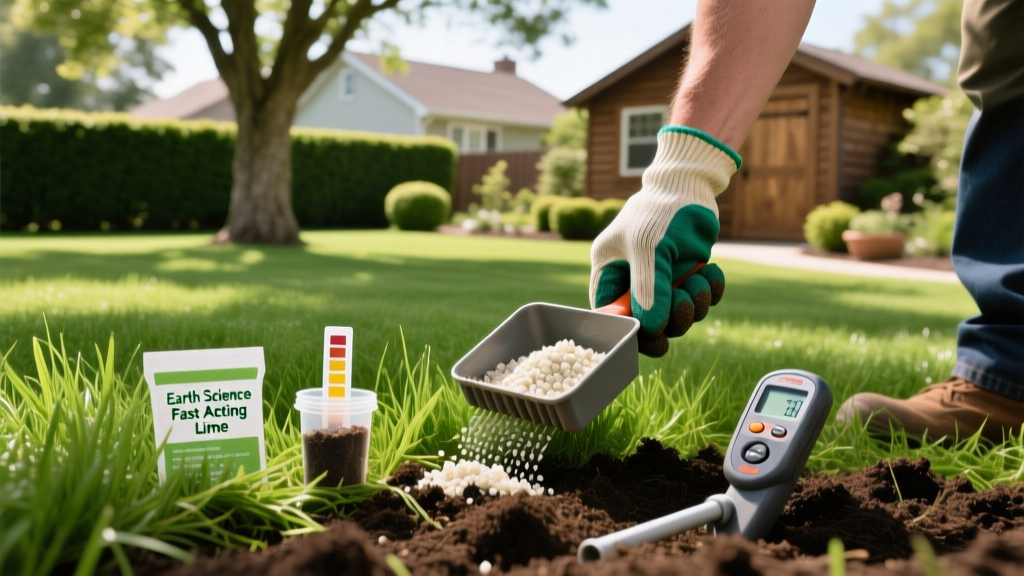
Earth Science Fast Acting Lime: Application & Soil pH Guide
The Chemistry of Fast-Acting Lime vs. Traditional Aglime
Correcting acidic soil is non-negotiable for maintaining a dense, vigorous turfgrass canopy. When soil pH drops below 6.0, essential macronutrients like nitrogen, phosphorus, and potassium become chemically locked, rendering your fertilization program useless. While traditional agricultural limestone (aglime) has been the standard amendment for decades, its slow reaction time often frustrates homeowners. This is where earth science fast acting lime bridges the gap between immediate results and long-term soil health.
Traditional aglime consists of crushed calcium carbonate (CaCO3) with particle sizes ranging from 20 to 40 mesh. Because the neutralizing power of lime is directly proportional to its surface area, these coarse particles can take 6 to 12 months to fully react with soil hydrogen ions. Fast-acting formulations, however, utilize micro-ground calcium carbonate pulverized to 100 mesh or finer. This massive increase in surface area accelerates the chemical neutralization process, shifting soil pH in as little as 2 to 4 weeks.
Particle Size and Pelletization Technology
The primary challenge with 100-mesh lime dust is application; it creates hazardous dust clouds and blows away in light winds. To solve this, manufacturers use a water-soluble organic binder to compress the micro-fine particles into uniform, dust-free pellets. When these pellets hit the soil and receive irrigation or rainfall, the binder dissolves instantly, releasing the micro-fine calcium carbonate directly into the thatch and root zone. According to University of Minnesota Turfgrass Science, uniform pellet size also ensures consistent distribution across the lawn when using rotary spreaders, preventing the localized pH spikes common with uneven crushed lime.
Earth Science Fast Acting Lime: Product Breakdown
Quick Specs: Earth Science Fast Acting Lime
- Active Ingredient: Calcium Carbonate (CaCO3) + Humic Acid
- Particle Size: 100+ mesh (micro-ground before pelletizing)
- Calcium Carbonate Equivalent (CCE): 85% - 95%
- Typical Coverage: 5,000 to 10,000 sq. ft. per 40 lb bag (depending on current pH)
- Average Retail Price (2026): $19.00 - $24.00 per 40 lb bag
What separates this specific formulation from generic fast-acting brands is the inclusion of humic acid. Humic substances act as chelating agents, improving the soil's Cation Exchange Capacity (CEC). This means the soil becomes more efficient at holding onto the calcium ions released by the lime, preventing them from leaching away in sandy soils before they can displace acidic hydrogen and aluminum ions.
Step-by-Step Application Protocol
Applying lime without a recent soil test is a waste of money. You must know both your active pH (current soil acidity) and your buffer pH (the soil's resistance to pH change). As noted by the Royal Horticultural Society, clay soils with high buffer pH require significantly more lime to achieve the same pH shift as sandy soils.
- Conduct a Soil Test: Use a mail-in lab test (not a cheap liquid home kit) to determine your exact buffer pH index. Target a final pH of 6.5 for cool-season grasses (Kentucky Bluegrass, Fescue) and 5.8 to 6.0 for warm-season grasses (Bermuda, Zoysia).
- Calculate the Rate: For a standard pH correction from 5.5 to 6.5 in loam soil, apply 6 to 8 lbs of fast-acting lime per 1,000 sq. ft. If your soil test recommends more than 15 lbs per 1,000 sq. ft., split the application into two doses spaced 4 weeks apart to avoid nutrient lockout.
- Calibrate Your Spreader: For a Scotts EdgeGuard Deluxe rotary spreader, set the dial to 5.5. For a Lesco drop spreader, use setting 8. Always perform a test pass on your driveway to ensure the pellets are dropping evenly.
- Apply to Dry Foliage: Apply the pellets when the grass blades are completely dry. If the grass is wet, the pellets will stick to the foliage and begin dissolving prematurely, potentially causing localized leaf burn.
- Water Immediately: Apply 0.25 to 0.5 inches of irrigation immediately after application. This washes the pellets off the grass blades, dissolves the binder, and pushes the micro-fine calcium carbonate into the soil profile.
Troubleshooting Common pH Correction Failures
Even with premium amendments, homeowners occasionally report that their follow-up soil test shows no pH change. This is rarely a product failure; it is almost always an application error.
| Symptom | Probable Cause | Corrective Action |
|---|---|---|
| pH remains unchanged after 6 weeks | Ignored Buffer pH; applied based only on active pH. | Re-test soil. Apply a second dose calculated using the buffer pH index. |
| Yellowing/burn spots on turf | Applied to wet grass or failed to water in immediately. | Flush the area with 1 inch of water to dilute the concentrated salts on the leaf surface. |
| Lime pellets sitting on top of thatch | Thatch layer exceeds 0.5 inches, preventing soil contact. | Core aerate or dethatch the lawn before reapplying to ensure soil-to-lime contact. |
| pH spikes too high (above 7.2) | Over-application in low-CEC sandy soils. | Apply elemental sulfur at 1 lb per 1,000 sq. ft. to gently lower the pH back to optimal ranges. |
Cost-Benefit Analysis: Is the Premium Worth It?
At $19 to $24 per 40 lb bag, earth science fast acting lime carries a significant premium over traditional pulverized aglime, which typically costs $6 to $9 for the same weight. However, analyzing the true cost requires looking at coverage efficiency and labor.
Because fast-acting lime is highly concentrated and pelletized for precise spreader calibration, a single 40 lb bag often treats up to 10,000 square feet for maintenance-level pH buffering. Traditional aglime, due to its lower surface area and uneven particle size, often requires 50 to 80 lbs per 1,000 square feet to achieve the same chemical neutralization. When you factor in the cost of buying multiple bags of traditional lime, plus the physical labor of lugging 200+ lbs of material across your property, the fast-acting pelletized option frequently breaks even in total project cost while saving hours of labor and delivering results weeks faster.
Pro Tip for Fall Renovations: If you are overseeding in early fall and realize your pH is too low, traditional lime will not react fast enough to help the new seedlings. Fast-acting lime applied 14 days before seeding will correct the rhizosphere pH just in time for the germination and root-establishment phases of cool-season grasses.
Frequently Asked Questions
Can I apply fast-acting lime at the same time as starter fertilizer?
Yes, but with a caveat. Fast-acting lime and phosphorus-heavy starter fertilizers can react in the soil to form calcium phosphate, an insoluble compound that locks up the phosphorus. To prevent this, apply the starter fertilizer first, water it in thoroughly, and wait 48 to 72 hours before applying the lime. This allows the phosphorus to be absorbed by the soil complex before the calcium ions are introduced.
Does this product help with moss control?
Indirectly, yes. Moss thrives in acidic, compacted soils with a pH below 5.5. By raising the soil pH to the 6.2–6.8 range, you create an environment where turfgrass outcompetes moss. However, lime is not a moss killer. You must physically rake out the existing moss and address underlying drainage or shade issues for permanent eradication.
How long do the effects of fast-acting lime last in the soil?
While the initial pH shift occurs in 2 to 4 weeks, the residual buffering effect typically lasts 12 to 18 months, depending on your soil type and local rainfall. Sandy soils with high leaching rates will require annual maintenance applications (approx. 3 lbs per 1,000 sq. ft.), while heavy clay soils may only need reapplication every 2 to 3 years.

