
Lawn Care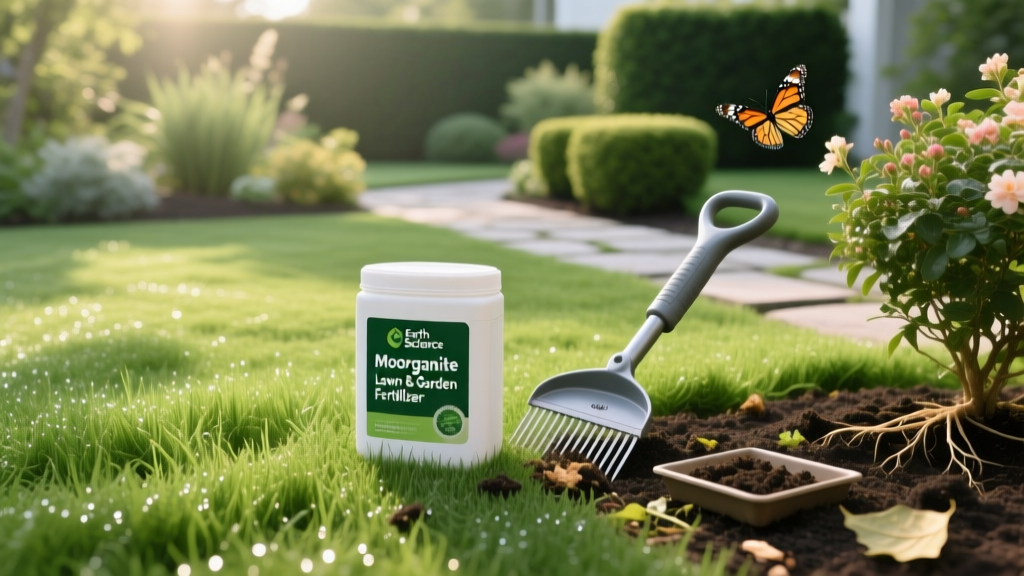
Earth Science Mooorganite Lawn & Garden Fertilizer: Complete Guide
Transitioning from synthetic salts to organic soil nutrition requires a fundamental shift in how you view lawn care. Earth Science Mooorganite Lawn & Garden Fertilizer represents a specific category of composted dairy manure-based granular organics designed not just to feed the grass, but to rebuild the soil food web. Unlike fast-release synthetics that force immediate top growth at the expense of root mass, Mooorganite relies on microbial mineralization to deliver a steady, burn-proof nutrient stream. This guide breaks down the exact nutritional mechanics, spreader calibration data, and soil temperature thresholds required to get maximum efficacy from this specific formulation in 2026.
Nutritional Profile & Ingredient Breakdown
Core NPK Analysis: 5-1-4
Nitrogen (N): 5% (100% water-insoluble, microbially derived)
Phosphorus (P): 1% (Low-analysis for runoff compliance)
Potassium (K): 4% (Sulfate of potash derived)
Secondary Nutrients: Calcium, Magnesium, Humic Acids, Fulvic Acids
Nitrogen (N): 5% (100% water-insoluble, microbially derived)
Phosphorus (P): 1% (Low-analysis for runoff compliance)
Potassium (K): 4% (Sulfate of potash derived)
Secondary Nutrients: Calcium, Magnesium, Humic Acids, Fulvic Acids
The 5-1-4 ratio is highly strategic for modern turfgrass management. The low phosphorus content (1%) aligns with stringent municipal runoff regulations while providing enough P for baseline root development. The 4% potassium load, largely derived from natural sulfate of potash, is critical for osmoregulation—helping grass blades retain water during summer droughts and synthesize antifreeze proteins during late-frost events.
More importantly, the nitrogen in Mooorganite is bound in complex organic proteins and amino acids. It cannot be absorbed directly by turf roots. Instead, it requires soil bacteria and fungi to break down the carbon-nitrogen bonds, a process that releases ammonium and nitrate ions slowly over 8 to 12 weeks. This eliminates the 'surge and crash' growth cycle associated with synthetic urea.
Mooorganite vs. Synthetic & Biosolid Alternatives
Understanding where Earth Science Mooorganite fits in the broader fertilizer market requires a direct comparison against standard synthetic urea and biosolid-based organics (like Milorganite).
| Feature | Earth Science Mooorganite (5-1-4) | Standard Synthetic (32-0-4) | Biosolid Organics (5-4-0) |
|---|---|---|---|
| Nitrogen Release Time | 8–12 Weeks | 2–4 Weeks | 8–10 Weeks |
| Burn Risk | Zero (Salt index < 0.5) | High (Requires immediate watering) | Low |
| Soil Organic Matter (SOM) Boost | High (Composted dairy humus) | None | Moderate |
| Heavy Metal Concerns | None (Agricultural dairy source) | None | Trace (Municipal wastewater origin) |
Step-by-Step Application Protocol
Because organic granules are often less uniform in size than synthetic prills, spreader calibration is critical to prevent striping. The target application rate for established lawns is 12 to 15 lbs per 1,000 square feet, delivering approximately 0.6 to 0.75 lbs of actual nitrogen per 1,000 sq ft.
- Verify Soil Temperature: Organic nitrogen mineralization stalls when soil temperatures drop below 55°F (12.7°C). Use a soil probe thermometer at a 2-inch depth. If the soil is colder than 55°F, delay application; the nutrients will simply sit inert and risk washing away in spring rains.
- Calibrate the Spreader: For a standard Scotts EdgeGuard Mini Rotary Spreader, set the dial to 4.5. For a Lesco commercial spreader, use setting 14. Always perform a 500 sq ft test pass on a clean driveway to verify granule distribution before hitting the turf.
- Apply in a Crisscross Pattern: Apply half the required granules walking North-South, and the second half walking East-West. This mitigates the irregular particle size of composted manure granules.
- Watering In: Unlike synthetics that need water to dissolve salts, Mooorganite needs water to activate soil microbes. Apply exactly 0.25 inches of irrigation immediately after spreading. This pushes the granules into the thatch layer and provides the moisture microbes need to begin breaking down the organic nitrogen bonds.
Common Application Mistakes & Troubleshooting
Warning: The 'Green-Up' Lag
Homeowners transitioning from synthetics often panic when Mooorganite fails to turn the lawn dark green within 5 days. Because the nitrogen must be processed by the soil microbiome, visual results typically take 14 to 21 days. Do not reapply early; you risk overloading the soil with carbon, which can cause temporary nitrogen immobilization as microbes consume available soil N to break down the excess carbon.
Homeowners transitioning from synthetics often panic when Mooorganite fails to turn the lawn dark green within 5 days. Because the nitrogen must be processed by the soil microbiome, visual results typically take 14 to 21 days. Do not reapply early; you risk overloading the soil with carbon, which can cause temporary nitrogen immobilization as microbes consume available soil N to break down the excess carbon.
Dealing with Clay vs. Sandy Soils
In heavy clay soils, the humic acids in Mooorganite act as a natural chelating agent, binding to tightly packed clay particles and creating microscopic pore spaces for root respiration. However, in highly leached sandy soils, the primary benefit is the boost to Cation Exchange Capacity (CEC). According to research published by the Cornell University Soil Health Laboratory, increasing soil organic matter via composted manure applications directly correlates to a higher CEC, allowing sandy soils to retain positively charged nutrients like calcium, magnesium, and potassium that would otherwise leach into the water table.
Cost Analysis & Coverage Expectations
Organic fertilizers carry a higher upfront cost per bag, but the long-term ROI manifests in reduced irrigation needs and decreased fungicide applications due to stronger root systems. In 2026, a standard 40 lb bag of Earth Science Mooorganite retails between $28.00 and $34.00.
- Coverage: At 15 lbs per 1,000 sq ft, a 40 lb bag covers approximately 2,650 square feet.
- Cost per 1,000 sq ft: Roughly $11.30 to $12.80 per application.
- Comparison: Standard synthetic urea costs about $4.00 to $6.00 per 1,000 sq ft. While Mooorganite is roughly double the upfront cost, you eliminate the need for separate humic acid supplements ($8/1,000 sq ft) and core aeration services, balancing the annual budget.
Seasonal Timing Strategy
For cool-season grasses (Kentucky Bluegrass, Tall Fescue), apply Mooorganite in late spring (mid-May) and early fall (September). The fall application is critical; the slow-release potassium fortifies the crown against winter desiccation, while the organic matter insulates the root zone.
For warm-season grasses (Bermuda, Zoysia, St. Augustine), apply immediately after spring green-up (when soil temps consistently hit 65°F) and again in late August. Avoid late-fall applications on warm-season grasses, as the slow nitrogen release can force tender new growth right before the first frost, leading to severe winter kill.
Pro-Tip: Thatch Management
Because Mooorganite introduces billions of beneficial saprophytic fungi and bacteria, it actively accelerates the decomposition of thatch. The University of Minnesota Extension notes that maintaining a robust microbial population is the most effective biological control for thatch layers exceeding 0.5 inches, reducing the need for mechanical dethatching.
Because Mooorganite introduces billions of beneficial saprophytic fungi and bacteria, it actively accelerates the decomposition of thatch. The University of Minnesota Extension notes that maintaining a robust microbial population is the most effective biological control for thatch layers exceeding 0.5 inches, reducing the need for mechanical dethatching.
Frequently Asked Questions
Does Mooorganite attract wildlife or pests?
Properly composted dairy manure fertilizers undergo high-heat thermophilic composting (reaching 140°F+), which destroys weed seeds and eliminates the raw volatile organic compounds (VOCs) that attract dogs, rodents, and flies. If your batch has a strong, offensive ammonia or raw manure odor, it was not fully composted and should be returned to the retailer.
Can I mix Mooorganite with liquid synthetic iron?
Yes. Combining Mooorganite's slow-release organic base with a fast-acting liquid chelated iron (like Fe-EDDHA) is an excellent strategy for achieving immediate visual darkening while the organic nitrogen begins its 14-day mineralization process. Apply the liquid iron 48 hours after granular application to prevent the iron from binding to the surface humic acids before it reaches the leaf tissue.

