
Lawn Care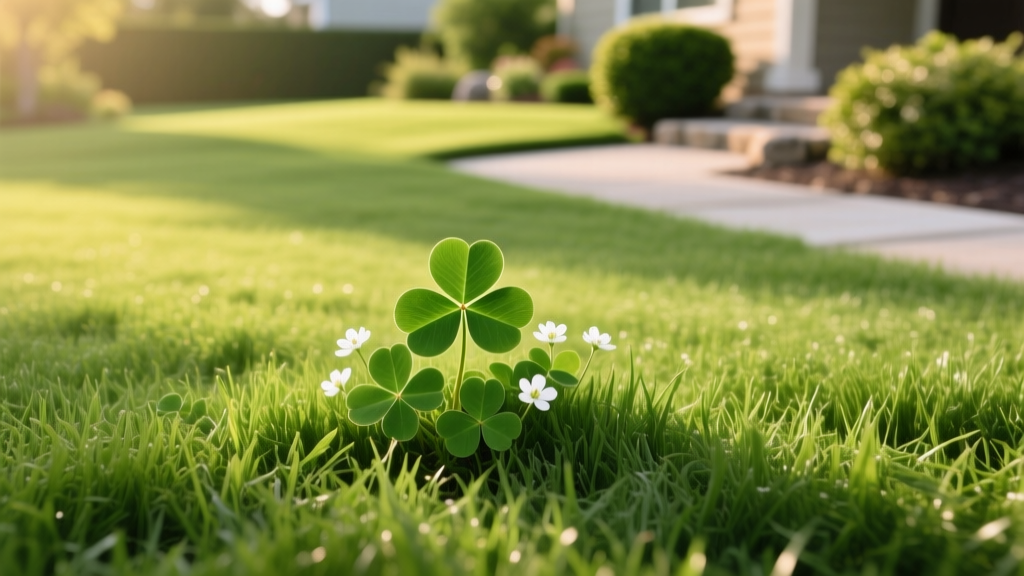
Clover in Lawns: How to Eliminate It Using Targeted Spot Treatments
The Biological Reality: Clover as a Soil Indicator
Before reaching for a broadcast herbicide, understand why Trifolium repens (white clover) is thriving in your turf. Clover is a legume equipped with Rhizobium bacteria in its root nodules, allowing it to fix atmospheric nitrogen. If clover is outcompeting your grass, it is a definitive biological indicator that your soil's available nitrogen levels have dropped below the 2 to 4 lbs per 1,000 square feet annually required by most turfgrasses. Broadcast spraying without addressing the soil void guarantees a reinvasion within 12 to 18 months. This guide focuses strictly on high-efficacy spot-treatment protocols to eradicate existing clover patches while preserving the surrounding turf canopy.
Diagnostic Warning: Do not confuse clover with Yellow Woodsorrel (Oxalis stricta). Clover has three distinct oval/teardrop leaflets and white/pink spherical flowers. Oxalis has heart-shaped leaflets and small yellow cup-like flowers. Oxalis requires entirely different chemical controls (e.g., Fluroxypyr) and will survive standard clover herbicides.
Pre-Treatment Diagnostics: Identifying Your Clover and Turf
Spot-treating clover in lawns requires matching the active ingredient to both the specific clover variant and your turfgrass species. Applying the wrong chemistry can result in severe phytotoxicity, particularly in warm-season grasses.
| Clover / Lookalike Species | Identifying Features | Optimal Spot-Treatment Chemistry |
|---|---|---|
| White Clover (T. repens) | 3 oval leaflets, white chevron 'V' mark, creeping stolons. | 2,4-D + Dicamba + MCPP (3-way) or Carfentrazone. |
| Microclover (T. repens var. Pirouette) | Smaller leaves, fewer flowers, aggressive stolon growth. | Triclopyr + Fluroxypyr blends. |
| Yellow Woodsorrel (Oxalis) | 3 heart-shaped leaflets, yellow flowers, explosive seed pods. | Fluroxypyr or Triclopyr (Avoid standard 2,4-D). |
Chemical Spot-Treatment Protocols: The Heavy Hitters
For isolated patches ranging from 10 to 500 square feet, liquid spot-treatment using a 1-gallon or 2-gallon pump sprayer is vastly superior to granular weed-and-feed products. Granular products require dew to stick to the clover leaves and often bounce off the waxy cuticle, resulting in poor efficacy and wasted product.
Protocol A: Fast Burn-Down (Cool-Season Grasses & Bermudagrass)
For Fescue, Kentucky Bluegrass, Ryegrass, and fully dormant or active Bermudagrass, a 4-way herbicide containing Carfentrazone-ethyl provides the fastest visible results. Carfentrazone is a PPO inhibitor that causes rapid cell membrane rupture, turning clover leaves black within 24 to 48 hours, while the systemic ingredients (2,4-D and Dicamba) travel to the roots over 14 days.
- Recommended Product: SpeedZone Broadleaf Herbicide for Turf.
- Active Ingredients: 2,4-D (28.5%), MCPP-p (5.6%), Dicamba (2.2%), Carfentrazone-ethyl (0.6%).
- Cost: ~$45 to $55 per gallon (covers roughly 1.5 acres, making it highly cost-effective for large properties).
- Mixing Rate: 1.5 fl oz per 1 gallon of water per 1,000 sq ft.
- Critical Additive: You must add a Non-Ionic Surfactant (NIS) at 0.25% v/v (approx. 1/2 teaspoon per gallon). Clover leaves are highly hydrophobic; without a surfactant, the spray beads up and rolls off.
Protocol B: Warm-Season Sensitivity (St. Augustine & Centipedegrass)
Phytotoxicity Alert: Never apply 2,4-D or Dicamba to St. Augustinegrass or Centipedegrass. These grasses are highly sensitive and will suffer severe stunting, yellowing, or total canopy death.
If you are managing clover in lawns composed of St. Augustine or Centipede, you must use Atrazine or Penoxsulam. Atrazine works best when applied during cooler months (below 85°F) and acts as both a pre-emergent and post-emergent. For active spot-treatment in warmer months, Penoxsulam (found in products like Celsius WG) is the safest, most effective option for these sensitive turf types, though it costs roughly $120 for a 10 oz bottle.
Protocol C: The Organic Iron Approach (FeHEDTA)
For homeowners strictly avoiding synthetic auxin herbicides, Chelated Iron (FeHEDTA) is the only scientifically validated organic alternative. Broadleaf weeds absorb iron differently than monocot grasses, leading to lethal oxidative stress in the clover while the grass simply turns a temporary dark green.
- Recommended Product: Fiesta Turf Weed Killer (Iron HEDDA).
- Cost: ~$35 to $40 per quart.
- Application: Apply undiluted or slightly diluted directly to the clover foliage until wet. Expect blackening within 3 hours. Requires a second application 21 days later to kill the root system.
Step-by-Step Application Framework for Maximum Kill Rate
According to weed science data from the NC State Extension TurfFiles, the timing and physical preparation of the clover dictate the success of the spot treatment. Follow this exact sequence:
- Delay Mowing: Do not mow for 48 hours before spraying. You need maximum leaf surface area on the clover to absorb the chemical payload.
- Hydrate the Target: If the lawn is drought-stressed, water it deeply the night before. Stressed clover shuts down its vascular system (translocation), meaning systemic herbicides like 2,4-D will kill the top growth but fail to reach the taproot.
- Mix and Agitate: Fill the pump sprayer halfway with water, add the surfactant, then the herbicide, then the remaining water. Agitate thoroughly.
- Targeted Spraying: Use a pin-stream nozzle or a shielded spray tip. Spray the clover patch until the leaves are uniformly wet, but not to the point of runoff. Dripping herbicide wastes chemical and increases soil residue.
- Post-Spray Wait: Allow 48 hours of dry weather post-application. Do not irrigate or mow during this window.
Post-Eradication: Closing the Canopy Void
Once the clover turns brown and dies back (typically 14 to 21 days post-spray), you are left with a bare soil void. If left alone, crabgrass or spurge will colonize the space within weeks. You must immediately rehabilitate the spot.
The Nitrogen Injection Technique
Because the clover was present due to low nitrogen, apply a fast-release nitrogen source directly to the void. Use a handheld spreader to apply Urea (46-0-0) at a rate of 1 lb of product per 1,000 sq ft. Water it in immediately. This spikes the soil nitrogen, giving your existing turfgrass the exact fuel it needs to laterally spread and choke out future weed seeds.
Overseeding the Dead Patch
If the clover patch was larger than 12 inches in diameter, lateral grass spread will be too slow. Rake out the dead clover thatch, expose the top 1/4 inch of soil, and drop a handful of turf-type tall fescue or Kentucky bluegrass seed (matching your existing lawn). Top-dress with 1/8 inch of compost and keep the spot moist twice daily for 14 days. The UC Statewide IPM Program emphasizes that maintaining a dense, 3-inch high turf canopy is the ultimate pre-emergent defense against clover stolon establishment.
Troubleshooting Edge Cases
Edge Case: Clover Returns After 3 Weeks
If the clover foliage died but new shoots emerge from the center of the patch, the initial application failed to translocate to the deep taproot. This usually happens if you sprayed during a heatwave (above 85°F) or if you mowed too soon after spraying. Wait 7 days, then apply a second spot-treatment using a Triclopyr-heavy blend (e.g., Ortho Chickweed, Clover & Oxalis Killer) which has superior translocation properties in mature taproots.
If the clover foliage died but new shoots emerge from the center of the patch, the initial application failed to translocate to the deep taproot. This usually happens if you sprayed during a heatwave (above 85°F) or if you mowed too soon after spraying. Wait 7 days, then apply a second spot-treatment using a Triclopyr-heavy blend (e.g., Ortho Chickweed, Clover & Oxalis Killer) which has superior translocation properties in mature taproots.
Eliminating clover in lawns is not about nuking the yard with blanket chemicals; it is a surgical process of identifying the soil deficiency, applying the correct chemistry with a surfactant, and aggressively rehabbing the void. By treating clover as a symptom of soil health rather than just an aesthetic nuisance, you transition from a cycle of endless spraying to long-term turf dominance.

