
Lawn Care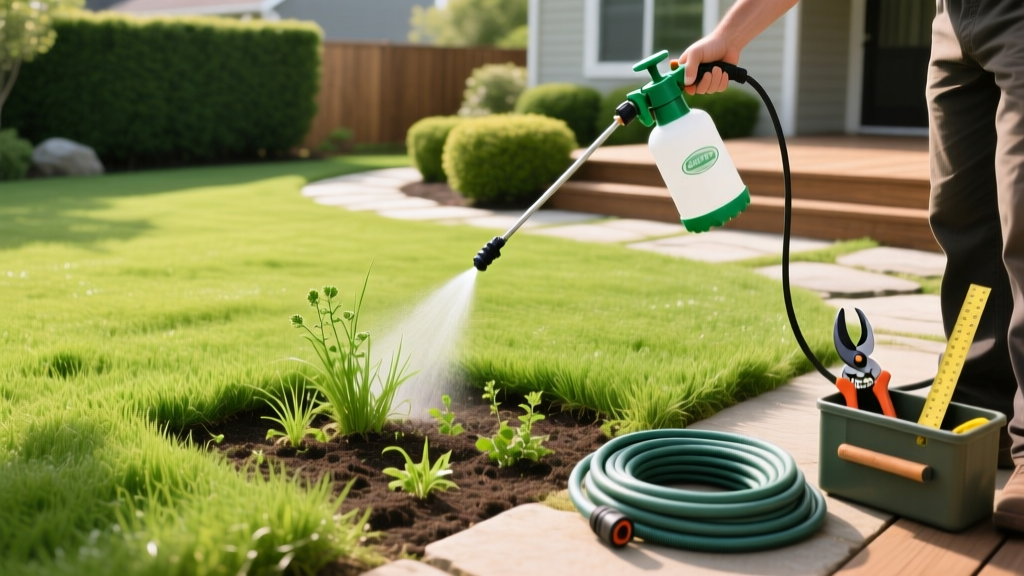
How to Eliminate Grassy Weeds in Lawn: Spot-Treatment Guide
The Biological Challenge of Grassy Weed Intruders
Managing grassy weeds in lawn environments presents a unique biological challenge. Unlike broadleaf weeds (dicots), grassy weeds belong to the Poaceae family—the exact same monocot family as your desirable turfgrass. Because they share similar cellular structures and metabolic pathways, standard broadleaf herbicides containing 2,4-D, dicamba, or MCPP will have zero effect on them. Eradicating these intruders requires highly specific, selective post-emergent herbicides or precise non-selective spot treatments. According to University of Minnesota Extension turfgrass specialists, misidentification is the primary reason homeowners waste money on ineffective chemical applications.
The Diagnostic Matrix: Identifying Your Grassy Weed
Before mixing any chemicals, you must accurately identify the target species. Grassy weeds are categorized by their life cycle (annual vs. perennial) and their preferred growing season (cool-season vs. warm-season). Use the diagnostic matrix below to confirm your intruder.
| Weed Species | Life Cycle | Growth Habit | Ligule & Collar | Distinctive Visual Trait |
|---|---|---|---|---|
| Crabgrass | Summer Annual | Prostrate, branching | Membranous, jagged | Light green, wide leaves, finger-like seedheads |
| Goosegrass | Summer Annual | Prostrate to erect | Membranous, silver base | Whitish/silver center crown, zipper-like seedheads |
| Dallisgrass | Warm Perennial | Clumping, deep roots | Membranous, hairy collar | Dark green, coarse texture, distinct seed stalks |
| Quackgrass | Cool Perennial | Erect, rhizomatous | Membranous, auricles present | Blue-green tint, aggressive underground rhizomes |
| Poa Annua | Winter Annual | Clumping, shallow roots | Membranous, pointed | Apple-green color, boat-shaped leaf tips, prolific seeding |
Targeted Spot-Treatment Protocols by Species
Spot-treating requires a calculated approach to avoid damaging the surrounding desirable turf. The following protocols outline the exact active ingredients, application rates, and safety parameters for the most common grassy weeds.
1. Crabgrass and Goosegrass (Summer Annuals)
For post-emergent control of crabgrass in cool-season lawns (Kentucky bluegrass, tall fescue) and Bermuda grass, Quinclorac is the industry standard. Products like Drive XLR8 contain 3.8 lbs of quinclorac per gallon.
- Mixing Rate: 0.75 fl oz per 1,000 sq ft (approx. 0.25 fl oz per gallon of water for spot spraying).
- Adjuvant: Must include a methylated seed oil (MSO) or non-ionic surfactant (NIS) at 1% v/v (1.3 oz per gallon).
- Turf Safety Warning: Quinclorac will cause severe chlorosis (yellowing) and stunting in St. Augustine and Centipede grass. Do not use on these turf types.
For Goosegrass, which is notoriously resistant to quinclorac, use Fenoxaprop-p-ethyl (Acclaim Extra) at 0.12 to 0.24 fl oz per 1,000 sq ft. Fenoxaprop is safe for tall fescue and Kentucky bluegrass but will damage Bermuda grass.
2. Dallisgrass (The Perennial Nightmare)
Dallisgrass is exceptionally difficult to eradicate because it grows from a deep, fibrous root system and reproduces via both seeds and short rhizomes. Historically, MSMA was the go-to herbicide, but it is now restricted for residential use.
- In Tall Fescue Lawns: Use Fluazifop (Ornamec or Fusilade II). Mix at 0.5 to 0.75 fl oz per gallon of water. Fluazifop is a graminicide that selectively kills grassy weeds without harming broadleaf plants or tall fescue, though it may cause temporary fescue stunting.
- In Warm-Season Lawns (Bermuda/Zoysia): There are no highly effective selective herbicides for dallisgrass in residential warm-season turf. You must use a Glyphosate spot-treatment. Mix a 2% solution (2.5 fl oz of 41% glyphosate per gallon). Use a shielded applicator or a sponge brush to paint the chemical directly onto the dallisgrass leaves, avoiding the surrounding Bermuda.
3. Quackgrass (Cool-Season Perennial)
Quackgrass spreads aggressively via underground rhizomes. Pulling it manually is futile, as any 1-inch fragment left in the soil will regenerate.
Pro-Tip for Cool-Season Lawns: Use Mesotrione (Tenacity). Unlike glyphosate, mesotrione selectively targets quackgrass in Kentucky bluegrass and tall fescue by inhibiting photosynthesis, causing the weed to turn stark white before dying. Mix at 1 teaspoon per gallon of water, adding 1 teaspoon of NIS. Expect the quackgrass to bleach white for 2-3 weeks before browning.
4. Poa Annua (Annual Bluegrass)
Because Poa annua is a cool-season weed that dies off in summer heat, post-emergent spot treatment in spring is often a waste of chemicals. However, if control is necessary in late fall or early winter:
- In Bermuda/Zoysia: Use Foramsulfuron (Revolver) at 0.1 to 0.2 fl oz per 1,000 sq ft. Revolver is highly effective but costs approximately $180 per 2.5 oz bottle, making it strictly a spot-treatment product.
- In St. Augustine/Bermuda: Sulfosulfuron (Certainty) at 0.75 oz per acre (approx. 1/4 tsp per gallon for spot spraying) provides excellent suppression.
Equipment Calibration and Surfactant Science
According to Purdue University Turfgrass Science, herbicide failure is frequently caused by poor equipment calibration and ignored water chemistry. When spot-treating grassy weeds in lawn settings, follow these exact parameters:
- Nozzle Selection: Swap the standard cone nozzle on your pump sprayer for a TeeJet 8002VS flat fan nozzle. This ensures a uniform spray pattern and prevents the heavy droplet overlap that causes turf burn.
- Pressure Control: Pump your 1-gallon sprayer exactly 15 to 20 times to achieve 20-30 PSI. Higher pressures create fine mist drift that will damage adjacent ornamental beds.
- Water pH and Hardness: Hard water (high in calcium and magnesium) binds to active ingredients like glyphosate and quinclorac, neutralizing them. If your municipal water is hard, add Ammonium Sulfate (AMS) at a rate of 1 tablespoon per gallon of water before adding the herbicide. This conditions the water and significantly increases herbicide uptake.
Post-Treatment Lawn Recovery
Spot-treating grassy weeds leaves bare patches in your turf canopy. The recovery protocol depends on the herbicide used and your grass type.
Overseeding Timelines
If you used Quinclorac or Mesotrione, you must wait before planting new seed. Quinclorac has a residual soil activity that can inhibit the germination of Kentucky bluegrass and tall fescue for up to 28 days. Mesotrione, however, is unique; it can be applied at the exact time of seeding cool-season grasses, as it actually protects new seedlings from broadleaf and Poa annua competition.
Fertilization Protocol
Once the grassy weed has turned completely brown (usually 10-14 days post-application), rake out the dead debris. Apply a quick-release nitrogen fertilizer (such as 46-0-0 Urea) at a rate of 0.5 lbs of actual nitrogen per 1,000 sq ft to stimulate the surrounding desirable turf to spread laterally and fill the void. Water the area deeply to move the nitrogen into the root zone and prevent foliar burn.

