
Lawn Care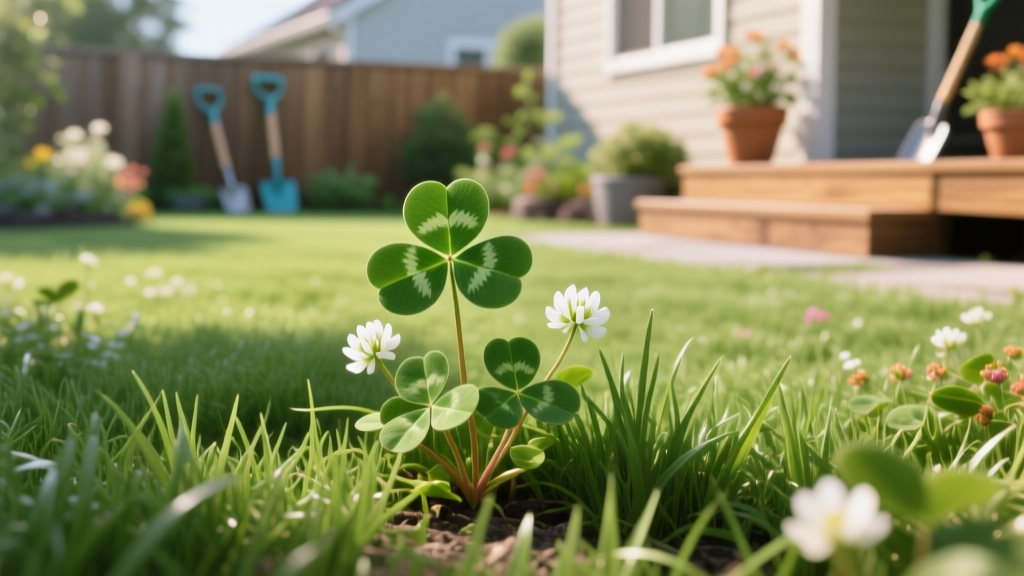
How to Identify and Eliminate Japanese Clover Weed in Your Lawn
Japanese clover weed (Kummerowia striata, formerly classified as Lespedeza striata) is a highly adaptive summer annual broadleaf weed that aggressively colonizes thinning turf. Unlike common white clover, which thrives in cool, moist conditions, Japanese clover weed is a heat-tolerant invader that peaks in late summer, often choking out desirable grass species just as drought stress weakens your lawn. Eradicating this weed requires more than a blanket application of generic broadleaf killers; it demands precise identification, targeted spot-treatment protocols, and fundamental soil corrections.
The Botanical Profile: Why Japanese Clover Weed Invades
Accurate identification is the first critical step in spot-treatment. Homeowners frequently misidentify Japanese clover weed as white clover (Trifolium repens) or black medic (Medicago lupulina), leading to ineffective herbicide selections. According to weed science data from NC State TurfFiles, Japanese clover exhibits distinct morphological traits that separate it from other trifoliate weeds.
- Leaf Structure: The leaflets are oblong and narrow, featuring a prominent midrib and distinct parallel veins. This contrasts sharply with the rounded, heart-shaped leaflets of white clover.
- Stem Characteristics: Stems are heavily pubescent (hairy) and root at the nodes, allowing the plant to form dense, mat-like patches up to 18 inches in diameter.
- Floral Markers: In late July through September, it produces small, inconspicuous pink or purplish flowers tucked tightly into the leaf axils, unlike the prominent spherical white flower heads of standard clover.
Diagnostic Warning: If you pull a stem and notice a strong, distinct taproot rather than a shallow fibrous root system, and the leaves lack the white 'V' chevron marking typical of white clover, you are dealing with Japanese clover weed. Standard 2,4-D formulations that easily kill white clover will often only stunt Japanese clover, requiring repeat applications or alternative active ingredients.
Spot-Treatment Decision Matrix: Herbicide Selection
Japanese clover weed possesses a waxy cuticle and a robust taproot that makes it moderately resistant to weak systemic herbicides. For effective spot-treatment, you must select an active ingredient that translocates effectively to the root zone. The following matrix outlines the most effective chemical controls based on your specific turfgrass type.
| Active Ingredient | Trade Name Example | Safe For Turf Type | Spot-Treatment Rate (per 1,000 sq ft) | Est. Cost |
|---|---|---|---|---|
| Triclopyr + 2,4-D + Dicamba | Ortho WeedClear / Southern Ag | Cool-season & most Warm-season | 1.5 fl oz per gallon of water | $14.00 |
| Metsulfuron-methyl | Manor / MSM Turf | Warm-season ONLY (Bermuda, Zoysia, St. Augustine) | 0.02 oz (approx. 1/2 tsp) per gallon | $8.50 |
| Quinclorac | Drive XLR8 | Cool-season & Bermuda | 0.75 fl oz per gallon of water | $18.00 |
| Prodiamine (Pre-emergent) | Barricade 65 WDG | All established turf | 0.4 oz per 1,000 sq ft (granular) | $12.00 |
Step-by-Step Post-Emergent Spot Treatment Protocol
Applying the correct herbicide is only half the battle; application technique dictates whether the chemical reaches the taproot or merely burns the top growth. Follow this precise protocol for maximum efficacy.
- Calibrate Your Equipment: Use a 1-gallon or 2-gallon pump sprayer equipped with a flat-fan nozzle (such as a TeeJet 8002 or 11002). Avoid cone nozzles, which waste product and increase drift. Maintain a steady pressure of 20 to 30 PSI.
- Integrate a Surfactant: Japanese clover weed's hairy stems and waxy leaves repel water-based sprays. You must add a Non-Ionic Surfactant (NIS) at a rate of 0.25% v/v (roughly 1/2 teaspoon per gallon of mixed herbicide). This breaks the surface tension, allowing the chemical to coat the oblong leaflets and penetrate the cuticle.
- Optimize Environmental Conditions: Apply the spot-treatment when daytime temperatures are between 65°F and 85°F. Spraying when temperatures exceed 90°F will cause rapid volatilization, leading to severe phytotoxicity (burning) on your surrounding desirable turfgrass.
- Execute the Application: Spray the Japanese clover patches until the leaves are uniformly wet, but not to the point of runoff. Avoid broadcasting the chemical over the entire lawn; spot-treating saves money and protects soil biology.
- Post-Application Withholding: Do not irrigate the lawn or allow rainfall for at least 48 hours. Wait 72 hours before mowing to allow maximum translocation of the herbicide down to the taproot.
Cultural Eradication: Fixing the Soil Mechanics
Herbicides provide a temporary cure, but Japanese clover weed is an indicator plant. Its presence signals specific soil deficiencies. As a legume, Kummerowia striata fixes its own atmospheric nitrogen via rhizobial bacteria in its root nodules. This means it will aggressively outcompete your turfgrass in nitrogen-deficient environments. Furthermore, research highlighted by Penn State Extension notes that this weed thrives in heavily compacted, acidic soils where turfgrass roots struggle to breathe and absorb nutrients.
'You cannot chemically eradicate Japanese clover weed long-term without addressing the soil compaction and nitrogen deficits that invited it in the first place. The weed is merely a symptom of a failing turf ecosystem.'
The Soil Correction Framework
- Nitrogen Loading: Shift your fertilization program to deliver 2.5 to 3.5 lbs of nitrogen per 1,000 square feet annually for cool-season grasses, or 2 to 3 lbs for warm-season grasses. Use a slow-release methylene urea or polymer-coated urea to provide steady feeding without excessive top-growth flushes.
- pH Amendment: Japanese clover tolerates a pH as low as 5.0. Conduct a soil test and apply pelletized lime to raise your soil pH to the optimal 6.2 to 6.8 range, which unlocks phosphorus and potassium for your turfgrass.
- Core Aeration: Perform deep-tine core aeration in the fall (for cool-season grasses) or late spring (for warm-season grasses) to alleviate the soil compaction that Japanese clover exploits. Extract cores at least 3 inches deep on 3-inch centers.
Seasonal Timeline for Total Lespedeza Control
To achieve a zero-tolerance policy for Japanese clover weed, integrate chemical and cultural controls into a strict seasonal calendar.
- Early March (Soil Temp 50°F - 55°F): Apply a pre-emergent herbicide containing Prodiamine or Dithiopyr. This creates a chemical barrier in the top inch of soil, preventing Japanese clover seeds from germinating as spring temperatures rise.
- Late May to Early June: Conduct your first post-emergent spot-treatment. At this stage, the weeds are young, vegetative, and highly susceptible to Triclopyr or Metsulfuron-methyl mixtures.
- Mid-August: Execute a secondary spot-treatment if necessary. This is the critical cutoff point; you must kill the plants before they set seed in early September. Once seeds drop, they remain viable in the soil seedbank for up to three years.
- October: Perform core aeration, apply lime based on soil test results, and overseed bare patches with a competitive, dense turfgrass cultivar to physically crowd out next year's germination.
By combining precise post-emergent spot-treatments with aggressive soil amendment, you will systematically starve Japanese clover weed of its ecological advantages, resulting in a dense, uniform, and weed-resistant lawn.

