
Lawn Care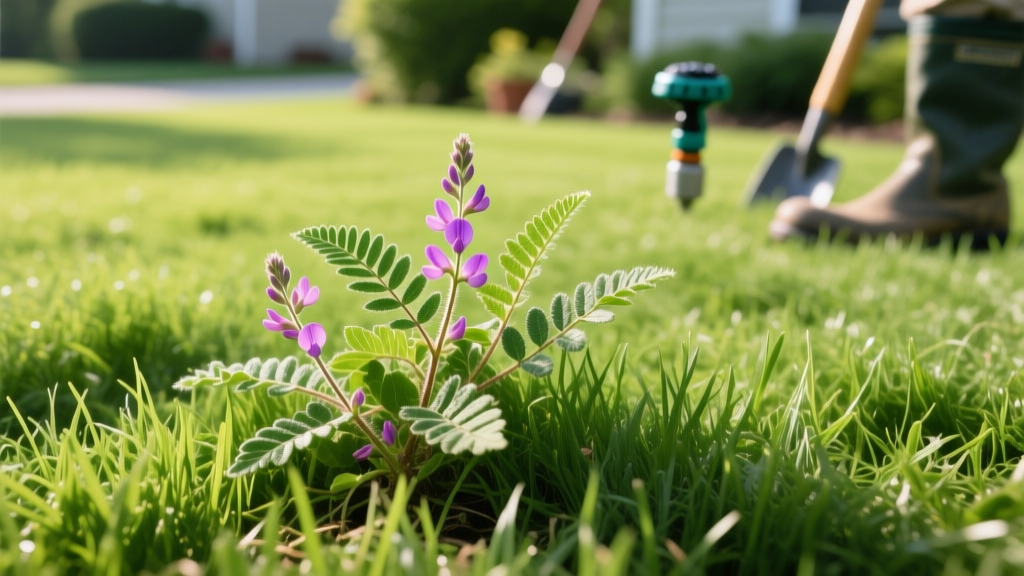
How to Identify and Eliminate Lespedeza Weed in Lawns
The Biology of Lespedeza: Why It Invades Your Lawn
Lespedeza (primarily Lespedeza striata or Japanese clover) is a summer annual weed that thrives in environments where turfgrass struggles. Unlike broadleaf weeds that require rich soil, lespedeza is an aggressive pioneer species that exploits compacted, low-fertility, and drought-stressed lawns. It germinates when soil temperatures consistently reach 60°F in late spring, growing rapidly through the summer months before producing seed in early fall.
The primary reason lespedeza outcompetes turfgrass is its nitrogen-fixing ability. Like other legumes, it hosts rhizobia bacteria in its root nodules, allowing it to synthesize its own nitrogen from the atmosphere. If your lawn is under-fertilized, lespedeza will not suffer the same nitrogen deficiency as your grass, giving it a distinct competitive advantage. According to NC State TurfFiles, lespedeza is most problematic in the Transition Zone and Southeastern United States, particularly in Centipedegrass, Bermudagrass, and thin Fescue lawns.
Identification Matrix: Lespedeza vs. White Clover
Homeowners frequently misidentify lespedeza as white clover (Trifolium repens). While both are legumes with trifoliate (three-leaf) structures, their growth habits and leaf morphologies differ significantly. Misidentification often leads to improper herbicide selection and application timing.
| Characteristic | Lespedeza (Japanese Clover) | White Clover |
|---|---|---|
| Growth Habit | Prostrate, grows flat and tight to the soil surface; stems become wiry and woody in late summer. | Stolons (runners) root at nodes; grows slightly more upright and forms dense, spongy mats. |
| Leaf Structure | Three leaflets with smooth margins and a highly prominent, distinct central vein on each leaflet. | Three leaflets with finely toothed (serrated) margins and a faint, pale "V" watermark pattern. |
| Flowers | Small, inconspicuous pinkish-purple flowers tucked tightly in the leaf axils. | Prominent, spherical white (or pinkish) flower heads on long stalks above the canopy. |
| Lifespan | Summer annual (dies at first frost, reproduces via seed). | Perennial (survives winter, spreads via seed and stolons). |
Pre-Emergent Strategies: Stopping Lespedeza Before It Sprouts
Because lespedeza is a summer annual, the most cost-effective and environmentally sound control method is preventing seed germination. Once the weed develops its wiry, woody stems in August, post-emergent herbicides struggle to penetrate the thick cuticle, requiring multiple applications.
Timing and Soil Temperature Triggers
Do not rely on calendar dates; rely on soil thermometers. Lespedeza seeds germinate when the 2-inch soil temperature reaches 55°F to 60°F for three consecutive days. In the Transition Zone, this typically occurs between late March and mid-April. Applying pre-emergents too early (February) risks the chemical barrier degrading before the late-summer germination flush; applying too late (May) allows the initial flush to establish.
Pro Tip: The Split-Application Method
For severe lespedeza infestations, use a split-application of pre-emergent. Apply 60% of your total annual rate in early spring (soil temp 50°F), and the remaining 40% in early June. This extends the chemical barrier through the peak late-summer germination window without exceeding the maximum annual active ingredient limits on the product label.
Top Pre-Emergent Active Ingredients
- Prodiamine (Barricade 65 WDG): Provides a long-lasting barrier by inhibiting root development. Apply at 0.83 oz per 1,000 sq ft. Cost: ~$80 per pound (treats ~19,000 sq ft). Must be watered in with 0.25 inches of irrigation within 48 hours.
- Dithiopyr (Dimension 2EW): Offers early post-emergent control of lespedeza seedlings (up to the 3-leaf stage) in addition to pre-emergent prevention. Apply at 0.5 fl oz per 1,000 sq ft. Cost: ~$120 per gallon. Ideal if you missed your early spring window.
Post-Emergent Spot Treatments: Eradicating Active Growth
If lespedeza has already established in your lawn, spot-treating with post-emergent systemic herbicides is required. The active ingredient you choose must align with your specific turfgrass species, as lespedeza killers that are safe for cool-season grasses will severely damage warm-season turf.
Cool-Season vs. Warm-Season Herbicide Selection
A common and costly failure mode occurs when homeowners purchase generic "broadleaf weed killers" containing high concentrations of 2,4-D and apply them to Centipedegrass or St. Augustinegrass. This causes severe phytotoxicity, resulting in yellowing, stunting, and potential turf death.
| Turfgrass Type | Recommended Herbicide | Active Ingredients | Application Rate (per 1,000 sq ft) |
|---|---|---|---|
| Cool-Season (Fescue, Kentucky Bluegrass, Ryegrass) | Trimec Classic or SpeedZone | 2,4-D + MCPP + Dicamba | 1.5 fl oz (Trimec) mixed with 0.25% non-ionic surfactant |
| Warm-Season (Bermuda, Zoysia) | Three-Way Ester or Southern Ag | 2,4-D + MCPP + Dicamba (lower concentrations) | 1.0 to 1.2 fl oz (check label for Bermuda sensitivity) |
| Sensitive Warm-Season (St. Augustine, Centipede) | Celsius WG | Thiencarbazone + Iodosulfuron + Dicamba | 0.057 oz (mixed with 0.5% v/v non-ionic surfactant) |
As noted by University of Georgia Extension, Celsius WG is the gold standard for sensitive warm-season lawns. While a 10-ounce bottle costs approximately $130, it treats over 43,000 square feet, making the per-application cost highly economical while ensuring turf safety.
The Application Protocol for Maximum Efficacy
- Mow First: Mow the lawn 24 hours before application to remove excess leaf canopy and expose the low-growing lespedeza rosettes.
- Add Surfactant: Lespedeza leaves develop a waxy cuticle by mid-summer. Always add a non-ionic surfactant (like DuoStick or standard NIS) at 0.25% v/v to break surface tension and drive the herbicide into the leaf tissue.
- Nozzle Selection: Use a flat-fan nozzle (e.g., TeeJet 8002 or 11002) calibrated to deliver 1.5 to 2.0 gallons of spray solution per 1,000 square feet. This ensures thorough coverage without runoff.
- Temperature Restrictions: Never apply post-emergent herbicides when ambient air temperatures exceed 85°F. High heat volatilizes chemicals like 2,4-D, causing them to drift and damage nearby ornamental shrubs and trees.
Cultural Fixes: Making Your Lawn Hostile to Lespedeza
Herbicides only treat the symptom; cultural practices cure the disease. Lespedeza is a biological indicator of poor soil health. If you do not alter the soil environment, the weed will return the following year from the existing seed bank.
Core Aeration and Compaction Relief
Lespedeza thrives in soil with high bulk density (compaction) where turfgrass roots cannot penetrate to access deep moisture. Perform core aeration in the fall for cool-season grasses and late spring for warm-season grasses. Use a walk-behind core aerator to pull 3-inch deep plugs at a spacing of 2 to 3 inches apart. Leave the plugs on the lawn to decompose; they introduce soil microbes back into the thatch layer, accelerating decomposition and improving water infiltration.
Nitrogen Management
Because lespedeza fixes its own nitrogen, it is highly sensitive to competition from fast-growing, well-fed turfgrass. Shift your fertilization strategy to outcompete the weed:
- Cool-Season Lawns: Apply 3.0 to 4.0 lbs of actual nitrogen per 1,000 sq ft annually, heavily weighted toward the fall months (September and November) to build deep root reserves.
- Warm-Season Lawns: Apply 2.0 to 3.0 lbs of actual nitrogen per 1,000 sq ft annually during the active growing season (May through August). Use slow-release nitrogen sources (like methylene urea or sulfur-coated urea) to provide a steady 8-week feeding window, promoting dense lateral turf growth that shades out lespedeza seedlings.
Soil pH Correction
Test your soil pH. Lespedeza tolerates acidic soils (pH 5.0 to 5.8) better than most turfgrasses. If your soil test indicates a pH below 6.0, apply pelletized limestone at the rate recommended by your local extension office (typically 25 to 50 lbs per 1,000 sq ft) in the fall. Raising the pH to 6.2–6.5 optimizes nutrient availability for your grass while creating a less favorable environment for legume weeds.

