
Lawn Care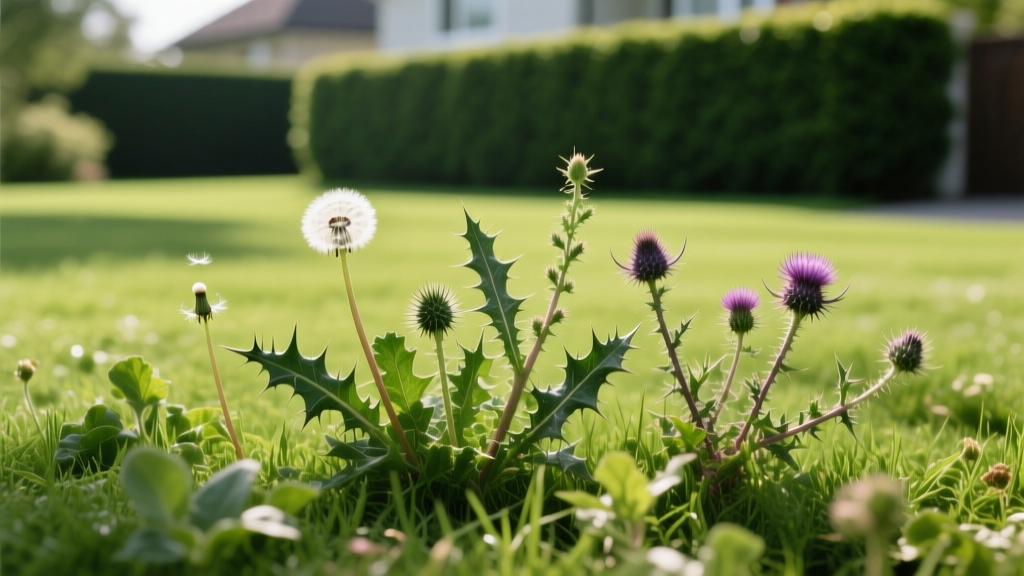
Prickly Weeds in Lawn: Identification and Spot-Treatment Guide
Stepping barefoot onto a lawn infested with spiny invaders is a quick way to ruin a weekend. Prickly weeds in lawn environments not only cause physical discomfort but also indicate underlying turf thinning, soil compaction, or improper mowing heights. Unlike broadleaf clover or dandelions, weeds that produce burs, spines, or rigid thistles require targeted chemical and mechanical interventions to eradicate completely without damaging the surrounding desirable turf.
This spot-treatment guide bypasses generic advice to provide exact herbicide formulations, precise mixing ratios, and species-specific extraction techniques for the most common spiny lawn invaders.
The Usual Suspects: Identifying Prickly Lawn Invaders
Before mixing any herbicide, you must correctly identify the weed. Misidentification leads to wasted chemicals and phytotoxicity. The three most frequent offenders in residential turf are:
Lawn Burweed (Soliva sessilis)
A winter annual broadleaf weed that thrives in thin, compacted cool-season and warm-season lawns. It grows low to the ground, forming a mat-like rosette with fern-like leaves. By late spring, it produces hard, needle-sharp burs that easily pierce skin and pet paws. Burweed dies off in early summer, leaving behind thousands of viable seeds for the next year.
Spiny Sandbur (Cenchrus spinifex)
A summer annual grassy weed that looks remarkably like desirable turfgrass until it shoots up its spiky, burr-covered seed heads. Sandbur thrives in hot, dry, sandy soils and poorly irrigated lawns. Because it is a grassy weed, standard broadleaf herbicides will not kill it; it requires specific post-emergent grassy weed killers or pre-emergent timing.
Canada Thistle (Cirsium arvense)
A perennial broadleaf weed with deeply lobed, spiny leaves and purple flowers. Unlike annual burrs, Canada thistle spreads via an extensive, deep underground rhizome network. Pulling the top leaves the root intact, guaranteeing it will resprout within weeks. According to Penn State Extension, systemic herbicides are mandatory for thistle eradication.
Chemical Spot-Treatment Matrix
Selecting the correct active ingredient is critical. Using a non-selective herbicide like glyphosate will kill the weed, but it will also leave a dead, bare patch in your lawn that invites worse weeds. Use this matrix to select the right selective post-emergent herbicide based on your turf type.
| Weed Species | Recommended Herbicide | Active Ingredients | Warm-Season Safe? | Cool-Season Safe? |
|---|---|---|---|---|
| Lawn Burweed | Celsius WG | Thiencarbazone, Iodosulfuron, Dicamba | Yes (Bermuda, Zoysia, St. Augustine) | No |
| Lawn Burweed | SpeedZone Southern | 2,4-D, MCPP, Dicamba, Carfentrazone | Yes | No |
| Spiny Sandbur | Celsius WG (Early stage) | Thiencarbazone, Iodosulfuron, Dicamba | Yes | No |
| Spiny Sandbur | Quinclorac (Drive XLR8) | Quinclorac | Yes (Check label for St. Aug) | Yes (Fescue, Bluegrass) |
| Canada Thistle | Trimec Classic / SpeedZone | 2,4-D, MCPP, Dicamba | Yes (Lower rates) | Yes |
Note: Always consult the NC State TurfFiles database or your specific product label to verify safety for your exact grass cultivar, as some herbicides will severely damage specific varieties like Floratam St. Augustine or Centipedegrass.
Step-by-Step Spot-Spraying Protocol
Broadcast spraying an entire lawn for a few patches of prickly weeds is a waste of money and increases chemical runoff. Spot-treating requires precise calibration. Follow this exact protocol for mixing and applying Celsius WG or SpeedZone for broadleaf prickly weeds.
- Calculate the Target Area: Measure the square footage of the weed patches. For spot treatment, you will typically mix enough solution to cover 1,000 square feet, which requires 1.5 to 2.0 gallons of water.
- Measure the Herbicide:
- For Celsius WG: Use 0.057 ounces (approx. 1.6 grams) per 1,000 sq ft.
- For SpeedZone Southern: Use 1.0 to 1.5 fluid ounces per 1,000 sq ft.
- Add a Non-Ionic Surfactant (NIS): Prickly weeds like burweed have waxy cuticles that repel water. Add a high-quality NIS (like Hi-Yield Spreader Sticker) at a rate of 0.5% by volume. For 2 gallons of water, this equals roughly 1.3 teaspoons of surfactant. This reduces surface tension and forces the herbicide to stick to the spiny leaves.
- Mix Order (WALES Method): Fill the sprayer halfway with water. Add Wettable powders (WG), Agitate, Liquid surfactants, Emulsifiable concentrates, then Solutions. Agitate thoroughly.
- Apply at the Right Temperature: Spray when ambient temperatures are between 65°F and 85°F.
Warning: Applying ester-based herbicides like SpeedZone when temperatures exceed 85°F causes rapid volatilization. The chemical will turn into a gas and drift, severely burning your desirable turfgrass.
Mechanical Extraction for Deep-Rooted Thistles
While chemical spot-treatment is highly effective for annual burweed and sandbur, mature Canada Thistles often require a combined mechanical and chemical approach due to their extensive rhizomes. According to Texas A&M AgriLife Extension, relying solely on hand-pulling thistles is futile because any root fragment left in the soil will generate a new plant.
"For perennial spiny weeds, the goal of mechanical removal is not to extract the root, but to wound the plant tissue to maximize systemic herbicide uptake during the fall rosette stage."
The Cut-and-Paint Method:
- Use heavy leather gloves and pruning shears to cut the thistle stalk 2 inches above the soil line.
- Immediately (within 60 seconds) apply a concentrated, non-diluted drop of a systemic herbicide containing Clopyralid or Triclopyr directly to the fresh cut using a small sponge applicator or eye dropper.
- The plant's vascular system will pull the concentrated chemical down into the deep rhizomes, killing the root network without spraying the surrounding lawn.
Preventative Pre-Emergent Timelines
Spot-treating prickly weeds after they have produced burs means you are fighting a losing battle; the seeds are already in the soil seed bank. True eradication requires blocking germination. The timing of your pre-emergent application dictates your success rate for the following year.
Winter Annuals (Lawn Burweed)
Target: Block fall germination.
Timing: Apply when soil temperatures drop to 70°F (typically late August to mid-September).
Product: Prodiamine 65 WDG at 0.185 oz per 1,000 sq ft.
Summer Annuals (Spiny Sandbur)
Target: Block spring germination.
Timing: Apply when soil temperatures reach 52°F for three consecutive days (typically early March).
Product: Dithiopyr (Dimension) at 0.5 oz per 1,000 sq ft.
By combining precise post-emergent spot-treatments for existing prickly weeds with strictly timed pre-emergent barriers, you can reclaim a soft, barefoot-friendly lawn within a single growing season. Always calibrate your sprayer annually and record your application dates to refine your local microclimate timing.

