
Lawn Care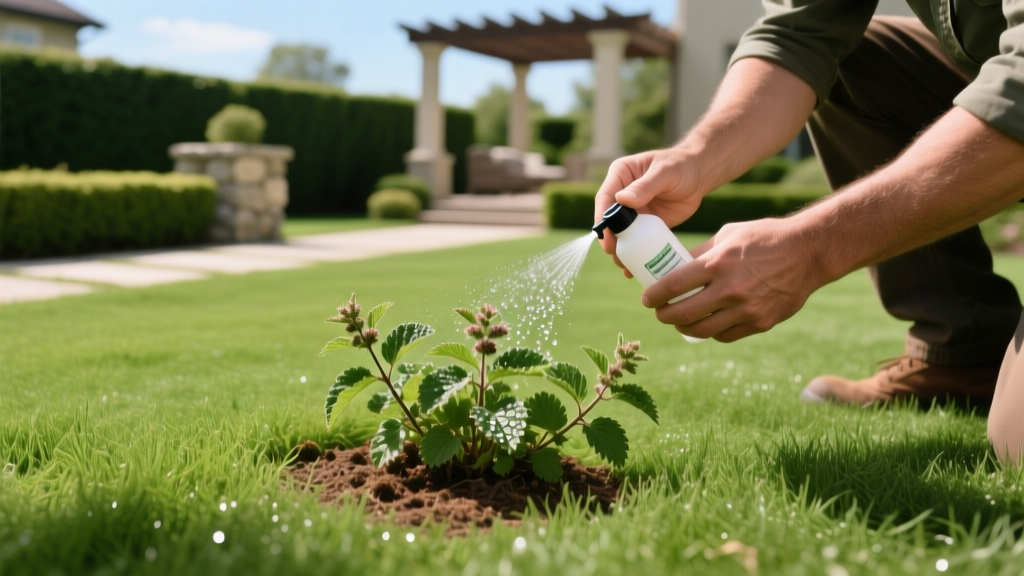
How to Eliminate Knotweed in Lawn: Spot-Treatment Guide
The Knotweed Confusion: Prostrate vs. Japanese
Before mixing any herbicides, you must correctly identify the specific knotweed species invading your turf. Homeowners frequently confuse Prostrate knotweed (Polygonum aviculare) with Japanese knotweed (Reynoutria japonica). This misidentification leads to catastrophic treatment failures.
Japanese knotweed is a highly invasive, bamboo-like perennial shrub that grows up to 10 feet tall, destroys concrete foundations, and requires aggressive, non-selective eradication protocols (often involving professional-grade imazapyr or repeated glyphosate injections). It is not a turfgrass weed. Prostrate knotweed, conversely, is a low-growing, wiry summer annual that mats tightly against the soil surface, choking out cool- and warm-season grasses. This guide focuses exclusively on the spot-treatment and cultural eradication of prostrate knotweed in lawn environments.
Identifying Prostrate Knotweed in Turf
Prostrate knotweed is a master of survival in neglected turf. It features heavily branched, wiry stems that grow flat against the ground, radiating outward from a central taproot. The leaves are small, alternate, and typically blue-green to grayish-green, measuring about 1/2 to 1 inch long.
The definitive diagnostic feature—the one that separates it from similar weeds like spurge or purslane—is the ocrea. This is a thin, papery, silvery sheath that wraps around the stem at the base of each leaf node. If you gently pull a leaf back and see a translucent, papery collar at the joint, you have confirmed prostrate knotweed. According to the NC State Extension, this sheath is present on all knotweed species and is the most reliable field identifier for turf managers.
The Milk Test
Many homeowners confuse young knotweed with spotted spurge. Break the stem: spurge exudes a thick, white, milky latex sap. Knotweed stems will break cleanly and exude a clear, watery sap. If it bleeds white milk, you are looking at spurge, which requires a different chemical approach.
The Diagnostic Indicator: Why Knotweed is in Your Lawn
In agronomy, weeds are indicator species. Prostrate knotweed is the ultimate indicator of severe soil compaction and low nitrogen availability. It thrives in high-traffic areas—along driveways, near mailboxes, and on the edges of sidewalks—where the soil is pounded hard and turfgrass roots suffocate.
⚠️ The Compaction Threshold:
Turfgrass requires soil pore space to access oxygen and water. When soil bulk density exceeds 1.4 g/cm³ (common in clay-heavy, high-traffic lawns), grass roots die off. Prostrate knotweed possesses a massive, deep taproot capable of penetrating heavily compacted soil layers that grass cannot breach. If you treat the weed without addressing the compaction, the knotweed will return the following spring.
Turfgrass requires soil pore space to access oxygen and water. When soil bulk density exceeds 1.4 g/cm³ (common in clay-heavy, high-traffic lawns), grass roots die off. Prostrate knotweed possesses a massive, deep taproot capable of penetrating heavily compacted soil layers that grass cannot breach. If you treat the weed without addressing the compaction, the knotweed will return the following spring.
Chemical Control: Pre-Emergent and Post-Emergent Protocols
Effective eradication requires a two-pronged chemical approach. Mature knotweed develops a thick, waxy cuticle that repels water-based herbicides, making early intervention critical.
The Timing Trap: Soil Temperature vs. Calendar Dates
A common failure mode is applying pre-emergent herbicides based on crabgrass timing. Crabgrass germinates when soil temperatures reach 55°F to 60°F at a 2-inch depth. Prostrate knotweed germinates much earlier, often when soil temperatures are between 50°F and 55°F. If you wait until the forsythia bushes bloom (the standard crabgrass indicator), your knotweed pre-emergent window has already closed. You must apply pre-emergents in late February to early March in transition zones, or as soon as the ground thaws in northern zones.
Herbicide Selection Matrix
| Treatment Phase | Active Ingredient | Product Example | Application Rate (per 1,000 sq ft) |
|---|---|---|---|
| Pre-Emergent | Prodiamine | Prodiamine 65 WDG | 0.23 - 0.41 oz (mixed in 1-2 gal water) |
| Early Post-Emergent (2-4 leaf) | 2,4-D + Dicamba + MCPP | Trimec Classic | 1.5 fl oz per gallon of water |
| Late Post-Emergent (Mature) | Carfentrazone + 2,4-D + MCPP + Dicamba | SpeedZone Broadleaf | 1.0 - 1.5 fl oz per gallon of water |
For mature plants, the inclusion of carfentrazone (found in SpeedZone) is highly recommended. Carfentrazone is a PPO inhibitor that causes rapid cell membrane disruption, burning through the waxy cuticle of mature knotweed much faster than traditional auxin herbicides like 2,4-D alone. The UC Statewide IPM Program notes that combining systemic auxins with contact burners provides the most reliable control for mature broadleaf weeds in turf.
Step-by-Step Spot-Treatment Application
When treating isolated patches of knotweed, follow this exact protocol to maximize kill rates and protect surrounding turfgrass.
- Calibrate Your Sprayer: Mark a 20x50 ft area (1,000 sq ft). Fill your pump sprayer with water and spray the area at your normal walking pace. Measure how much water it took to cover the area. This is your carrier volume (usually 1.5 to 2 gallons).
- Mix the Solution: Fill the sprayer halfway with water. Add the precise amount of post-emergent herbicide (e.g., 1.5 oz of SpeedZone). Agitate.
- Add the Surfactant (CRITICAL): Add 1/2 teaspoon of a high-quality non-ionic surfactant (such as Hi-Yield Spreader Sticker or a methylated seed oil). Surfactants reduce the surface tension of the water droplets, allowing the chemical to spread flat across the waxy knotweed leaf rather than beading up and rolling off into the soil.
- Apply Under Optimal Conditions: Spray the knotweed patches until the leaves are uniformly wet, but not dripping. Do not spray when temperatures exceed 85°F, as 2,4-D and dicamba can volatilize (turn into a gas) and drift onto sensitive ornamental plants or vegetable gardens.
- Observe the 48-Hour Rule: Do not water the lawn or allow rainfall for at least 48 hours post-application. The herbicide needs time to translocate from the leaves down into the deep taproot.
Common Application Mistakes and Failure Modes
- Skipping the Surfactant: Spraying mature knotweed in mid-summer without a surfactant will result in a 0% kill rate. The waxy cuticle will simply repel the water-based solution.
- Mowing Too Soon: Mowing within 24 hours before or after spraying removes the leaf surface area required to absorb the chemical. Always wait 48 hours after application to mow.
- Ignoring the Taproot: Pulling mature knotweed by hand almost always snaps the wiry stem at the soil line, leaving the deep taproot intact. The plant will resprout within two weeks. Chemical translocation or deep mechanical extraction (using a dandelion digger to extract the full root) is mandatory.
Cultural Remediation: Fixing the Soil
Chemical control only removes the existing plants. To prevent prostrate knotweed from returning, you must alter the soil environment so that turfgrass outcompetes the weed.
Core Aeration and Topdressing
In late summer or early fall (for cool-season grasses), perform deep core aeration. Use a walk-behind aerator that pulls 2-to-3-inch soil plugs, spacing them no more than 3 inches apart. This physically fractures the compacted soil layer. Immediately following aeration, topdress the area with a 1/4-inch layer of screened compost. The compost will work its way into the aeration holes, improving soil structure, increasing microbial activity, and enhancing drainage.
Overseeding with Competitive Cultivars
Bare, compacted soil is an open invitation for knotweed seeds, which can remain viable in the soil seed bank for up to 20 years. After aerating, overseed the affected areas with aggressive, traffic-tolerant turfgrass cultivars. For cool-season lawns, use a blend of Tall Fescue (which boasts deep, drought-tolerant roots) and Kentucky Bluegrass (which spreads via rhizomes to fill in bare spots). Apply a starter fertilizer (e.g., 18-24-12) at the time of seeding to promote rapid establishment. Once the turf canopy is dense and the soil is decompacted, prostrate knotweed will be entirely shaded out and unable to germinate.

