
Lawn Care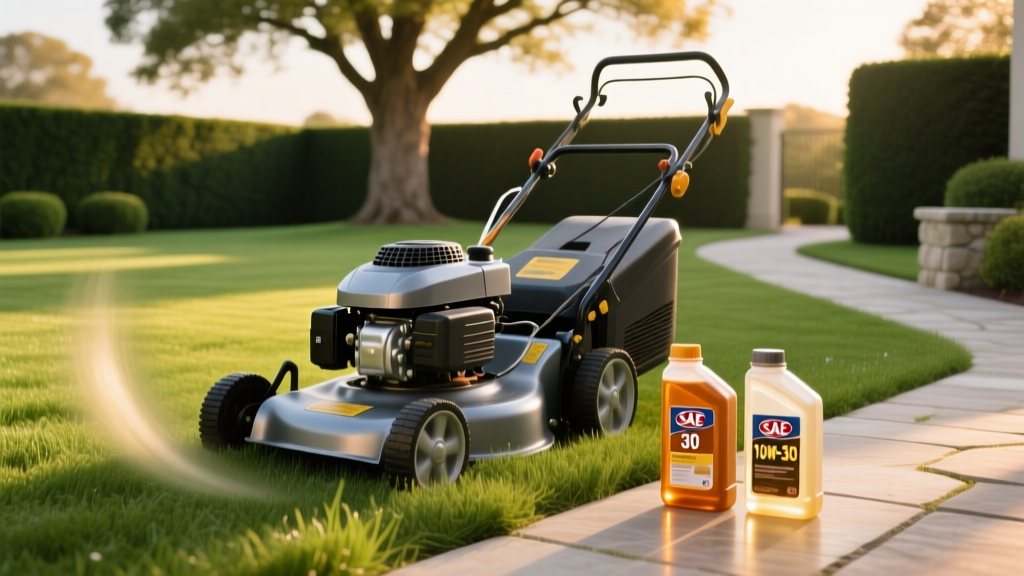
Engine Oil for Mower Maintenance: SAE 30 vs 10W-30 Explained
Selecting the correct engine oil for mower equipment is the single most critical factor in determining whether your machine lasts 500 hours or 2,000 hours. Unlike liquid-cooled automotive engines that operate at a steady 210°F (99°C), air-cooled small engines routinely see internal oil temperatures spike above 250°F (121°C) during heavy summer mowing. This extreme thermal load demands specific viscosity profiles and additive packages that standard automotive oils simply cannot provide.
This guide breaks down the exact science behind small-engine lubrication, compares the industry-standard SAE 30 and 10W-30 formulations, and provides OEM-specific capacity charts for the most common mower engines on the market in 2026.
Decoding Viscosity: Why SAE 30 and 10W-30 Dominate
Viscosity refers to a fluid's resistance to flow. The Society of Automotive Engineers (SAE) established the SAE J300 standard to classify engine oils based on their kinematic viscosity at specific temperatures. For lawn equipment, two grades dominate the market:
- SAE 30 (Single-Grade): A straight-weight oil that provides a thick, stable lubricating film at high operating temperatures. It lacks viscosity modifiers, meaning it will not shear down under the intense mechanical stress of a mower's splash-lubrication system. However, it becomes too thick to flow properly below 40°F (4°C).
- 10W-30 (Multi-Grade): Contains polymer viscosity index improvers (VIIs) that allow the oil to flow like a 10-weight oil in cold weather, while protecting like a 30-weight oil at operating temperature. This makes it the premier choice for homeowners in regions with drastic seasonal temperature swings.
The Temperature Threshold Rule
The choice between these two grades should be dictated entirely by your ambient mowing temperature. If you only mow between May and September in a climate where morning temperatures never drop below 50°F, straight SAE 30 is technically superior. Because it lacks VII polymers, it is less prone to carbon buildup and varnish deposits inside the crankcase over a 100-hour service interval.
| Oil Grade | Optimal Ambient Temp Range | Best Use Case | Avg. Price (2026) |
|---|---|---|---|
| SAE 30 Conventional | 40°F to 100°F+ (4°C+) | Strict summer mowing, commercial zero-turns | $5.00 - $7.00 / qt |
| 10W-30 Conventional | 0°F to 100°F (-18°C to 38°C) | Spring/Fall mowing, variable climates | $5.50 - $8.00 / qt |
| 10W-30 Full Synthetic | -20°F to 120°F (-29°C to 49°C) | Heavy commercial use, extreme heat, extended intervals | $9.00 - $13.00 / qt |
Synthetic vs. Conventional: Is the Premium Price Justified?
For a standard homeowner pushing a 21-inch walk-behind mower for 30 hours a year, conventional oil changed every 50 hours is perfectly adequate. However, full synthetic engine oil for mower applications becomes a mandatory investment under specific conditions.
When to Upgrade to Full Synthetic:
- You operate a commercial zero-turn mower (e.g., Scag, Exmark) for 400+ hours annually.
- You mow in ambient temperatures exceeding 95°F (35°C) with high humidity, which severely limits air-cooling efficiency.
- Your engine features an oil filter (common on Kawasaki V-Twins), allowing for extended 100-hour drain intervals.
Full synthetics utilize uniformly sized hydrocarbon molecules that resist thermal breakdown and oxidation far better than refined crude oils. According to the American Petroleum Institute (API), modern API SP-rated synthetic oils offer enhanced high-temperature deposit protection, which is critical for preventing piston ring sticking in air-cooled cylinders.
OEM Specifications: Exact Capacities and Requirements
One of the most common causes of small engine failure is incorrect oil volume. Small engines do not have the deep oil pans of cars; a difference of just 4 ounces can mean the difference between proper splash lubrication and catastrophic connecting-rod failure. Below are the exact factory specifications for the three most prevalent mower engine families.
Honda GCV Series (GCV160, GCV170, GCV190)
Found on countless Honda HRX and HRR walk-behind mowers, these engines are notorious for lacking a traditional drain plug. You must drain them via the fill tube.
- Capacity: 0.58 US quarts (0.55 Liters)
- Recommended Grade: 10W-30 (API SJ or later)
- Drain Method: Tilt the engine or use a pneumatic fluid extractor (e.g., Mityvac 7201).
Briggs & Stratton Quantum and Intek Series
The workhorses of the suburban lawn, these single-cylinder engines rely heavily on a dipper on the connecting rod to splash oil onto the cylinder walls.
- Capacity (Single Cylinder): 15 to 18 oz (0.47 to 0.53 Liters) depending on exact model.
- Capacity (V-Twin Intek): 1.9 US quarts (1.8 Liters).
- Recommended Grade: SAE 30 (above 40°F) or 10W-30 (variable temps).
Kawasaki FR and FX Series
Standard on premium zero-turn mowers like the Toro Titan and John Deere Z-Trak. These are pressurized, full-pressure lubrication systems with spin-on filters.
- Capacity (FR651 V-Twin): 2.0 US quarts (1.9 Liters) with filter change.
- Recommended Grade: 10W-40 or 20W-50 (Kawasaki specifically favors slightly heavier multi-grades for their V-Twins to protect the pressurized main bearings).
Step-by-Step: The 15-Minute Hot-Drain Method
Changing engine oil for mower equipment requires a different approach than a car. Always perform the drain when the engine is hot (run it for 5 minutes prior). Hot oil suspends carbon particulates and flows faster, ensuring you remove up to 95% of the contaminated fluid rather than leaving sludge in the crankcase sump.
- Prep and Safety: Disconnect the spark plug wire. This is non-negotiable to prevent accidental engagement of the blade or engine kickback while your hands are near the crankcase.
- Extract or Drain: If your engine has a yellow or black square-head drain plug (usually 3/8" drive), place a low-profile catch pan underneath. If it is a Honda-style plugless design, insert a fluid extraction pump tube down the dipstick hole.
- The Tilt Technique: For plugless engines without an extractor, tilt the mower backward (never forward, or oil will flood the air filter and carburetor) and let it drain out the fill tube into a catch pan.
- Refill with Precision: Pour in exactly 80% of the required capacity. Wait 60 seconds for the oil to settle in the sump, then check the dipstick. Never check the dipstick while it is threaded into the block; simply rest it on top of the threads for the reading.
- Top Off: Add the remaining oil in 1-ounce increments until it reaches the top hash mark.
Warning: The Ethanol Factor
Modern E10 (10% ethanol) gasoline attracts moisture and degrades engine oil rapidly when it slips past the piston rings into the crankcase. If you use E10 fuel, you must strictly adhere to 50-hour oil change intervals. The Environmental Protection Agency (EPA) reminds consumers to always recycle used motor oil at designated collection centers, as a single mower's oil change can contaminate thousands of gallons of groundwater if dumped improperly.
Modern E10 (10% ethanol) gasoline attracts moisture and degrades engine oil rapidly when it slips past the piston rings into the crankcase. If you use E10 fuel, you must strictly adhere to 50-hour oil change intervals. The Environmental Protection Agency (EPA) reminds consumers to always recycle used motor oil at designated collection centers, as a single mower's oil change can contaminate thousands of gallons of groundwater if dumped improperly.
Common Engine Oil for Mower Mistakes (and How They Kill Engines)
Mistake 1: Using Automotive 5W-20 or 0W-20
Modern cars use ultra-thin oils to meet CAFE fuel economy standards. If you put 5W-20 in an air-cooled mower engine, the 250°F+ operating temperatures will cause the oil to shear, dropping its effective viscosity to that of water. This leads to metal-on-metal contact, piston scuffing, and total seizure within hours.
Mistake 2: Overfilling the Crankcase
Homeowners frequently overfill small engines because they do not wait for the oil to drain down the dipstick tube. When the oil level is too high, the spinning crankshaft counterweights dip into the oil pool. This "windage" whips the oil into an aerated foam. Foam cannot lubricate or transfer heat, resulting in spun connecting rod bearings and a thrown rod.
Mistake 3: Ignoring the API Service Rating
While small engines require a minimum API rating of SJ, buying outdated, cheap oil that has been sitting on a shelf since 2015 means you are missing out on modern anti-wear additives like zinc dialkyldithiophosphate (ZDDP). Always check the bottle for the current API SP or SN Plus "donut" symbol to ensure the additive package is intact.
Frequently Asked Questions
Can I use marine 2-cycle oil in my 4-stroke mower?
No. 2-cycle oils (TC-W3) are designed to be burned in the combustion chamber. They lack the friction modifiers and detergents required to lubricate a 4-stroke crankcase and will cause rapid bearing wear.
How do I know if my mower oil needs changing before the 50-hour mark?
Pull the dipstick and wipe it on a white paper towel. Fresh oil is translucent amber. If the oil is opaque black, smells strongly of raw gasoline, or has a milky, chocolate-milk appearance (indicating water intrusion from condensation), change it immediately regardless of hours logged.
Is it safe to mix SAE 30 and 10W-30?
While mixing them in an emergency will not instantly destroy the engine, it alters the carefully engineered viscosity curve. The VII polymers in the 10W-30 will be diluted, reducing cold-start protection. Always drain the system completely if switching grades.

