Lawn Care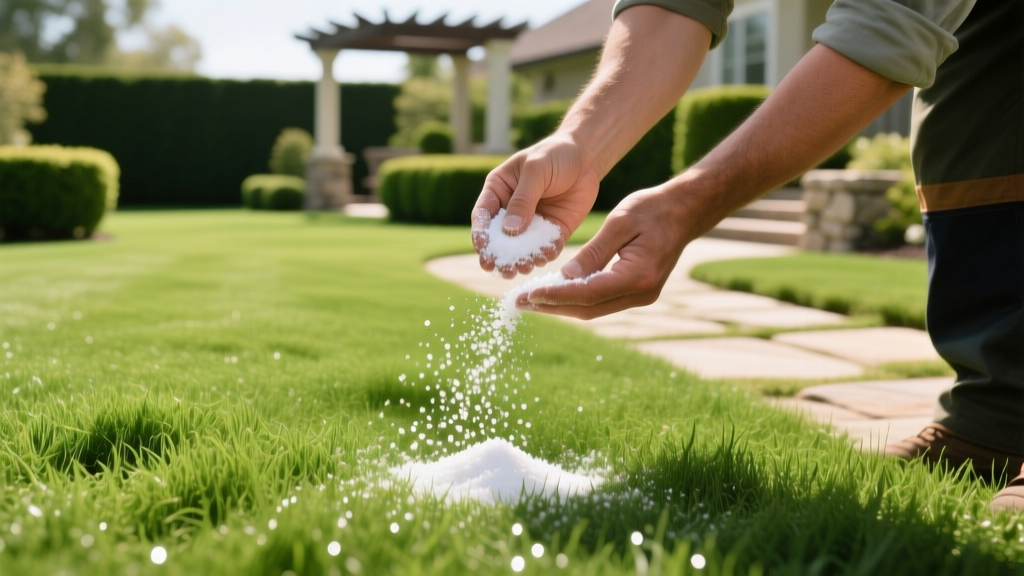
How to Apply Epsom Salt for Grass: Step-by-Step Lawn Guide
Epsom salt, chemically known as magnesium sulfate, is a highly targeted secondary nutrient supplement for turfgrass. While standard NPK (nitrogen-phosphorus-potassium) fertilizers drive top growth, Epsom salt addresses specific micronutrient deficiencies that cause yellowing, poor nutrient uptake, and weak root systems. However, applying it without a strategic, step-by-step procedure can lead to soil salinity issues and calcium displacement. This guide details the exact measurements, application methods, and scientific prerequisites for using Epsom salt for grass effectively in 2026.
The Science: Why Use Epsom Salt on Your Lawn?
Epsom salt consists of approximately 10% magnesium and 13% sulfur. Magnesium is the central atom in the chlorophyll molecule; without it, grass cannot perform photosynthesis efficiently, leading to interveinal chlorosis (yellowing between leaf veins). Sulfur is essential for synthesizing amino acids and proteins, directly impacting the turf's ability to recover from foot traffic and environmental stress.
"Magnesium is a secondary macronutrient. While turf requires it in smaller quantities than nitrogen, a deficiency will severely limit the plant's ability to utilize other applied fertilizers, effectively wasting your primary lawn care investments." — University of Minnesota Extension
Unlike synthetic chelated magnesium products that can cost upwards of $45 per gallon, generic Epsom salt (such as the Epsoak brand by San Francisco Salt Company, typically $14 for a 4 lb bag) offers a cost-effective, highly water-soluble alternative for rapid nutrient delivery.
Pre-Requisite Step: Soil Testing for Magnesium Deficiency
Never apply Epsom salt based on visual yellowing alone. Nitrogen deficiency, iron chlorosis, and fungal infections like take-all root rot present identical above-ground symptoms. Furthermore, adding magnesium to soils that already have high calcium levels can cause soil particles to disperse, destroying soil structure and reducing water infiltration.
- Collect Samples: Use a clean trowel to extract 5 to 6 soil cores at a depth of 3 to 4 inches across your lawn's zones.
- Test the Soil: Use a mail-in university extension test (e.g., Penn State Agricultural Analytical Services, ~$15) or a reliable home kit like the Luster Leaf 1601 Rapitest ($16). Look specifically for the 'Mg' (Magnesium) and 'Ca' (Calcium) ppm readings.
- Analyze the Ratio: Ideal turfgrass soil maintains a calcium-to-magnesium ratio of roughly 6:1 to 10:1. If your magnesium reads below 25 ppm or the ratio is heavily skewed toward calcium, Epsom salt is warranted.
Step-by-Step Application Procedure
Step 1: Calculate Your Lawn's Square Footage
Measure the length and width of your turf areas. Subtract the square footage of your home, driveway, and garden beds. Accurate measurement prevents over-application, which can cause osmotic stress and burn grass blades. A standard suburban lawn typically ranges from 5,000 to 8,000 square feet of actual turf area.
Step 2: Choose Your Application Method and Mix
Epsom salt can be applied as a soil drench (granular or liquid) or a foliar spray. Foliar sprays provide a rapid, 48-hour visual green-up but require frequent reapplication. Soil drenches offer long-term structural correction.
| Application Method | Mixing Ratio | Coverage Area | Frequency |
|---|---|---|---|
| Granular Soil Drench | 3 lbs per 1,000 sq ft | Broadcast spreader | Once per growing season (Spring) |
| Liquid Soil Drench | 1 cup per gallon of water | 1 gallon covers ~1,000 sq ft | Every 4-6 weeks during active growth |
| Foliar Spray | 2 tablespoons per gallon | 1 gallon covers ~1,000 sq ft | Monthly (Stop if leaves show burn) |
Step 3: Execute the Application
Method A: Foliar Spray (Fastest Results)
Use a pump sprayer or a hose-end sprayer (like the Chapin 20000, ~$18). Set the dial to 2 oz/gallon. Spray evenly across the grass blades until lightly wet, but not dripping. Do not water the lawn for at least 24 hours to allow stomatal absorption.
Method B: Granular Soil Drench (Best for Long-Term Health)
Load 3 lbs of Epsom salt per 1,000 sq ft into a rotary spreader. Apply to a dry lawn, then immediately irrigate with 0.25 inches of water to dissolve the crystals and wash them into the root zone, preventing localized salt burns on the blades.
Step 4: Timing and Weather Constraints
Apply Epsom salt only when ambient temperatures are below 85°F. High heat combined with salt solutions accelerates evaporation, leaving concentrated magnesium sulfate crystals on the leaf tissue that will draw moisture out of the grass, causing severe tip burn. Early morning applications (between 6:00 AM and 9:00 AM) are optimal.
Epsom Salt vs. Dolomitic Lime: Which Do You Need?
Homeowners frequently confuse Epsom salt with dolomitic lime because both supply magnesium. However, their chemical behaviors in the soil are vastly different. Applying the wrong amendment can ruin your soil's pH balance.
| Feature | Epsom Salt (Magnesium Sulfate) | Dolomitic Lime (Calcium Magnesium Carbonate) |
|---|---|---|
| Primary Purpose | Supplies Mg and S without altering pH | Supplies Mg and Ca while raising soil pH |
| Soil pH Impact | Neutral (No effect on pH) | Alkaline (Raises pH, reduces acidity) |
| Best Used When | Soil pH is already optimal (6.0 - 7.0) but Mg is low | Soil is acidic (pH below 5.8) AND Mg is low |
| Solubility | Highly water-soluble, fast-acting | Slow-release, requires months to break down |
According to the UMass Amherst Turf Program, applying lime to a lawn that already has a neutral pH simply to access magnesium will lock up vital micronutrients like iron and manganese, causing severe secondary deficiencies.
Common Edge Cases and Mistakes to Avoid
- The Calcium Displacement Error: Magnesium and calcium compete for the same cation exchange sites in the soil. If your soil test shows low calcium, applying heavy doses of Epsom salt will push calcium out of the soil profile, leading to blossom end rot in nearby garden plants and weakened turf cell walls. Always balance Ca and Mg.
- Salt Buildup in Clay Soils: Heavy clay soils retain salts longer than sandy loams. If you have dense clay, reduce the Epsom salt application rate by 25% and ensure you are aerating the lawn annually to prevent toxic sodium and sulfate accumulation.
- Mixing with Calcium-Based Fertilizers: Never mix liquid Epsom salt in the same tank as calcium nitrate or calcium ammonium nitrate. The sulfate and calcium will bind, creating calcium sulfate (gypsum), which will precipitate out of the solution and clog your sprayer nozzles.
Maintenance Summary Checklist
- Verify Mg deficiency via soil test (Target: >25 ppm).
- Confirm soil pH is between 6.0 and 7.0 before choosing Epsom salt over lime.
- Apply granular at 3 lbs/1,000 sq ft in spring, or foliar spray at 2 tbsp/gallon monthly.
- Irrigate immediately after granular application; avoid foliar spraying above 85°F.