
Lawn Care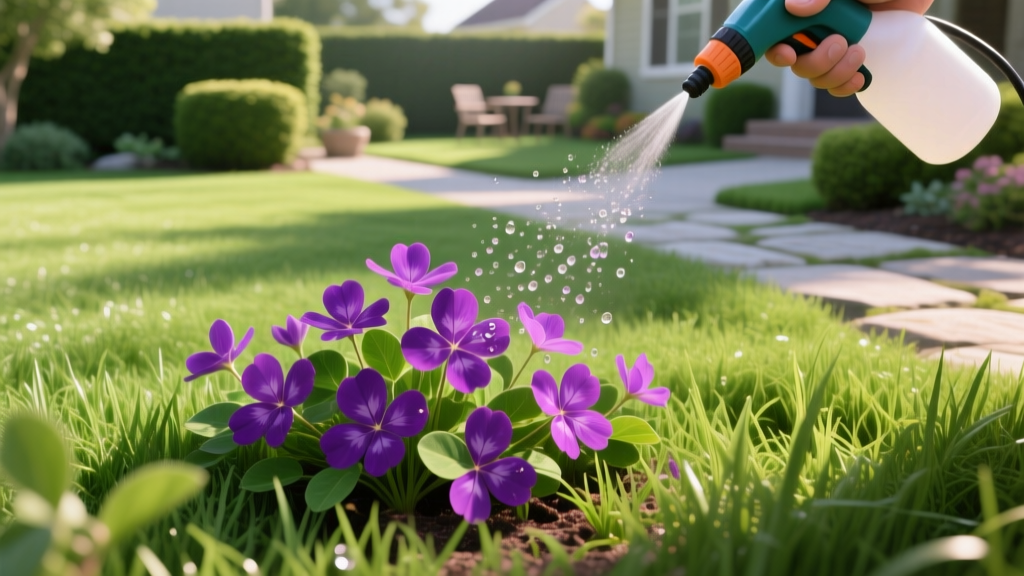
Spot-Treatment Guide: Eradicating Purple Clover in Lawn
The Botanical Reality: What is 'Purple Clover'?
When homeowners spot violet-hued blooms spreading across their turf, they typically diagnose the issue as 'purple clover.' However, from an agronomic standpoint, there is no single weed species officially classified as purple clover. The violet flowers invading your lawn are almost certainly one of three distinct broadleaf weeds: Red Clover (Trifolium pratense), White Clover (Trifolium repens) experiencing environmental stress, or Lespedeza (Kummerowia striata). Misidentifying the weed leads to ineffective chemical applications and wasted money.
Red Clover is the most common culprit. Unlike its low-growing white counterpart, Red Clover grows upright, reaching 12 to 24 inches if left unmowed, and features prominent white 'V-shaped' chevrons on its trifoliate leaves. According to NC State University's TurfFiles, Red Clover thrives in low-nitrogen, slightly acidic soils, utilizing symbiotic Rhizobium bacteria in its root nodules to fix atmospheric nitrogen. This gives it a massive competitive advantage over nitrogen-starved turfgrass.
Weed Identification Matrix
| Weed Species | Leaf Structure & Markings | Flower Profile | Growth Habit |
|---|---|---|---|
| Red Clover (T. pratense) | Trifoliate; distinct white 'V' chevron on each leaflet; fine hairs on stems. | Spherical, 1-inch heads; dark pink to purplish-red. | Upright, bunch-type; grows 12-24 inches tall. |
| White Clover (T. repens) | Trifoliate; white 'V' chevron; smooth, hairless stems. | Spherical, 0.5-inch heads; white turning pink/purple as they age. | Prostrate, stoloniferous (creeping); hugs the soil. |
| Lespedeza (K. striata) | Three narrow, oblong leaflets; no chevron markings; wiry stems. | Small, inconspicuous pink/purple flowers in leaf axils. | Prostrate to semi-upright; forms dense, wiry mats. |
Why Purple Clover Invades Your Turf
Clover is an indicator weed. Its presence is a direct symptom of underlying soil deficiencies. The primary driver for clover invasion is low soil nitrogen. While your turfgrass relies on available soil nitrogen to produce chlorophyll and dense tillers, clover generates its own. Furthermore, clover thrives in compacted soils where turfgrass roots suffocate and fail to establish. If your soil pH sits between 6.0 and 7.0, and your nitrogen application rate is below 2 lbs per 1,000 sq ft annually, your lawn is primed for a clover takeover.
Diagnostic Tip: Before treating, perform a soil test. If your soil test reveals phosphorus levels above 50 ppm and nitrogen is deficient, the clover is simply exploiting the nutrient gap. Eradication will fail long-term unless the fertility program is corrected.
Spot-Treatment Protocols for Purple Clover
Because clover often appears in isolated patches rather than blanketing the entire yard, broadcast spraying is inefficient and environmentally taxing. Spot-treatment targets the weed while preserving the surrounding turfgrass microbiome. Below are the two most effective spot-treatment pathways for 2026 turf management.
Pathway 1: Chemical Spot-Treatments (Selective Herbicides)
For rapid eradication of mature Red Clover and Lespedeza, synthetic auxin herbicides are the industry standard. These chemicals mimic plant growth hormones, causing unregulated cellular division, epinasty (twisting), and eventual vascular collapse in broadleaf weeds, while monocot turfgrass remains unaffected.
- Professional-Grade Choice: SpeedZone Broadleaf Herbicide for Turf. This formulation combines four active ingredients: 2,4-D, MCPP, Dicamba, and Carfentrazone-ethyl. Carfentrazone provides a 'burn-down' effect within 24 hours, while the systemic auxins kill the deep taproots over 14 days.
- Mixing Rate: 1.5 fluid ounces of SpeedZone per 1 gallon of water per 1,000 square feet.
- Adjuvant Requirement: You must add a Non-Ionic Surfactant (NIS) at a rate of 0.25% v/v (roughly 1/3 teaspoon per gallon). Clover leaves have a waxy cuticle; without a surfactant, the herbicide beads up and rolls off.
- Consumer-Grade Choice: Ortho WeedClear for Lawns (Ready-to-Spray). Contains 2,4-D and Quinclorac. Less potent than SpeedZone but highly accessible for small residential patches. Expect to pay around $18 for a 20 oz hose-end bottle.
Warning: Temperature Volatilization
Never apply 2,4-D or Dicamba when daytime temperatures exceed 85°F (29°C). At high temperatures, these chemicals vaporize and drift, causing severe phytotoxicity (leaf cupping and distortion) to nearby ornamental shrubs, tomato plants, and desirable broadleaf perennials. Apply in the early morning when temperatures are between 65°F and 80°F.
Never apply 2,4-D or Dicamba when daytime temperatures exceed 85°F (29°C). At high temperatures, these chemicals vaporize and drift, causing severe phytotoxicity (leaf cupping and distortion) to nearby ornamental shrubs, tomato plants, and desirable broadleaf perennials. Apply in the early morning when temperatures are between 65°F and 80°F.
Pathway 2: Organic & Iron-Based Spot-Removal
For homeowners managing organic lawns or those with sensitive warm-season grasses like St. Augustine or Centipede (which can be injured by high doses of 2,4-D), Iron HEDTA (FeHEDTA) is the premier spot-treatment. Products like Fiesta Turf Weed Killer utilize chelated iron to induce oxidative stress and rapid desiccation in broadleaf weeds.
- Application Rate: Mix 3 to 5 fluid ounces of Fiesta per 1 gallon of water.
- Technique: Spray the clover patches until just before runoff. The iron will cause the clover to blacken and desiccate within 3 to 4 hours.
- The Catch: Iron HEDTA is primarily a contact herbicide. It rarely kills the deep taproot of mature Red Clover on the first pass. You must schedule a second application 21 days later to eliminate the regrowth. Expect to pay approximately $35 to $45 per gallon for Fiesta concentrate.
Post-Eradication Lawn Recovery
Killing the weed is only 50% of the battle. If you leave bare soil and a nitrogen deficit, Lespedeza or new clover seeds will germinate within weeks. According to the University of Minnesota Extension, dense turfgrass is the only permanent defense against broadleaf weeds.
The 3-Step Recovery Protocol
- Step 1: Nitrogen Injection. Within 7 days of the clover dying back, apply a fast-release nitrogen source like Urea (46-0-0) at a rate of 1 lb of actual nitrogen per 1,000 sq ft. This forces the surrounding turfgrass to aggressively tiller and fill the void.
- Step 2: Core Aeration. If the clover patch was located in a high-traffic area, soil compaction is likely. Rent a core aerator and pull 3-inch plugs to restore oxygen to the rhizosphere.
- Step 3: Overseeding. For cool-season lawns (Fescue, Kentucky Bluegrass), overseed the bare patches with a matched seed blend at 4 lbs per 1,000 sq ft. Keep the seed moist for 14 days. Note: Do not apply pre-emergent herbicides if you plan to overseed, as they will inhibit grass seed germination.
Frequently Asked Questions
Will mowing lower eliminate purple clover?
No. While lowering your mowing height might scalp the upright flowers of Red Clover, it severely weakens your turfgrass, reducing its ability to photosynthesize and shade the soil. Furthermore, Lespedeza and White Clover thrive at low mowing heights (under 2 inches). Maintain a mowing height of 3 to 4 inches to promote deep turf roots and shade out weed seedlings.
Is purple clover harmful to dogs?
True clovers (Trifolium species) are non-toxic to dogs and are often used in pet-safe lawn mixes. However, if the clover has been treated with chemical herbicides like 2,4-D, you must keep pets off the lawn until the application has completely dried (usually 2 to 4 hours). Always refer to the specific product label for re-entry intervals.
Can I use vinegar to kill clover?
Horticultural vinegar (20% to 30% acetic acid) will burn the foliage of young clover, but it is entirely non-selective. It will severely damage or kill your surrounding turfgrass upon contact. Furthermore, it does not translocate to the roots, meaning mature Red Clover will simply regrow from its taproot within two weeks. Stick to selective auxin herbicides or Iron HEDTA for targeted control.
For further reading on managing leguminous weeds in turf, consult the UC Statewide Integrated Pest Management Program for region-specific timing and ecological impact data.

