
Lawn Care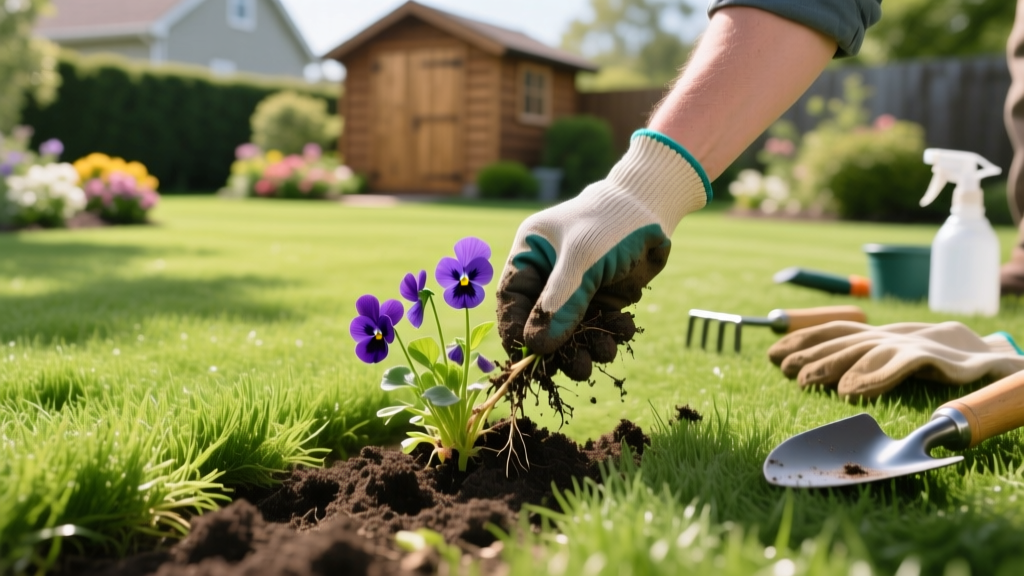
How to Kill Wild Violets in Lawn: Step-by-Step Eradication Guide
Wild violets (Viola sororia and Viola papilionacea) are aggressive perennial broadleaf weeds that rapidly colonize thin, acidic, or compacted turfgrass. Unlike annual weeds that die off in winter, wild violets in lawn environments survive via deep rhizomatous root systems and hidden self-pollinating seeds. Eradicating them requires a precise combination of systemic herbicide chemistry, adjuvant surfactants, and strategic timing.
Why Wild Violets Are So Difficult to Kill
Homeowners often fail to eliminate wild violets because they treat them like standard broadleaf weeds such as dandelions. Violets possess three distinct biological defenses that require specialized maintenance procedures:
- Waxy Leaf Cuticle: The leaves of wild violets are coated in a thick, waxy substance that repels water-based liquid herbicides, causing the chemical to bead up and roll off onto the soil.
- Rhizomatous Root System: Violets spread horizontally underground via thick rhizomes. Hand-pulling usually snaps the brittle taproot, leaving the rhizome network intact to resprout within weeks.
- Cleistogamous Flowers: In addition to their showy purple or white spring flowers, violets produce tiny, hidden, self-pollinating flowers near the soil surface in late summer. These drop seeds directly into the thatch layer, ensuring a new generation even if you mow frequently.
Step 1: Identification and Lawn Assessment
Before mixing chemicals, confirm the infestation level and map the affected zones. Wild violets thrive in damp, shaded areas with poor soil drainage and low pH.
Visual Identification Markers
- Leaves: Heart-shaped, glossy green, with finely scalloped edges, growing in a basal rosette pattern.
- Flowers: Five-petaled blooms ranging from deep violet to white, often with dark veining on the lower petals.
- Growth Habit: Forms dense, low-growing mats that choke out surrounding turfgrass, typically measuring 4 to 8 inches in height.
Assess the density of the wild violets in lawn beds and turf. If the infestation covers less than 20% of your yard, spot treatment is the most cost-effective and environmentally sound approach. If coverage exceeds 30%, a broadcast application may be necessary, followed by aggressive fall overseeding.
Step 2: Selecting the Right Herbicide Chemistry
Standard 2,4-D herbicides will only burn the top growth of wild violets, resulting in rapid regrowth. To achieve total kill, your herbicide must contain Triclopyr, a systemic active ingredient that translocates down through the phloem to destroy the rhizomes. According to University of Minnesota Extension, combining Triclopyr with Dicamba or Carfentrazone provides the most reliable broadleaf control.
Active Ingredient Efficacy Matrix
| Active Ingredient | Efficacy on Violets | Mode of Action | Recommended Product Example |
|---|---|---|---|
| Triclopyr | High (Systemic) | Translocates to rhizomes, killing the root network | Ortho WeedClear, Monterey Triclopyr |
| Carfentrazone-ethyl | Medium (Contact) | Rapid cell membrane disruption (burns tops quickly) | PBI Gordon SpeedZone |
| Dicamba | Medium (Systemic) | Root and foliar absorption, best used in 3-way mixes | Most 3-Way Turf Herbicides |
| 2,4-D Amine | Low (Contact) | Only burns foliage; rhizomes will resprout | Southern Ag 2,4-D |
| Quinclorac | None | Effective on grassy weeds; useless on wild violets | Drive XLR8 |
Pro Selection: For consumer-grade applications, Ortho WeedClear for Lawns is highly effective because it explicitly includes Triclopyr alongside Quinclorac and Dicamba. For professional-grade results, a tank mix of Trimec 992 (2,4-D + MCPP + Dicamba) fortified with a separate Triclopyr ester provides superior cuticle penetration.
Step 3: Mixing and Applying with a Surfactant
Because of the waxy leaf cuticle, applying herbicide without a surfactant will result in a 70% failure rate. A Non-Ionic Surfactant (NIS) breaks the surface tension of the liquid, allowing the chemical to spread evenly and penetrate the leaf tissue.
Exact Mixing Ratios for a 1-Gallon Pump Sprayer
- Water Base: Fill the tank with 0.5 gallons of clean water.
- Herbicide: Add 1.5 fluid ounces of a Triclopyr-based concentrate (check specific label rates, as esters and amines differ in concentration).
- Surfactant: Add 0.25% to 0.5% v/v of NIS (approximately 1.5 to 2 teaspoons per gallon). Products like Southern Ag Surfactant or Hi-Yield Spreader Sticker cost around $15 for a 16 oz bottle.
- Agitation: Add the remaining 0.5 gallons of water and shake the tank vigorously to ensure a uniform emulsion.
Critical Application Rules: Never apply Triclopyr or Dicamba when daytime temperatures exceed 85°F. High heat causes the herbicide to vaporize, leading to phytotoxic drift that will severely damage neighboring trees, shrubs, and ornamental flowers. Apply during early morning or late evening when winds are below 5 MPH.
Use a backpack or handheld pump sprayer equipped with a flat fan nozzle (such as the TeeJet 8002VS). Calibrate the sprayer to 40 PSI to produce medium-sized droplets that ensure complete foliage coverage without excessive runoff into the soil profile. Lightly mist the violet leaves until they are uniformly wet, but not dripping.
Step 4: Post-Application Lawn Recovery and Prevention
Herbicide application is only half the procedure. As the Purdue University Turfgrass Science program notes, weeds are simply symptoms of poor turf density and unfavorable soil conditions.
Immediate Post-Care (Days 1 to 14)
- Mowing Delay: Wait a minimum of 48 hours before mowing to allow the herbicide to fully translocate into the rhizomes.
- Watering: Avoid overhead irrigation for 24 hours post-application to prevent washing the chemical off the leaves. If rainfall occurs within 6 hours, a reapplication may be necessary.
- Observation: Violets treated with Triclopyr and Carfentrazone will show severe epinasty (twisting and curling) within 48 hours, followed by complete necrosis in 14 to 21 days.
Long-Term Cultural Prevention
Wild violets are indicator weeds. Their presence strongly suggests your soil is compacted and acidic. To prevent future germination:
- Test Soil pH: Violets thrive in soil with a pH below 6.0. Conduct a soil test and apply pelletized limestone at a rate of 40-50 lbs per 1,000 sq ft to raise the pH to the optimal 6.5 - 7.0 range for turfgrass.
- Core Aeration: Perform deep-tine core aeration in the fall to alleviate the soil compaction that suffocates grass roots but favors violet rhizomes.
- Overseeding: Once the violet mats have died back, rake out the dead debris and overseed with a shade-tolerant, aggressive grass blend (such as Kentucky Bluegrass or Fine Fescue) at a rate of 4 to 6 lbs per 1,000 sq ft to outcompete new weed seedlings.
Frequently Asked Questions
Will horticultural vinegar kill wild violets?
No. While 20% or 30% horticultural vinegar will rapidly burn the foliage of wild violets due to its high acetic acid content, it possesses no systemic properties. The rhizomes will remain entirely unaffected, and the weeds will resprout within two weeks. Furthermore, repeated vinegar applications severely lower soil pH, which actually creates a more favorable environment for future violet growth.
Can I just pull wild violets by hand?
Hand-pulling is only viable for isolated, newly sprouted seedlings. For established plants, you must use a specialized weeding tool, such as a Fiskars Stand-Up Weeder or a dandelion digger, to extract the root system at least 4 inches deep into the soil. If the white, fleshy rhizome snaps off in the ground, the plant will regenerate.
Are wild violets edible or beneficial to the lawn?
Wild violet leaves and flowers are technically edible and contain high levels of Vitamin C, often used in salads or syrups. However, you must never consume them if they have been treated with synthetic herbicides. Ecologically, they provide early spring nectar for pollinators like fritillary butterflies. If you choose to keep them in designated garden beds, maintain a strict 2-foot mulched buffer zone to prevent their rhizomes from creeping into your turfgrass.
When is the absolute best time to treat them?
Early to mid-fall (late September through early November) is the optimal treatment window. During this period, perennial weeds are actively pulling carbohydrates down into their root systems to prepare for winter dormancy. This downward physiological flow pulls the systemic Triclopyr herbicide directly into the rhizomes, ensuring a complete root kill before the next spring.

