
Lawn Care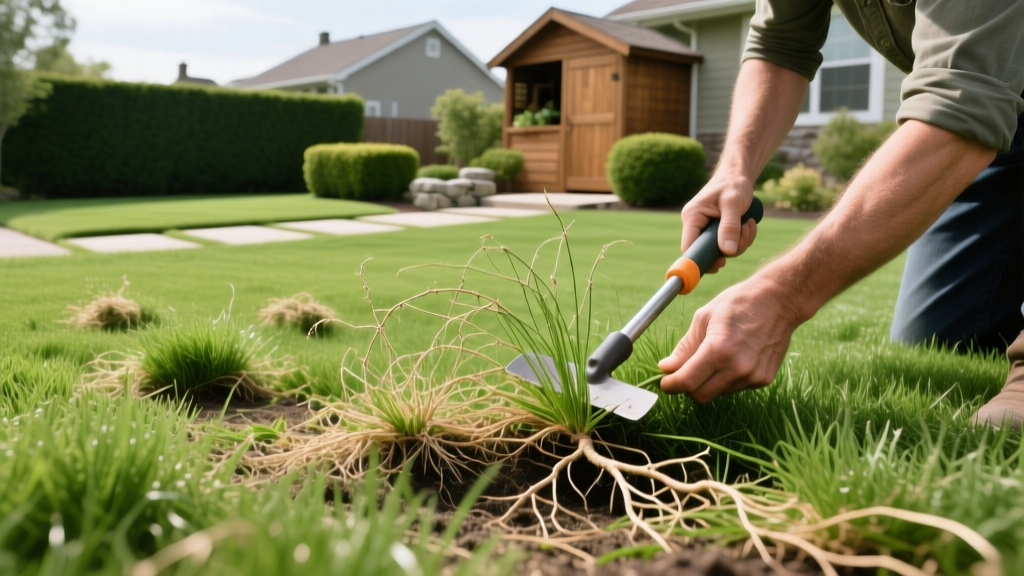
Step-by-Step Guide to Eradicating Wiregrass in Home Lawns
The 'Wiregrass' Identity Crisis: What Are You Actually Fighting?
In turfgrass management, the colloquial term 'wiregrass' causes significant confusion among homeowners. It is most frequently used to describe Goosegrass (Eleusine indica), a notoriously tough summer annual weed. It earns the 'wiregrass' nickname because of its flattened, silver-white stem base that feels like a stiff wire and resists being pulled by hand. Less commonly, some homeowners use the term to describe invasive Bermudagrass (Cynodon dactylon) due to its wiry, above-ground stolons.
This step-by-step eradication protocol focuses on the most common and frustrating culprit: Goosegrass. Unlike crabgrass, which germinates in early spring, goosegrass requires warmer soil temperatures and typically emerges in late spring to early summer. Its tough, wiry base allows it to survive close mowing, and its prolific seed production ensures it will return the following year if left unchecked. According to turf researchers at Penn State Extension, goosegrass is highly adaptable to compacted soils where desirable turf struggles to compete.
Expert Identification Tip: Pull a suspect weed from the soil. If the base of the stem is distinctly white or silver, flattened, and feels wiry to the touch, you are dealing with goosegrass. If the seedhead resembles a zipper with seeds arranged in distinct rows, this confirms the identification.
Phase 1: Pre-Emergent Defense (Early Spring)
Because goosegrass germinates later than crabgrass, a standard early-spring pre-emergent application often degrades before the wiregrass seeds sprout. A split-application strategy is mandatory for effective control.
- Monitor Soil Temperatures: Goosegrass germination triggers when soil temperatures at a 2-inch depth reach 60°F to 65°F for consecutive days. Use a digital soil probe thermometer rather than relying on air temperature.
- First Application (Crabgrass Timing): Apply a standard pre-emergent like Prodiamine 65 WDG (Barricade) at a rate of 0.5 oz per 1,000 square feet when soil temps hit 55°F. This establishes a baseline barrier.
- Second Application (Goosegrass Timing): Apply Dithiopyr (Dimension) at 0.5 oz per 1,000 square feet roughly 6 to 8 weeks later, just as soil temps approach 60°F. Dimension is unique because it offers early post-emergent control, meaning it will kill goosegrass seedlings even if they have already sprouted and reached the 1-leaf stage.
- Watering In: Pre-emergents require 0.25 to 0.5 inches of irrigation or rainfall within 48 hours to activate the chemical barrier in the top inch of the soil profile.
Phase 2: Post-Emergent Eradication (Summer)
If the wiry stems break through your pre-emergent barrier, or if you are dealing with a mature infestation in July or August, you must switch to selective post-emergent herbicides. The correct chemistry depends entirely on your turf type. Using the wrong chemical will result in severe turf phytotoxicity or complete failure to kill the weed.
Selective Herbicide Comparison Matrix
| Active Ingredient | Brand Example | Safe For (Turf Type) | Application Rate (per 1,000 sq ft) | Adjuvant Required? |
|---|---|---|---|---|
| Fenoxaprop-p-ethyl | Acclaim Extra | Cool-season (Fescue, Bluegrass, Ryegrass) | 0.4 fl oz | No |
| Topramezone | Pylex | Cool-season (Fescue, Bluegrass) | 0.011 fl oz | Yes (MSO + Urea) |
| Thiencarbazone + Iodosulfuron + Dicamba | Celsius WG | Warm-season (Bermuda, Zoysia, St. Augustine) | 0.06 oz (dry) | Yes (Non-ionic surfactant) |
| Quinclorac | Drive XLR8 | Cool-season & Bermuda (Check label for Zoysia) | 0.5 fl oz | Yes (Methylated Seed Oil) |
⚠️ WARNING Regarding MSMA: Older lawn care guides often recommend MSMA for wiregrass control. As of recent EPA regulations, MSMA is heavily restricted and largely unavailable for residential home lawn use. Furthermore, MSMA causes severe phytotoxicity to cool-season grasses and can damage warm-season grasses if applied when temperatures exceed 85°F. Stick to the modern chemistries listed above.
For cool-season lawns, Acclaim Extra is the gold standard. It specifically targets grassy weeds without harming tall fescue or Kentucky bluegrass. Apply it when the goosegrass is young and actively growing. If the weed has matured and developed its signature wiry base, a second application 14 days later is usually required to achieve complete necrosis.
Phase 3: Cultural Maintenance to Prevent Return
Herbicides only treat the symptom. Goosegrass thrives in environments where desirable turf is weak. According to weed management protocols outlined by NC State Turfgrass Science, altering the lawn's physical environment is the most sustainable long-term defense.
- Relieve Soil Compaction: Goosegrass has a massive competitive advantage in heavily compacted soils where turfgrass roots cannot penetrate for oxygen and water. Perform core aeration in the fall (for cool-season grasses) or late spring (for warm-season grasses) to pull 3-inch soil plugs and alleviate compaction.
- Optimize Mowing Heights: Mowing too short scalps the lawn, allowing sunlight to reach the soil surface and trigger goosegrass seed germination. Maintain Tall Fescue at 3.0 to 4.0 inches, and Bermudagrass at 1.5 to 2.0 inches. A dense turf canopy acts as a natural, living pre-emergent by shading out weed seeds.
- Fix Drainage Issues: Goosegrass tolerates both extreme drought and poor drainage better than many turf species. Regrade low spots where water pools, and incorporate topdressing with compost to improve soil percolation.
Troubleshooting Common Wiregrass Control Failures
Why did my pre-emergent fail to stop the wiregrass?
Pre-emergent failure almost always comes down to timing or application errors. If you applied Prodiamine in early April but the goosegrass emerged in late June, the chemical barrier had likely degraded. Goosegrass requires a later, secondary application (the split-app method). Additionally, if you applied a liquid pre-emergent and it rained heavily the next day before it could bind to the soil organic matter, the active ingredient may have washed away.
Why is the post-emergent spray turning the weed white but not killing it?
If you used Topramezone (Pylex), the active ingredient is an HPPD inhibitor. It works by stopping chlorophyll production, causing the weed to turn stark white or pink before it eventually starves and dies. This bleaching effect is normal and indicates the herbicide is working. Do not reapply immediately; wait 14 to 21 days for the root system to fully exhaust its energy reserves and die.
Can I just pull wiregrass by hand?
For isolated patches of fewer than 10 plants, hand-pulling is viable, but you must use a weeding tool like a dandelion digger to extract the deep taproot. If you simply yank the wiry leaves, the stem will snap at the white base, leaving the crown and root intact in the soil. The plant will regenerate new shoots within 7 to 10 days.

