
Lawn Care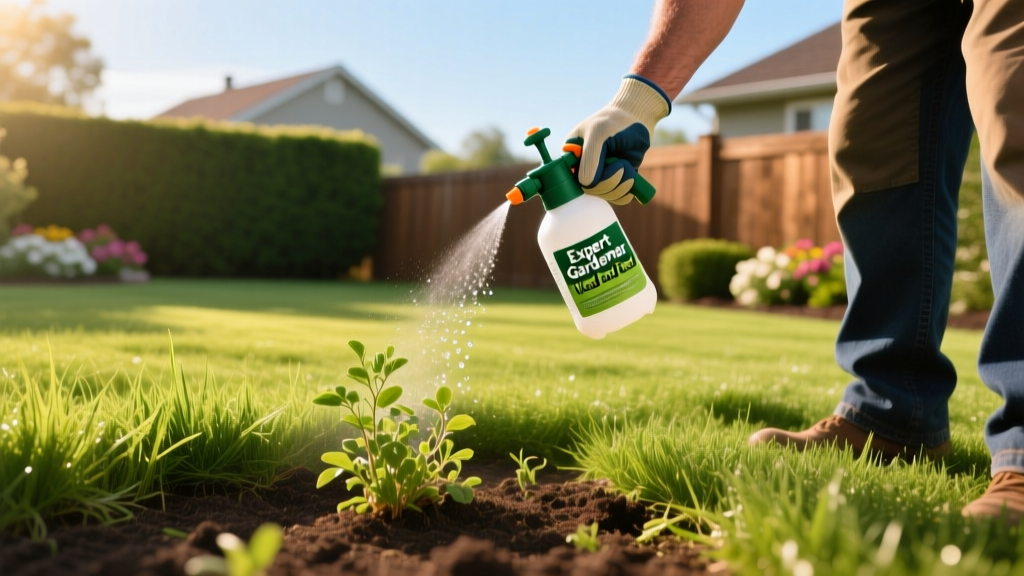
Using Expert Gardener Weed and Feed for Spot Treatment: A Guide
The Broadcast vs. Spot-Treatment Conflict
Expert Gardener Weed and Feed is a staple in big-box garden centers, offering an affordable, dual-action approach to lawn maintenance. Typically formulated with a high-nitrogen fertilizer base (often a 28-0-3 or 20-0-0 NPK ratio) and a three-way broadleaf herbicide blend (2,4-D, Mecoprop-p, and Dicamba), it is engineered for broadcast application across an entire lawn. However, when homeowners attempt to use granular Expert Gardener Weed and Feed for localized spot-treatments on isolated weed patches, they encounter severe chemical and agronomic inefficiencies.
Spot-treating requires precision delivery of an active ingredient directly to the weed's foliage or root zone without disrupting the surrounding turf. Granular weed and feed products rely on granules sticking to wet weed leaves and then being watered into the soil. Piling these granules onto a single dandelion or cluster of clover results in a massive localized overdose of soluble nitrogen and synthetic auxins. This almost guarantees fertilizer burn to the surrounding desirable grass, leaving a brown, dead ring around the very weed you were trying to eliminate.
WARNING: Nitrogen Burn Risk
Applying granular weed and feed at concentrations higher than the labeled broadcast rate (typically 2.8 lbs per 1,000 sq ft) will cause rapid osmotic stress and desiccation in cool-season grasses like Kentucky Bluegrass and Tall Fescue. Never mound granular products onto individual weeds.
Weed Species Identification and Targeted Chemistry
To effectively spot-treat, you must first identify the weed species and match it to the correct herbicide chemistry. The standard Expert Gardener Weed and Feed formula targets broadleaf weeds but is entirely ineffective against grassy weeds and sedges. Below is a decision matrix for common lawn invaders and the appropriate spot-treatment strategy.
| Weed Species | Classification | Standard W&F Efficacy | Correct Spot-Treatment Active Ingredient |
|---|---|---|---|
| Dandelion (Taraxacum officinale) | Broadleaf Perennial | High (if granules adhere) | 2,4-D + Dicamba (Liquid) |
| White Clover (Trifolium repens) | Broadleaf Perennial | Moderate | MCPP + Dicamba (Liquid) |
| Crabgrass (Digitaria) | Grassy Annual | None | Quinclorac (Liquid) |
| Yellow Nutsedge (Cyperus esculentus) | Sedge Perennial | None | Sulfentrazone or Halosulfuron |
The Liquid Alternative: Expert Gardener Lawn Weed Killer Concentrate
For true spot-treatment, abandon the granular Weed and Feed and switch to a liquid selective herbicide. Expert Gardener offers a liquid concentrate (often labeled as Lawn Weed Killer or Weed Control) that utilizes similar active ingredients but in an ester or amine liquid formulation designed for foliar absorption. Liquid applications bypass the soil-bound nitrogen burn risk and deliver the herbicide directly to the weed's vascular system.
Step-by-Step Liquid Spot-Spraying Protocol
- Calibrate Your Sprayer: Use a 1-gallon or 2-gallon pump sprayer equipped with a flat-fan nozzle (not a cone nozzle). A flat-fan nozzle produces a uniform spray pattern that minimizes drift onto desirable ornamental plants.
- Mix the Surfactant First: Herbicides struggle to penetrate the waxy cuticle of mature weeds. Add a non-ionic surfactant (NIS) at a rate of 1 teaspoon per gallon of water. This breaks the surface tension of the water, allowing the chemical to spread and adhere to the leaf surface.
- Add the Herbicide: Pour the liquid Expert Gardener concentrate into the tank. The standard spot-treatment mixing ratio is typically 2.5 fluid ounces of concentrate per gallon of water, which treats approximately 1,000 square feet. For isolated spot-treatments of just a few weeds, mix 0.75 fluid ounces per quart of water.
- Monitor Temperature and Wind: Apply only when ambient temperatures are between 60°F and 85°F. According to the Environmental Protection Agency (EPA), ester-based 2,4-D and Dicamba formulations are prone to volatilization (turning into a gas) at temperatures above 85°F, which can drift and severely damage nearby tomato plants, grapes, and flowering shrubs. Wind speeds must be below 5 mph.
- Spray to Wet, Not Drench: Apply a fine mist directly to the weed until the leaves are visibly wet but not dripping. Drenching the soil wastes the product and increases the risk of root uptake by surrounding turfgrass.
Cost Comparison: Broadcast Granular vs. Targeted Liquid
Homeowners often default to granular weed and feed because it feels like a 'two-in-one' value. However, when dealing with localized weed infestations (covering less than 15% of the total lawn area), the economics heavily favor liquid spot-treatments.
Financial Breakdown (2026 Pricing Estimates)
- Granular Weed & Feed (14 lb bag): ~$22.00. Covers 5,000 sq ft. Cost per sq ft = $0.0044. If your weeds only occupy 200 sq ft, you are spending $22.00 and over-fertilizing 4,800 sq ft of healthy grass, potentially causing excessive thatch buildup and requiring more frequent mowing.
- Liquid Weed Killer Concentrate (32 oz bottle): ~$14.00. Yields up to 16 gallons of mixed solution, covering roughly 16,000 sq ft. Cost per sq ft = $0.0008. Spot-treating 200 sq ft costs roughly $0.16 in chemical product.
Conclusion: Liquid spot-treating is approximately 5.5 times more cost-effective per square foot of treated area and prevents unnecessary nitrogen loading on healthy turf.
Environmental and Soil Health Considerations
Repeated use of broadleaf weed and feed products, whether granular or liquid, introduces synthetic auxins into the soil profile. While 2,4-D and Dicamba have relatively short soil half-lives (typically 7 to 14 days), frequent applications can disrupt the soil microbiome and mycorrhizal fungi networks essential for turfgrass drought tolerance. Penn State Extension recommends integrating cultural controls—such as proper mowing heights (3.0 to 3.5 inches for cool-season grasses) and deep, infrequent irrigation—to naturally shade out weed seedlings and reduce reliance on chemical herbicides.
Furthermore, spot-treating with liquid herbicides drastically reduces the total volume of active ingredient introduced into the local watershed compared to broadcast applications. By limiting Dicamba use to only the areas where broadleaf weeds are actively growing, you minimize the risk of runoff during heavy spring rain events.
Frequently Asked Questions
Can I dissolve Expert Gardener granular weed and feed in water to make a liquid spot-spray?
No. Granular formulations contain inert carriers (like clay or sand) and slow-release nitrogen coatings that will not dissolve in water. Attempting to mix them in a pump sprayer will clog the filter and nozzle, and the resulting slurry will not provide uniform herbicide distribution.
How long after spot-treating with liquid herbicide can I water my lawn?
Wait at least 24 hours after application before irrigating or allowing rainfall. This ensures the systemic herbicide has fully translocated through the weed's phloem and reached the root crown. Watering too soon will wash the chemical off the foliage, rendering the treatment useless.
Will Expert Gardener Weed and Feed kill crabgrass?
Standard broadleaf Weed and Feed formulas will not kill crabgrass. Crabgrass is an annual grassy weed that requires a pre-emergent barrier (like Prodiamine or Dithiopyr) in early spring, or a post-emergent spot-treatment containing Quinclorac once it has germinated.

