
Lawn Care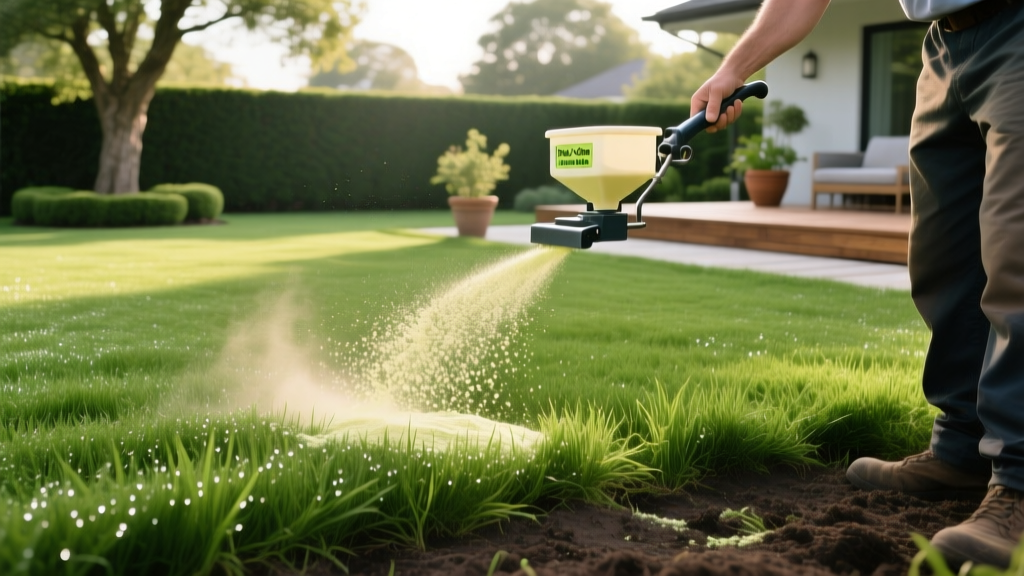
Fast Acting Lime for Lawns: Application Rates and Soil pH Fixes
The Chemistry of Fast Acting Lime vs. Traditional Aglime
When turfgrass soil pH drops below 6.0, essential macronutrients like nitrogen, phosphorus, and potassium become chemically bound to soil particles, rendering them inaccessible to grass roots. Traditional agricultural lime (aglime) corrects this, but its coarse 20- to 40-mesh particle size means it can take 6 to 12 months to fully react with soil acidity. Fast acting lime solves this timeline problem through mechanical micronization.
Fast acting lime is manufactured by grinding calcium carbonate (CaCO3) or dolomitic limestone into a micro-fine powder—typically 80- to 100-mesh (149 to 177 microns). This powder is then bound with organic polymers or water-soluble resins into lightweight, dust-free pellets. When these pellets hit moisture from irrigation or rain, they instantly dissolve back into their micro-fine state, exponentially increasing the surface area available to neutralize hydrogen ions in the soil profile. While traditional lime alters pH over a full growing season, fast acting variants begin shifting soil chemistry within 14 to 21 days.
Data Highlight: Surface Area Multiplier
A single pound of 20-mesh traditional lime contains roughly 10,000 individual particles. A single pound of 100-mesh fast acting lime contains over 1,000,000 particles. This 100x increase in reactive surface area is why application rates for fast acting lime are often 30% to 50% lower by weight than traditional aglime for the same immediate pH shift.
A single pound of 20-mesh traditional lime contains roughly 10,000 individual particles. A single pound of 100-mesh fast acting lime contains over 1,000,000 particles. This 100x increase in reactive surface area is why application rates for fast acting lime are often 30% to 50% lower by weight than traditional aglime for the same immediate pH shift.
Fast Acting Lime vs. Traditional Pelletized Lime
Choosing between standard and fast-acting formulations depends on your lawn's current buffer pH, your budget, and your renovation timeline. Use the comparison matrix below to determine which amendment fits your specific soil amendment strategy.
| Feature | Traditional Aglime (20-40 Mesh) | Fast Acting Lime (80-100 Mesh) |
|---|---|---|
| Reaction Time | 6 to 12 months | 14 to 28 days |
| Residual Longevity | 2 to 3 years | 6 to 12 months |
| Average Cost (30-40 lb bag) | $6.00 - $9.00 | $16.00 - $24.00 |
| Best Use Case | Fall maintenance, new construction | Pre-seeding, emergency pH rescue |
| Spreader Calibration | Standard settings | Requires specific low-rate settings |
Step-by-Step Application Guide for Correcting pH
Applying lime without a soil test is a guess that can lead to nutrient lockout. High pH (alkaline soil) causes iron chlorosis, turning turfgrass pale yellow while veins remain green. Follow this precise protocol to ensure accurate amendment.
Step 1: Secure a Lab-Grade Soil Test
Do not rely on cheap digital pH probes from big-box stores; they measure active acidity but ignore reserve acidity (buffer pH). Send a composite soil sample (10-15 cores taken at a 3-inch depth) to a certified lab like Penn State Extension's Agricultural Analytical Services Lab or Waypoint Analytical. You must request the SMP or Adams-Evans Buffer pH test. The buffer pH tells the lab how much calcium carbonate is required to neutralize the soil's cation exchange sites.
Step 2: Calculate Exact Poundage Based on CEC
Your soil's Cation Exchange Capacity (CEC) dictates lime requirements. Sandy soils (CEC < 10) have low buffering capacity and require less lime to shift pH, but they lose it faster. Heavy clays (CEC > 25) act like a sponge for hydrogen ions and require massive amounts of lime to force a change. If your lab report recommends 50 lbs of traditional aglime per 1,000 sq ft, you will typically apply 25 to 30 lbs of fast acting lime to achieve the same immediate 0.5 pH point increase.
Step 3: Spreader Calibration and Application
- Check Moisture: Apply fast acting lime to damp soil or immediately before a scheduled 0.5-inch irrigation cycle. The pellets must dissolve to activate.
- Set the Spreader: Because fast acting lime pellets are lighter and less dense than traditional limestone, using a standard aglime setting will under-apply the product. Consult the specific bag's calibration chart. For example, a Scotts Elite spreader typically requires a setting of 5.5 for Pennington Fast Acting Lime, compared to 7.0 for standard pelletized lime.
- Split Heavy Applications: Never apply more than 50 lbs of fast acting lime per 1,000 sq ft in a single pass. High concentrations of dissolving calcium can cause localized osmotic stress, burning turfgrass crowns. If your soil test calls for 80 lbs per 1,000 sq ft, apply 40 lbs, water it in, wait 14 days, and apply the remaining 40 lbs.
Warning: The Dolomitic vs. Calcitic Trap
Fast acting lime is available in both calcitic (high calcium) and dolomitic (calcium + magnesium) forms. If your soil test shows magnesium levels above 150 ppm, applying dolomitic lime will cause calcium-magnesium antagonism, locking out calcium and leading to poor root development and soil flocculation failure. Always match the lime type to your soil's specific Mg:Ca ratio.
Fast acting lime is available in both calcitic (high calcium) and dolomitic (calcium + magnesium) forms. If your soil test shows magnesium levels above 150 ppm, applying dolomitic lime will cause calcium-magnesium antagonism, locking out calcium and leading to poor root development and soil flocculation failure. Always match the lime type to your soil's specific Mg:Ca ratio.
Real-World Product Breakdown and Pricing
The soil amendment market has consolidated around a few highly engineered fast-acting formulations. Here is how the top contenders perform in real-world turf management scenarios.
- Pennington Fast Acting Lime (30 lb bag, ~$18): Utilizes Astrocide technology (a proprietary binder) to ensure rapid breakdown. Excellent for cool-season fescue lawns requiring a quick pH bump before fall overseeding. Coverage is rated at 5,000 sq ft for maintenance, but only 1,500 sq ft for heavy correction (pH below 5.5).
- Jonathan Green MAG-I-CAL (30 lb bag, ~$26): Technically a calcium carbonate amendment enhanced with humic acids. The humates help chelate locked nutrients while the calcium displaces sodium and hydrogen. It is significantly more expensive but provides dual-action soil conditioning, making it ideal for compacted, high-sodium soils.
- Sta-Green Fast Acting Lime (30 lb bag, ~$14): A budget-friendly option often found at regional hardware chains. The mesh size is slightly coarser (closer to 60-mesh) than premium brands, meaning it takes closer to 30 days to fully react, but it remains vastly superior to traditional aglime for spring applications.
Edge Cases: When Fast Acting Lime Fails
Even micro-fine calcium carbonate cannot overcome severe physical soil barriers. If your lawn suffers from a 2-inch thatch layer, the dissolving lime will bind to the thatch organic matter and never reach the mineral soil where root exchange occurs. You must perform core aeration or dethatching before applying fast acting lime.
Furthermore, if your soil is highly acidic due to constant ammonium-based fertilizer use (like ammonium sulfate), the soil's reserve acidity may be so deep that fast acting lime only treats the top 1.5 inches of the profile. In these scenarios, deep-tine aeration followed by a liquid calcium suspension (like calcium gluconate) injected into the soil profile is required to treat the subsoil before relying on granular fast acting lime for the topsoil.
Frequently Asked Questions
Can I apply fast acting lime and synthetic fertilizer at the same time?
Yes, but avoid mixing it directly in the spreader hopper with ammonium-based fertilizers. The calcium carbonate will react with the ammonium, releasing ammonia gas and wasting your nitrogen. Apply the fertilizer first, water it in, and apply the fast acting lime 48 hours later.
How long after applying fast acting lime can I overseed?
Because fast acting lime shifts pH rapidly without the caustic heat associated with hydrated lime, you can safely overseed 7 to 10 days after application and a thorough watering. This is a massive advantage over traditional lime, which requires waiting until the next seasonal transition to avoid seedling stress.

