
Lawn Care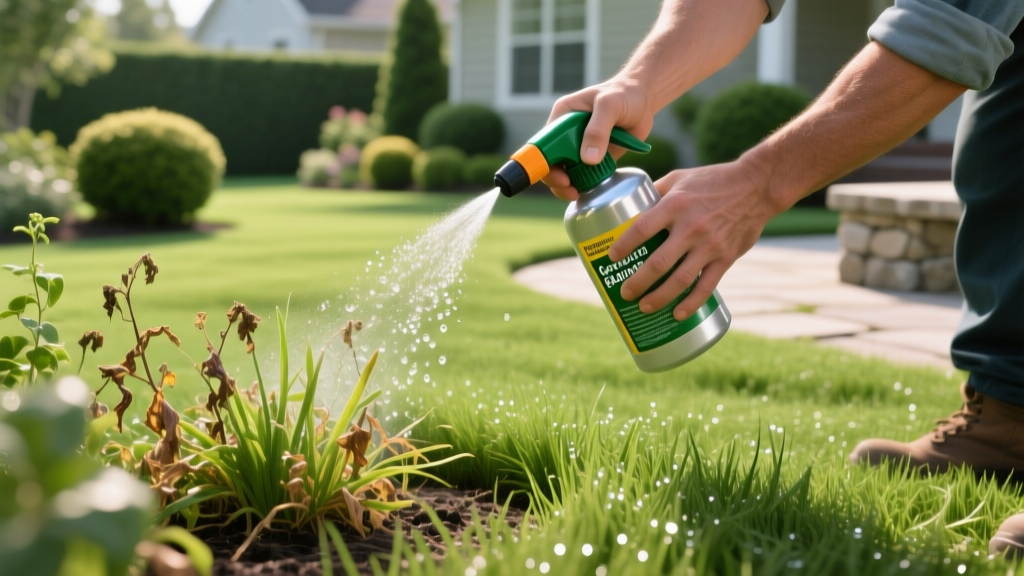
Fast-Acting Weed and Grass Killer: Spot Treatment Guide
The Science of Rapid Desiccation: How Non-Selective Herbicides Work
When managing hardscape edges, fence lines, or eradicating invasive rhizomatous grasses like Bermudagrass (Cynodon dactylon) and Quackgrass (Elymus repens) from a cool-season lawn, a fast acting weed and grass killer is mandatory. These non-selective herbicides do not differentiate between desirable turf and target weeds; they destroy all green tissue they contact. Understanding the biochemical pathways these active ingredients exploit is critical for achieving complete root kill without wasting product or causing unnecessary environmental exposure.
The speed of a herbicide is dictated by its mode of action. Contact herbicides destroy cell membranes upon exposure, yielding visible browning in minutes but often failing to kill deep root systems. Systemic herbicides translocate through the plant's phloem to the roots, taking longer to show visual symptoms but providing permanent eradication. For professional-grade spot treatments, selecting the right chemistry based on the target species and environmental conditions is the difference between a one-time application and a recurring infestation.
Active Ingredient Breakdown: Speed, Efficacy, and Cost
The market is saturated with consumer-grade 'weed and grass killers,' but professional turf managers rely on concentrated active ingredients calibrated for specific failure modes. Below is a technical breakdown of the four primary non-selective chemistries used for spot treatments.
1. Glyphosate (41% SL Formulation)
Glyphosate inhibits the EPSP synthase enzyme, halting the synthesis of essential aromatic amino acids. It is the gold standard for systemic root kill. While not the 'fastest' in terms of visual browning (typically 5 to 7 days for initial yellowing, 14 days for complete necrosis), it is unmatched for killing deep-rooted perennials like Johnsongrass and Dallisgrass. A 2.5-gallon jug of 41% generic glyphosate concentrate costs between $45 and $60, yielding thousands of gallons of finished spray solution at standard 1% to 2% v/v spot-treatment rates.
2. Pelargonic Acid (Scythe)
Pelargonic acid is a C9 fatty acid that strips the waxy cuticle from leaves, causing immediate cellular leakage and desiccation. You will see browning within 15 to 30 minutes of application, making it the true 'fast acting' option for immediate visual results. However, it is strictly a contact herbicide. It will burn the tops off mature weeds but will not translocate to kill rhizomes or taproots. Expect to pay $80 to $110 per gallon for commercial formulations.
3. Diquat (Reward)
Diquat is a bipyridylium compound that disrupts Photosystem I, generating destructive free radicals within the plant cells upon exposure to sunlight. It acts faster than glyphosate (visible wilting in 24 hours) and has limited systemic movement. It is highly effective for spot-treating annual grasses and broadleaf weeds in cooler temperatures where glyphosate translocation slows down. Commercial concentrate pricing averages $120 to $150 per gallon.
4. Glufosinate-ammonium (Finale)
Glufosinate inhibits glutamine synthetase, leading to ammonia accumulation and cell death. It bridges the gap between contact speed (2 to 3 days for visual browning) and systemic root kill. It is particularly effective on tough broadleaf weeds and certain grassy weeds that have developed glyphosate resistance, such as Annual Ryegrass and Palmer Amaranth. Pricing sits around $90 per gallon.
Spot-Treatment Decision Matrix
Use the following matrix to select the correct fast acting weed and grass killer based on your specific site conditions and target species.
| Active Ingredient | Visual Speed | Root Kill (Systemic) | Best Target Species | Ideal Temperature Range | Rainfast Period |
|---|---|---|---|---|---|
| Glyphosate 41% | 5-7 Days | Excellent | Bermudagrass, Quackgrass, Dallisgrass | 65°F - 85°F | 2 Hours |
| Pelargonic Acid | 15-30 Mins | Poor (Contact Only) | Annual broadleaves, seedling grasses | 50°F - 90°F | 15 Minutes |
| Diquat | 24-48 Hours | Moderate | Annual grasses, Poa annua, Chickweed | 45°F - 75°F | 30 Minutes |
| Glufosinate | 2-3 Days | Good | Resistant broadleaves, Annual Ryegrass | 60°F - 85°F | 4 Hours |
⚠️ WARNING: Non-Selective Drift Hazards
Because these products are non-selective, any spray drift onto desirable turfgrass will cause necrosis. Never use a high-pressure cone nozzle for spot treatments. Always use a low-pressure (30-40 PSI) flat fan nozzle, keep the wand within 12 inches of the target weed, and avoid spraying when wind speeds exceed 5 mph.
Step-by-Step Application Protocol for Maximum Efficacy
Achieving rapid, complete kill requires more than just spraying the leaves. Follow this calibration and application protocol to prevent the most common failure modes associated with non-selective herbicides.
Step 1: Water Conditioning and Tank Mixing
Hard water contains calcium and magnesium cations that bind to glyphosate and glufosinate molecules, rendering them inactive before they even enter the plant. If your local water supply exceeds 150 ppm in hardness, you must add a water conditioner.
- Ammonium Sulfate (AMS): Add 1 ounce of AMS per 3 gallons of water (or 1-2 lbs per 100 gallons) to the tank before adding the herbicide. This saturates the hard water ions, leaving the herbicide molecules free to penetrate the leaf cuticle.
- Surfactant Addition: Most commercial 41% glyphosate formulations include a surfactant, but adding a Non-Ionic Surfactant (NIS) at 0.25% v/v (1 teaspoon per gallon) ensures optimal leaf coverage. For Pelargonic acid, use a Crop Oil Concentrate (COC) at 1% v/v to drive the fatty acid through thick, waxy cuticles.
Step 2: Nozzle Selection and Calibration
For spot treatments using a 2-gallon hand-pump sprayer, install a TeeJet 8002VS flat fan nozzle. Pump the sprayer to exactly 30 to 40 PSI (most hand pumps have a pressure relief valve that pops at 40 PSI). This pressure generates medium-to-coarse droplets that resist wind drift while providing uniform coverage. Spray the weed until the leaves are uniformly wet, but stop before the liquid begins to drip off the tips (the point of runoff).
Step 3: The 'Wicking' Technique for Tall Invasive Grasses
When spot-treating tall invasive grasses like Johnsongrass or tall fescue clumps in a desirable, shorter lawn (e.g., Zoysia or hybrid Bermuda), spraying will inevitably hit the good grass. Instead, use the wicking method:
- Mix a 10% v/v solution of glyphosate in a small container.
- Put on a heavy-duty nitrile glove, then pull a 100% cotton work glove over it.
- Dip the cotton glove into the solution until damp, not dripping.
- Wipe your hand down the leaves of the tall invasive grass, coating the top and bottom of the leaf blades.
- The herbicide translocates to the roots of the tall weed without contacting the shorter, desirable turf below.
Common Failure Modes and Troubleshooting
If your fast acting weed and grass killer fails to eradicate the target, diagnose the issue using these common edge cases:
Failure Mode 1: Mowing Before Application
The Error: Mowing the lawn and immediately spot-spraying the weeds. Systemic herbicides like glyphosate require adequate leaf surface area to absorb and translocate the chemical down to the rhizomes. If you remove 50% of the weed's foliage with a mower, you remove 50% of the herbicide's entry points.
The Fix: Wait at least 5 to 7 days after mowing before applying systemic herbicides, allowing the target weed to regenerate sufficient leaf tissue.
Failure Mode 2: Drought-Stressed Weeds
The Error: Spraying during a late-summer drought. When weeds are moisture-stressed, they close their stomata and halt phloem translocation to conserve water. The herbicide sits in the leaves and degrades without reaching the roots.
The Fix: Irrigate the target area heavily 24 hours before application. Spray the herbicide the following morning when the plant is fully turgid and actively translocating sugars to the roots.
Post-Treatment Soil and Turf Recovery
When using a non-selective weed and grass killer in a lawn setting, you are intentionally creating dead zones that require renovation. Understanding the soil residual activity of your chosen chemistry dictates your overseeding timeline.
According to turf management guidelines from Texas A&M AgriLife Extension, glyphosate binds tightly to soil particles upon contact, rendering it biologically inactive. It relies entirely on foliar absorption. Once the target weed has completely browned (typically 10 to 14 days post-application), the soil is safe for seed-to-soil contact. You can core aerate, drop seed, and apply starter fertilizer immediately after the 14-day necrosis window without risking seedling phytotoxicity.
Pelargonic acid, conversely, has zero soil residual activity. Because it only destroys living cell membranes on contact and breaks down rapidly via microbial action, you can rake out the dead debris and overseed the spot the exact same day the foliage dries. For comprehensive safety protocols and environmental handling of these chemistries, always consult the EPA's official guidelines on weed control and pesticide safety.
By matching the active ingredient to the specific weed biology, conditioning your water, and utilizing precise application techniques, you transform a generic 'weed killer' into a highly calibrated tool for total landscape control.

