
Lawn Care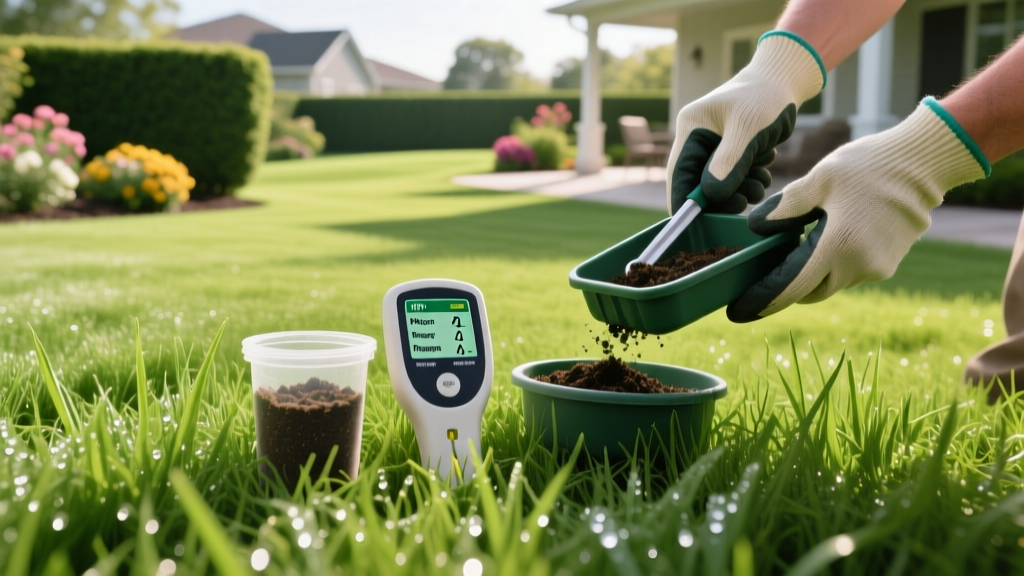
When and How to Feed Grass Based on Soil Test Results
Blindly broadcasting fertilizer is the most common financial and ecological mistake in lawn maintenance. To properly feed grass, you must treat your soil as a chemical battery. If the battery is full or the terminals are corroded, adding more power does nothing but cause runoff and turf burn. True lawn nutrition requires aligning your N-P-K inputs with your soil's Cation Exchange Capacity (CEC), pH buffer, and the specific metabolic cycles of your grass species.
Core Principle: Never feed grass based on a calendar date alone. Soil temperature, moisture levels, and recent Mehlich-3 soil test data must dictate your application rate and formula.
Decoding Your Soil Test to Feed Grass Accurately
Before purchasing any granular or liquid amendments, submit a core sample to a university extension lab. You need three specific data points to build a feeding strategy:
1. Soil pH and Buffer Index
Nutrient lockout occurs when pH is unbalanced. If your soil pH drops below 5.8, essential macronutrients like phosphorus bind to aluminum and iron, becoming completely unavailable to grass roots. Conversely, a pH above 7.5 locks out micronutrients like iron and manganese, causing severe chlorosis (yellowing).
- Cool-Season Grasses (Kentucky Bluegrass, Tall Fescue): Target pH 6.2 to 6.8.
- Warm-Season Grasses (Bermuda, Zoysia, Centipede): Target pH 5.8 to 6.5. (Note: Centipedegrass will suffer iron chlorosis if pH exceeds 6.5).
2. Cation Exchange Capacity (CEC)
CEC measures your soil's ability to hold onto positively charged nutrients (like potassium, calcium, and magnesium). It is measured in milliequivalents per 100 grams (meq/100g).
- Sandy Soils (CEC 3-8): Leach nutrients rapidly. You must feed grass using frequent, light applications (e.g., 0.5 lbs of Nitrogen per 1,000 sq ft every 4 weeks) and rely heavily on slow-release organic sources.
- Clay/Loam Soils (CEC 15-30+): Act as a nutrient reservoir. You can apply heavier doses less frequently without risking leaching into the water table.
The N-P-K Matrix: Selecting the Right Granular Formula
When you feed grass, the three numbers on the bag represent the percentage by weight of Nitrogen (N), Phosphorus (P), and Potassium (K). Below is a breakdown of how to select formulations based on 2026 market pricing and turf needs.
| Nutrient | Primary Function | Product Example & Cost (2026) | Application Rule |
|---|---|---|---|
| Nitrogen (N) | Leaf blade growth, chlorophyll production, and overall turf density. | Milorganite (6-4-0) - ~$18 per 32lb bag. | Apply 2-4 lbs per 1,000 sq ft annually. Use 50%+ slow-release methylene urea to prevent burn. |
| Phosphorus (P) | Root system establishment and seedling energy transfer. | Scotts Starter Food (24-25-4) - ~$25 per 15lb bag. | Banned in many states for established lawns. Only apply if soil test shows < 20 ppm Mehlich-3 P. |
| Potassium (K) | Cell wall thickness, drought tolerance, and winter hardiness. | SunCo 0-0-25 Sulfate of Potash - ~$30 per 50lb bag. | Crucial for fall winterizers. Apply 1 lb K per 1,000 sq ft in late autumn to prep for freeze stress. |
Seasonal Timing: When to Feed Grass for Peak Uptake
The metabolic peaks of cool-season and warm-season grasses are diametrically opposed. Feeding the wrong grass at the wrong time promotes weed competition and disease.
Cool-Season Schedule (Fescue, Bluegrass, Ryegrass)
Cool-season grasses grow most aggressively when soil temperatures are between 50°F and 65°F. You should allocate 60% to 70% of your annual nitrogen budget to the fall.
- Late Spring (Memorial Day): Light application (0.5 lbs N/1,000 sq ft) using organic or slow-release nitrogen to sustain the plant into summer without forcing excessive top growth that depletes root reserves.
- Early Fall (Labor Day): Heavy application (0.8 to 1.0 lbs N/1,000 sq ft). This fuels rhizome spreading and tillering.
- Late Fall (Thanksgiving): Winterizer application. Use a fast-release nitrogen source (like urea) right before the ground freezes. The grass will absorb it and store it in the crown for an explosive green-up the following March.
Warm-Season Schedule (Bermuda, Zoysia, St. Augustine)
Warm-season grasses thrive in soil temperatures between 75°F and 90°F. Never feed these grasses within 6 weeks of your average first frost date, as late nitrogen forces tender growth that will be killed by winter cold.
- Mid-Spring (2 weeks after last frost): Initiate feeding once the lawn is 50% green. Apply 0.5 to 1.0 lbs N/1,000 sq ft.
- Peak Summer (Every 6-8 weeks): Maintain heavy feeding (1.0 lbs N/1,000 sq ft) to support aggressive stolon and rhizome growth during peak heat.
- Early Fall (Labor Day): Final application. Transition to a high-potassium formula (e.g., 15-0-15) to harden off the turf for winter dormancy.
Warning: Applying high-nitrogen fertilizer to warm-season grass in late October promotes Large Patch fungus (Rhizoctonia solani) and severe winterkill. Always check your local frost dates before scheduling fall applications.
Spreader Calibration: The Math Behind the Application
Guessing your spreader dial setting guarantees overlapping burn stripes or under-fed weak zones. According to Penn State Extension, proper calibration takes exactly 10 minutes and saves your lawn from chemical burn.
The 1,000 Sq Ft Calibration Method:
- Measure a 100-foot distance in your driveway.
- Measure your spreader's effective swath width (usually 10 to 12 feet for rotary spreaders). Multiply the swath width by 100 to get your test area (e.g., 10 ft x 100 ft = 1,000 sq ft).
- Weigh out the exact amount of fertilizer required for 1,000 sq ft based on the bag's rate (e.g., if the bag says 3.5 lbs per 1,000 sq ft, weigh exactly 3.5 lbs into the hopper).
- Set the dial to a medium setting (e.g., 5) and walk the 100-foot distance at your normal pace.
- Weigh the leftover fertilizer. If you have 1 lb left, you applied 2.5 lbs (too little). Adjust the dial up by half a notch and repeat until the hopper empties exactly at the 100-foot mark.
Troubleshooting Fertilizer Burn and Deficiencies
Even with perfect timing, environmental variables can cause nutrient failures. Use this diagnostic matrix to correct issues in the field.
| Visual Symptom | Underlying Cause | Corrective Action |
|---|---|---|
| Brown, crispy leaf tips in straight lines | Urea burn from overlapping spreader passes or applying quick-release N to wet foliage. | Immediately irrigate with 0.5 inches of water to dissolve salt buildup and pull nitrogen into the root zone. |
| Uniform yellowing (chlorosis) with green veins | Iron deficiency, usually triggered by high soil pH (>7.2) locking out micronutrients. | Apply chelated iron (Fe-EDDHA) as a foliar spray. Do not use standard iron sulfate, as it will bind to high-pH soil instantly. |
| Purple or reddish tint on older blades | Phosphorus deficiency or cold-temperature stress preventing P uptake. | If soil test confirms low P, apply a starter fertilizer. If P is adequate, wait for soil temperatures to rise above 60°F. |
Long-Term Soil Health Integration
Synthetic fertilizers feed the plant directly, but they do not build the soil food web. To maximize the efficiency of your synthetic inputs, integrate liquid humic acid and kelp extracts into your program. As noted by the USDA NRCS, increasing soil organic matter by just 1% allows the soil to hold an additional 20,000 gallons of available water per acre, drastically reducing the drought stress that typically forces homeowners to over-apply synthetic nitrogen. For a comprehensive look at regional turf requirements, consult your local university extension, such as the University of Minnesota Turf Science program, to tailor these baseline rules to your specific microclimate.

