
Lawn Care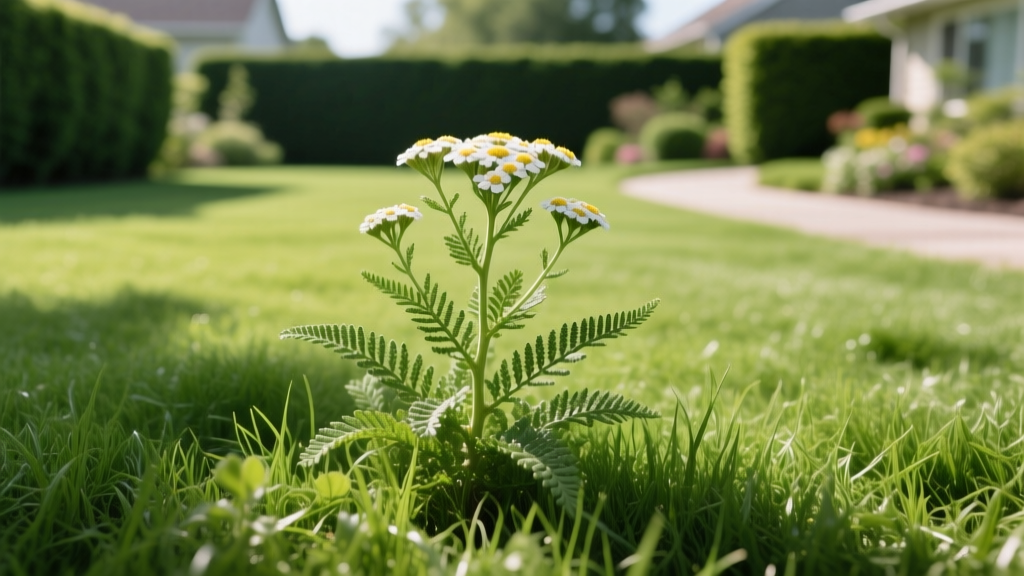
Fern Like Weed in Lawn: How to Identify and Kill Yarrow
The 'Fern-Like' Imposter: Identifying Your Lawn Invader
When homeowners spot a delicate, feathery plant invading their turf, they often search for a 'fern like weed in lawn' to figure out what is choking their grass. In 90% of cases across North American lawns, this imposter is Common Yarrow (Achillea millefolium). While true ferns require deep shade and constant moisture, yarrow thrives in full sun, poor soil, and drought conditions, making it a formidable opponent in turfgrass environments.
Quick Identification Checklist for Yarrow:
- Foliage: Bipinnately lobed, feathery, fern-like leaves that grow close to the ground in a rosette pattern before sending up flower stalks.
- Aroma: Crush the leaves between your fingers. Yarrow emits a distinct, sharp herbal scent resembling chamomile or sage.
- Flowers: Flat-topped clusters (corymbs) of tiny white or pale pink flowers appearing in early to mid-summer.
- Growth Habit: Spreads aggressively via underground rhizomes, forming dense, drought-tolerant mats that outcompete turfgrass.
Another occasional culprit is first-year Wild Carrot (Daucus carota), which produces a fern-like basal rosette before bolting into the tall, flowering 'Queen Anne's Lace' in its second year. However, wild carrot relies on a deep taproot rather than spreading rhizomes, making its spot-treatment protocol entirely different. This guide focuses primarily on eradicating the rhizomatous mat-forming yarrow, which poses the greater threat to lawn health.
Why Fern-Like Weeds Survive Standard Lawn Care
Standard broadleaf weed killers often fail against yarrow due to two specific biological defense mechanisms. Understanding these failure modes is critical for selecting the right spot-treatment chemistry.
1. The Trichome Barrier
Yarrow leaves are covered in microscopic, fine hairs called trichomes. When you spray a standard water-based herbicide, surface tension causes the droplets to bead up and roll off the leaf surface rather than penetrating the plant tissue. Without a chemical adjuvant to break this surface tension, the active ingredients never reach the cellular level.
2. The Rhizome Network
According to turfgrass pathology data from the University of Minnesota Extension, yarrow's underground rhizomes can extend several feet laterally and survive deep freezing and severe drought. If a systemic herbicide only kills the top growth (the 'burn-down' effect) but fails to translocate down into the rhizome network, the weed will simply resprout from the roots within 14 to 21 days.
Spot-Treatment Protocols: Chemical Eradication
To permanently kill yarrow, you need a multi-active-ingredient approach that combines rapid desiccation with deep systemic translocation. The exact product you choose depends entirely on your turfgrass species.
Cool-Season Lawns (Kentucky Bluegrass, Fescue, Ryegrass)
For cool-season grasses, a 4-way herbicide containing Carfentrazone-ethyl is the gold standard. Carfentrazone provides rapid cell membrane disruption (visible browning within 24 hours), while the companion chemicals (2,4-D, MCPP, and Dicamba) travel down to the rhizomes. Professional-grade SpeedZone or consumer-grade BioAdvanced All-In-One Lawn Weed Killer are highly effective formulations.
Warm-Season Lawns (St. Augustine, Centipede, Zoysia)
Warm-season grasses are highly sensitive to 2,4-D and MCPP, which can cause severe stunting or necrosis. For these lawns, use a selective herbicide formulated with Thiencarbazone-methyl, Iodosulfuron-methyl, and Dicamba (e.g., Celsius WG). This specific trio is safe for St. Augustine and Centipedegrass while remaining lethal to yarrow.
| Active Ingredient Profile | Target Grass Type | Application Rate (per 1,000 sq ft) | Estimated Cost |
|---|---|---|---|
| Carfentrazone + 2,4-D + MCPP + Dicamba | Cool-Season | 1.0 - 1.5 fl oz | ~$1.50 (Pro concentrate) |
| Thiencarbazone + Iodosulfuron + Dicamba | Warm-Season | 0.075 oz (dry weight) | ~$2.20 (Pro concentrate) |
| Non-Ionic Surfactant (NIS) | All Types (Required Additive) | 0.25% v/v (approx. 0.5 tsp/gal) | ~$0.10 |
Critical Temperature Warning: Never apply hormonal herbicides (2,4-D or Dicamba) when daytime temperatures exceed 85°F. At high temperatures, these chemicals volatilize (turn into a gas) and drift onto nearby ornamental shrubs, tomatoes, and garden beds, causing severe twisting and cupping damage. Apply in the early morning when temps are between 65°F and 80°F.
The Surfactant Mandate: Do Not Skip This Step
As noted by the NC State TurfFiles program, the physical structure of yarrow leaves demands the use of a Non-Ionic Surfactant (NIS). If you purchase a professional concentrate that does not already include a built-in surfactant, you must add one to your tank mix. Products like DyneAmic or a generic methylated seed oil (MSO) will strip the waxy cuticle and flatten the water droplets, forcing the herbicide through the trichome barrier. Mix at a rate of 0.25% volume/volume (roughly half a teaspoon per gallon of water).
Manual Extraction: The Organic Protocol
If you maintain a strictly organic lawn or are dealing with a small, isolated patch of yarrow near a vegetable garden where herbicide drift is unacceptable, manual extraction is viable—but only if executed with precision.
- Hydrate the Soil: Water the target area deeply the night before. Yarrow rhizomes snap easily in dry, compacted clay. Moist soil allows for clean extraction.
- Use a Hori-Hori Knife: Standard trowels are too wide and blunt. A Japanese Hori-Hori knife features a narrow, serrated blade ideal for slicing through turf and soil.
- Excavate to 6 Inches: Insert the knife at a 45-degree angle, circling the entire rosette. Yarrow rhizomes typically reside in the top 4 to 6 inches of the soil profile.
- Extract and Inspect: Pull the root mass gently. Inspect the white, stringy rhizomes. If you leave even a half-inch fragment of the rhizome in the soil, the plant will regenerate a new rosette within three weeks.
Post-Eradication: Closing the Canopy
Yarrow is an opportunistic pioneer species. It specifically targets lawns suffering from soil compaction, low nitrogen, and inadequate irrigation. Once the weed is dead and removed, you are left with a bare soil patch. If left alone, new yarrow seeds (which can remain viable in the soil seed bank for up to 5 years) will germinate in the sunlight.
'Weeds are symptoms of a turfgrass deficit. Eradicating the weed without fixing the soil environment simply prepares the seedbed for the next invasion.'
To permanently close the canopy, perform liquid aeration or mechanical core aeration on the affected zone to relieve the compaction that yarrow favors. Follow up immediately with an overseeding application of a competitive, drought-tolerant turfgrass cultivar (such as Turf-Type Tall Fescue for cool-season zones, or plug-planting Zeon Zoysia for warm-season zones). Apply a starter fertilizer (e.g., 18-24-12) to push rapid germination, ensuring the new grass shades the soil and blocks sunlight from reaching any remaining yarrow seeds.

