
Lawn Care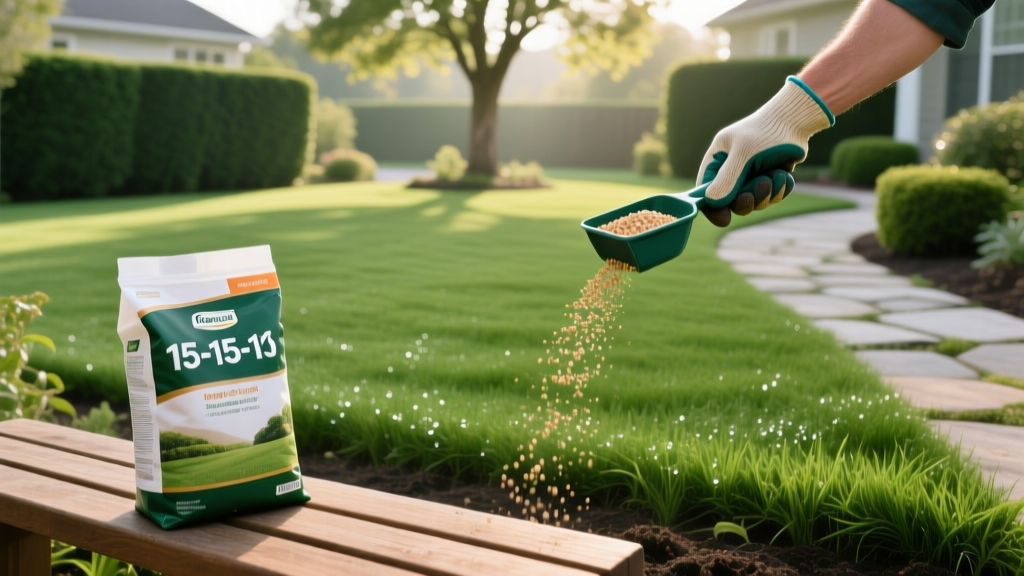
Fertilizer 15-15-15 for Lawns: When to Use and Application Rates
A 15-15-15 fertilizer contains equal parts nitrogen (N), phosphorus (P), and potassium (K) by weight. While this balanced ratio seems intuitively beneficial for overall plant health, applying it blindly to an established lawn is one of the most common—and environmentally harmful—mistakes in turf management. In 2026, with commercial 50-pound bags of triple-15 fertilizer averaging $45 to $60, understanding exactly when this formulation is warranted, and when to avoid it, is critical for both your budget and local waterways.
The N-P-K Breakdown: What 15-15-15 Actually Does
Every bag of fertilizer displays three numbers representing the percentage by weight of primary macronutrients. In a 50-pound bag of 15-15-15, you are getting:
- Nitrogen (15%): 7.5 lbs of N. Drives vegetative growth, chlorophyll production, and the deep green color of turfgrass.
- Phosphorus (15% as P2O5): 7.5 lbs of P. Essential for early root development, seedling establishment, and energy transfer within the plant.
- Potassium (15% as K2O): 7.5 lbs of K. Regulates water uptake, improves drought tolerance, and strengthens cell walls against disease and foot traffic.
⚠️ The Phosphorus Problem: Most established lawns in the US already have sufficient or excessive soil phosphorus levels. Applying more does not make the grass greener; it simply binds to soil particles and eventually runs off into storm drains, triggering toxic algae blooms in local lakes and rivers. Consequently, states like New York, Minnesota, and Washington strictly prohibit the use of phosphorus-containing lawn fertilizers unless a recent soil test proves a deficiency or you are establishing a new lawn.
Ideal Use Cases: When 15-15-15 Makes Sense
Because of the high phosphorus content, 15-15-15 is a specialized tool, not a routine maintenance fertilizer. It should only be deployed in specific scenarios.
Scenario Comparison Matrix
| Lawn Scenario | Is 15-15-15 Recommended? | Better Alternative Ratio |
|---|---|---|
| New Seed or Sod Installation | Yes. Phosphorus is critical for initial root strike. | 15-15-15 or 10-18-10 Starter |
| Established Cool-Season Lawn (Spring) | No. High P is wasteful and illegal in many zones. | 24-0-6 or 32-0-4 (High N, Zero P) |
| Established Warm-Season Lawn (Summer) | No. Potassium needs are better met without P. | 15-0-15 or 16-4-8 |
| Verified P-Deficient Soil (Soil Test) | Yes. Corrects specific macronutrient deficits. | 15-15-15 or custom blend |
The Math: Calculating Exact Application Rates
Turfgrass requires specific amounts of nitrogen per 1,000 square feet per application, typically ranging from 0.5 to 1.0 lbs of N. To find out how much 15-15-15 product you need to apply to hit that target, use this formula:
The Application Formula:
(Target lbs of Nitrogen ÷ Percentage of N) × 100 = lbs of product per 1,000 sq. ft.
Example: If your goal is to apply 1.0 lb of Nitrogen per 1,000 sq. ft:
(1.0 ÷ 15) × 100 = 6.67 lbs of 15-15-15 fertilizer per 1,000 sq. ft.
If you apply 6.67 lbs of product to deliver 1 lb of Nitrogen, you are simultaneously applying 1 lb of Phosphorus and 1 lb of Potassium. According to University of Minnesota Turfgrass Science, most established lawns require zero supplemental phosphorus, meaning that extra 1 lb of P is entirely wasted and becomes an environmental liability.
Spreader Calibration Settings
When applying 6.67 lbs per 1,000 sq. ft., you must calibrate your spreader to ensure even distribution and prevent fertilizer burn. For a standard 50-pound bag, this rate will cover approximately 7,500 square feet.
- Scotts EdgeGuard Deluxe Rotary: Setting 5.5 (Walk at a steady 3.5 mph pace)
- Lesco High Wheel Commercial: Setting 14 (Standard calibration for medium prill size)
- Echo PB-250LN Drop Spreader: Setting 8 (Overlap wheel tracks by 2 inches)
Step-by-Step Application Protocol for New Lawns
If you are using 15-15-15 as a starter fertilizer for a newly graded lawn or overseeding project, follow this protocol to maximize seed germination and root establishment.
- Conduct a Soil Test: Before purchasing, send a core sample to your local university extension office (e.g., Penn State Extension). Confirm that your soil actually requires phosphorus amendment.
- Grade and Rake: Prepare the seedbed. Remove debris and ensure the top 2 inches of soil are loose and level.
- Apply the Fertilizer: Load the 15-15-15 into your spreader. Make two perpendicular passes (one North-South, one East-West) at half the required rate each to guarantee uniform coverage and avoid striping.
- Incorporate (Optional but Recommended): Lightly rake the top 1/4 inch of soil to mix the fertilizer granules into the seedbed, protecting them from UV degradation and wind displacement.
- Sow Seed or Lay Sod: Apply your grass seed or lay sod immediately after fertilizer incorporation.
- Water Immediately: Apply 1/4 inch of water to dissolve the prills and activate the nutrients, pushing them into the root zone without washing away the seed.
Frequently Asked Questions
Can I use 15-15-15 on my vegetable garden instead of my lawn?
Yes. While 15-15-15 is often suboptimal for established turf, it is an excellent, cost-effective balanced fertilizer for vegetable gardens, particularly for heavy feeders like tomatoes, corn, and peppers that actively deplete soil phosphorus and potassium during fruiting stages.
Will 15-15-15 burn my lawn?
Standard 15-15-15 formulations are typically derived from urea and ammonium sulfate, which carry a moderate burn risk if over-applied or left on dry foliage. Always water the lawn immediately after application with at least 1/4 inch of irrigation to wash the granules off the grass blades and into the soil.
How long does it take to see results?
The nitrogen component (especially if it contains quick-release urea) will trigger visible greening within 5 to 7 days. The phosphorus and potassium work below ground, improving root mass and cellular strength over a 3 to 4 week period.

