
Lawn Care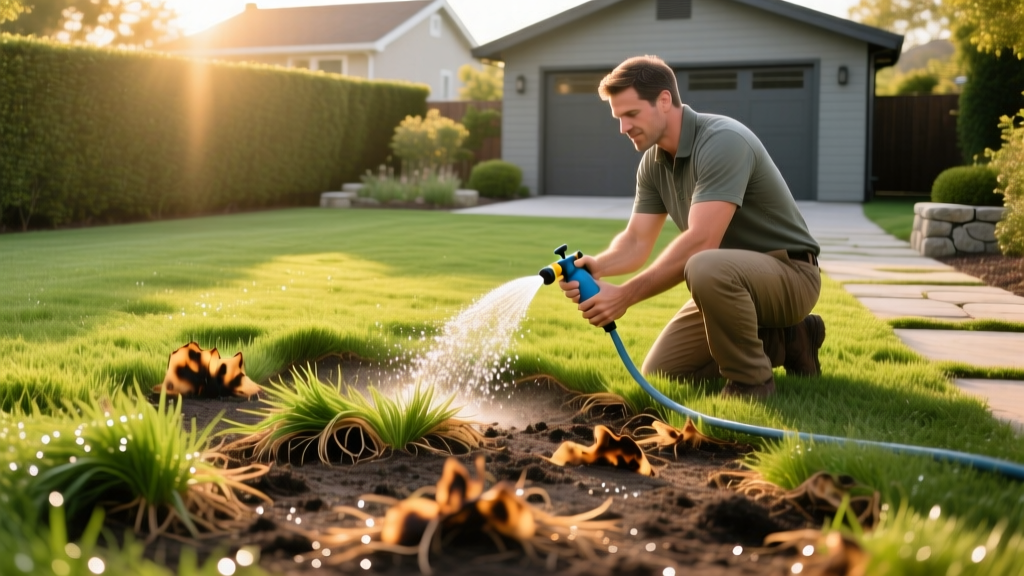
Burning Grass After Fertilizing: Step-by-Step Recovery Protocol
Diagnostic Alert: If you observe bright yellow or brown streaks matching your spreader's wheel tracks within 24 to 48 hours of application, you are dealing with acute osmotic stress (fertilizer burn). Immediate soil flushing is required within the first 72 hours to prevent permanent crown necrosis.
The Anatomy of Fertilizer Burn: Why Grass Burns
When homeowners notice burning grass after a heavy feeding, the damage is rarely caused by heat. Instead, it is the result of osmotic stress and salt toxicity. Fast-release nitrogen sources like urea (46-0-0) and ammonium sulfate (21-0-0) possess high salt indices. When granules become trapped in the thatch layer or rest against wet leaf blades, they draw moisture out of the plant tissue through reverse osmosis. Simultaneously, the rapid hydrolysis of urea releases ammonia gas, which chemically scorches the leaf cuticle.
According to turfgrass researchers at Purdue University Turfgrass Science, the severity of the burn is dictated by the soil's Cation Exchange Capacity (CEC), the ambient temperature during application, and the moisture level of the grass blades. Applying high-salt fertilizers to damp turf when temperatures exceed 85°F guarantees severe foliar burn.
Step 1: Immediate Triage and Soil Flushing
The moment you identify chemical scorch, your primary objective is to dilute the salt concentration in the root zone and wash residual granules off the leaf blades.
- Calculate Water Volume: You need to apply exactly 1 to 1.5 inches of water to the affected zones. Use a standard cylindrical rain gauge placed in the burn zone to measure output.
- Execute Heavy Irrigation: Run your sprinklers or oscillating hose-end sprayers for 45 to 60 minutes daily for three consecutive days. This pushes the soluble salts below the 6-inch active root zone.
- Avoid Surfactants: Do not apply liquid aeration agents or wetting agents during the flushing phase. Surfactants will increase the mobility of the salts, potentially driving them deeper into the root hairs before they are sufficiently diluted.
Step 2: The Crown Viability Test (Decision Matrix)
After 72 hours of flushing, you must determine if the turf is merely dormant/stressed or if the crown (the growing point located at the soil line) is dead. Do not rely on leaf color; brown leaves can mask a healthy crown.
How to Perform the Tug and Slice Test
Grasp a tuft of the burned grass near the base and pull gently. Next, use a sharp pocket knife or hori-hori tool to slice the stem horizontally exactly at the soil line.
| Crown Condition | Tug Resistance | Recovery Protocol |
|---|---|---|
| White or pale green, firm | High resistance | Continue flushing; turf will regenerate new tillers in 10-14 days. |
| Yellowish-brown, slightly soft | Moderate resistance | Apply liquid kelp extract (cytokinin-rich) to stimulate cell division. |
| Dark brown, mushy, foul odor | Zero resistance (pulls easily) | Crown is necrotic. Proceed immediately to Step 4 (Reseeding/Sodding). |
Step 3: Salt Neutralization and Soil Amendment
If your soil test indicates a massive spike in sodium or electrical conductivity (EC) following the burn, flushing alone may not restore soil structure. High sodium levels cause clay particles to disperse, sealing the soil surface and preventing oxygen from reaching the surviving roots.
To counteract this, apply pelletized gypsum (calcium sulfate dihydrate) at a rate of 50 lbs per 1,000 square feet. The calcium ions will displace the sodium ions on the soil's cation exchange sites, allowing the sodium to be safely leached out during your next irrigation cycle. Gypsum is pH-neutral and will not add additional nitrogen to the already overloaded soil profile.
Expert Insight: Never apply lime (calcium carbonate) to fix fertilizer burn. Lime alters soil pH and can trigger the rapid release of trapped ammonium into ammonia gas, exacerbating the chemical scorch. Stick strictly to gypsum for salt displacement.
Step 4: Targeted Reseeding and Sod Replacement
For zones where the crown viability test confirmed necrotic tissue, you must remove the dead thatch and introduce new genetics. Wait until the soil EC levels have normalized (typically 14 days post-flushing).
- For Cool-Season Lawns (Fescue, Kentucky Bluegrass): Use a slice seeder set to a depth of 1/4 inch. Select a seed blend coated with a moisture-retaining polymer (e.g., Scotts Turf Builder Grass Seed with Watersmart PLUS) to buffer the young seedlings against residual soil salts. Apply at 5 lbs per 1,000 sq ft.
- For Warm-Season Lawns (Bermuda, Zoysia): Sprigging or laying fresh sod is superior to seeding for rapid establishment. Cut out the dead patches with a sod cutter, amend the bare soil with 1 inch of compost, and lay fresh sod. Water the new sod twice daily for the first 10 days to ensure root knit.
Preventative Maintenance: Switching to Slow-Release Formulations
To ensure you never experience burning grass from maintenance again, you must audit your fertilizer program. The University of Minnesota Extension Turfgrass program heavily advocates for transitioning to slow-release nitrogen sources, particularly during late spring and summer applications when soil temperatures accelerate chemical reactions.
Nitrogen Source Burn Potential Matrix
| Nitrogen Source | Relative Salt Index | Burn Risk Profile |
|---|---|---|
| Urea (46-0-0) | 75.4 | Extreme (Requires immediate water-in) |
| Ammonium Sulfate (21-0-0) | 69.0 | High (Highly acidic, severe foliar burn) |
| Methylene Urea (MU) | 8.0 | Low (Microbe-dependent breakdown) |
| IBDU (Isobutylidene diurea) | 1.0 | Minimal (Hydrolysis-controlled, safe for seedlings) |
| Polymer-Coated Urea (PCU) | Varies (approx 10-15) | Low (Temperature-controlled osmotic release) |
Application Calibration Checklist
Even with low-salt fertilizers, mechanical errors cause localized burning. Before every application, execute this calibration protocol:
- Check the Impeller: Ensure the rotary spreader's impeller is spinning freely and is free of rust or caked fertilizer dust, which causes uneven distribution.
- Verify the Overlap: Most modern rotary spreaders (like the Scotts EdgeGuard) require a specific wheel-track overlap. Mark your wheel tracks with chalk on the driveway to confirm you are overlapping by the exact distance specified on the product bag (usually 2 to 4 feet).
- Close the Hopper on Turns: 80% of fertilizer burn occurs at the end of the run where the operator turns around with the hopper open. Always shut the flow gate before initiating a turn.

