
Lawn Care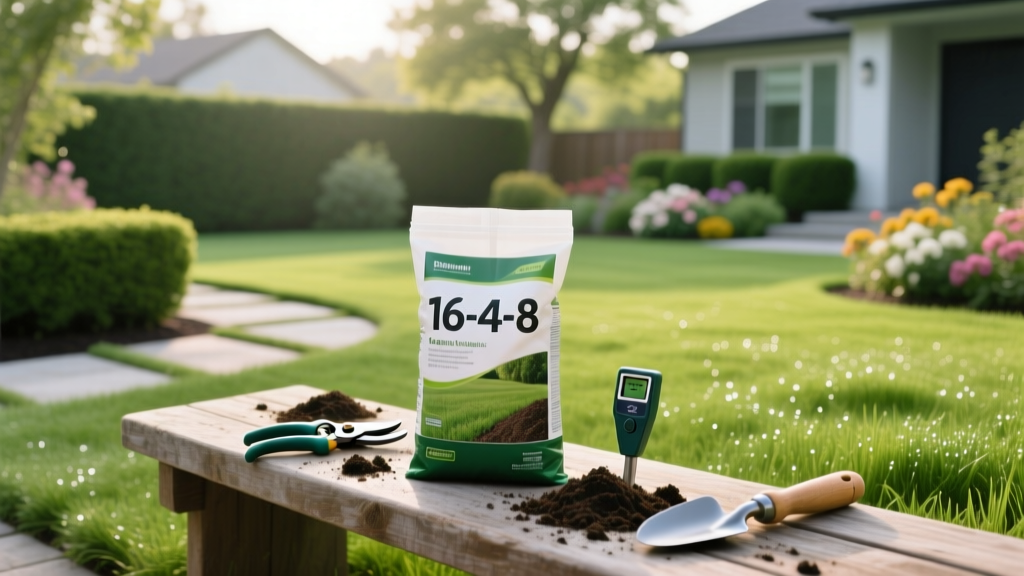
What Do the Numbers on Fertilizer Mean? The NPK Ratio Guide
Decoding the Bag: What Do the Numbers on Fertilizer Mean?
Every bag of commercial lawn fertilizer displays a three-number sequence, such as 32-0-4 or 16-4-8. These numbers represent the NPK ratio: the percentage by weight of Nitrogen (N), Phosphorus (P), and Potassium (K) contained in the product. Understanding what the numbers on fertilizer mean is the foundational step in agronomy, dictating not just the color of your grass, but its root depth, drought tolerance, and disease resistance.
The NPK Quick Reference:
- N (Nitrogen): Drives upward vegetative growth, blade density, and deep green color.
- P (Phosphorus): Stimulates early root development, seedling establishment, and energy transfer.
- K (Potassium): Fortifies cell walls for drought tolerance, winter hardiness, and disease resistance.
The remaining percentage of the bag consists of secondary macronutrients (like calcium and sulfur), micronutrients (iron, zinc), and inert carrier materials (like limestone or sand) that ensure even distribution through your spreader. According to the University of Minnesota Extension, applying the correct NPK ratio based on your grass type and existing soil profile is the single most critical factor in preventing nutrient runoff and turf burn.
Nitrogen (N): The Growth Engine and Release Rates
Nitrogen is the primary driver of lawn aesthetics. However, the first number on the bag only tells half the story. The source of the nitrogen dictates how the grass absorbs it. In 2026, premium fertilizers utilize polymer-coated urea (PCU) or methylene urea to provide steady feeding over 8 to 12 weeks, whereas budget options rely on fast-release urea or ammonium sulfate, which can cause rapid growth flushes followed by severe nitrogen leaching.
| Nitrogen Source | Release Speed | Burn Risk | Typical Cost per lb of N |
|---|---|---|---|
| Urea (46-0-0) | Fast (1-2 weeks) | High | $1.00 - $1.40 |
| Ammonium Sulfate | Fast (1-2 weeks) | Very High | $1.20 - $1.60 |
| Methylene Urea (MU) | Slow (6-8 weeks) | Low | $2.50 - $3.20 |
| Polymer-Coated Urea (PCU) | Controlled (8-16 weeks) | Very Low | $3.50 - $4.50 |
Phosphorus (P): The Root Builder and Regulatory Limits
The middle number represents Phosphorus, expressed as P2O5. While essential for new lawn establishment, seed germination, and root expansion, mature lawns rarely require additional phosphorus. Because excess phosphorus binds to soil particles and eventually washes into waterways causing toxic algal blooms, the Environmental Protection Agency (EPA) and numerous state governments strictly regulate its use.
Warning: Phosphorus Bans
States including New York, Minnesota, Florida, and Michigan have banned the sale of phosphorus-containing lawn fertilizers unless a recent soil test explicitly proves a deficiency, or the product is being used for new seed/sod establishment. This is why most standard maintenance fertilizers for mature lawns feature a '0' in the middle (e.g., 32-0-4).
States including New York, Minnesota, Florida, and Michigan have banned the sale of phosphorus-containing lawn fertilizers unless a recent soil test explicitly proves a deficiency, or the product is being used for new seed/sod establishment. This is why most standard maintenance fertilizers for mature lawns feature a '0' in the middle (e.g., 32-0-4).
Potassium (K): The Stress Defender
The third number is Potassium (K2O). Often overlooked by homeowners chasing deep green color, potassium is the turf's immune system. It regulates stomatal opening (water retention), thickens cell walls to resist fungal pathogens like Brown Patch, and acts as an antifreeze in the plant's vascular system during winter dormancy. Warm-season grasses transitioning into fall dormancy and cool-season grasses preparing for winter both require high-potassium formulations (such as 0-0-50 or 8-0-20) to survive environmental stress.
The Math Most Homeowners Skip: Calculating Actual Nutrient Weight
Knowing what the numbers on fertilizer mean is useless if you cannot calculate the actual weight of nutrients you are applying. The numbers are percentages, not pounds. The UMass Amherst Turf Program outlines a simple formula to determine exactly what you are paying for.
Step-by-Step Calculation Example
Imagine you purchase a 50-pound bag of 24-5-10 fertilizer for $40.00.
- Nitrogen: 50 lbs × 0.24 = 12 lbs of actual Nitrogen
- Phosphorus: 50 lbs × 0.05 = 2.5 lbs of actual Phosphorus
- Potassium: 50 lbs × 0.10 = 5 lbs of actual Potassium
To find the true value of the product, calculate the cost per pound of Nitrogen (the most expensive and heavily applied nutrient). Divide the bag price ($40) by the pounds of Nitrogen (12). This fertilizer costs $3.33 per pound of N. Comparing this metric across brands prevents you from overpaying for heavily marketed, low-analysis blends.
Real-World Product Matrix: 2026 Market Leaders
Different lawn scenarios require distinct NPK ratios. Below is a comparison of widely available professional and consumer-grade formulations currently dominating the market.
| Product / Brand | NPK Ratio | Best Use Case | Approx. Price (2026) |
|---|---|---|---|
| Scotts Turf Builder (Standard) | 32-0-4 | Spring/Summer maintenance for mature cool-season lawns. | $40 / 15k sq ft |
| Milorganite Organic | 6-4-0 | Safe, slow-release feeding; won't burn; builds soil biology. | $22 / 2.5k sq ft |
| Lesco Starter Fertilizer | 18-24-12 | New seed or sod establishment (high P for roots). | $45 / 15k sq ft |
| Simple Lawn Solutions Winterizer | 0-0-25 | Late fall application to boost winter hardiness and spring green-up. | $30 / 3.2k sq ft |
Matching NPK Ratios to Grass Types and Seasons
Applying a high-nitrogen blend at the wrong time of year is a primary cause of turf disease. Cool-season grasses (Kentucky Bluegrass, Tall Fescue) and warm-season grasses (Bermuda, Zoysia) have opposite metabolic peaks.
- Cool-Season Grasses: Require the bulk of their nitrogen in early fall (September/October) to build root reserves for winter. Spring applications should be light (under 0.5 lbs of N per 1,000 sq ft) to avoid excessive top growth that starves roots before summer heat.
- Warm-Season Grasses: Demand heavy nitrogen in late spring and mid-summer (May through August) when soil temperatures exceed 70°F and metabolic activity peaks. Nitrogen must be cut off entirely 6 weeks before the first expected frost to prevent tender growth from being killed by early freezes.
The Missing Step: Why Soil Tests Dictate Your Numbers
Guessing your NPK requirements based on generic seasonal schedules leads to nutrient lockout. If your soil pH is below 5.5 or above 7.5, the grass roots physically cannot absorb phosphorus and potassium, regardless of how much you apply. A laboratory soil test (available through local university cooperative extensions for roughly $15 to $30) measures your baseline P and K levels, organic matter percentage, and cation exchange capacity (CEC). Use the soil test's exact recommendations to select a fertilizer with the precise NPK numbers your lawn requires, eliminating waste and protecting local watersheds.

