
Lawn Care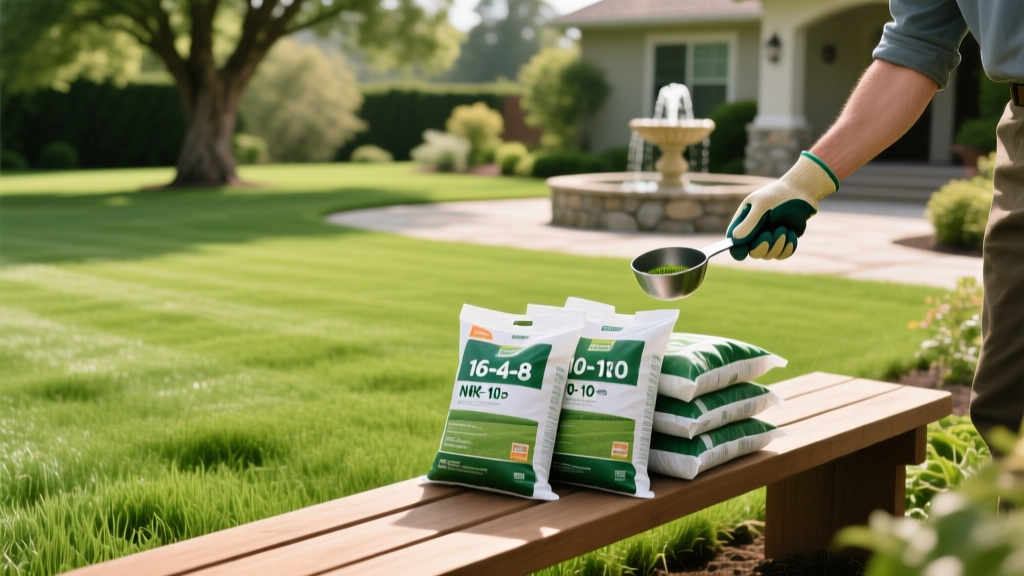
Fertilizer Number Explanation: Decoding NPK Ratios for Lawns
The Core Fertilizer Number Explanation: N-P-K Breakdown
Staring at a wall of fertilizer bags in a garden center can be overwhelming. You will see sequences like 10-10-10, 20-0-10, and 32-0-4 prominently displayed on the front of every bag. This complete fertilizer number explanation decodes those ratios, which represent the percentage by weight of the three primary macronutrients required for turfgrass health: Nitrogen (N), Phosphorus (P), and Potassium (K).
Nitrogen (N): The Growth Engine
The first number is Nitrogen, the most critical nutrient for lawn care. Nitrogen drives vigorous leaf blade growth, deep green coloration, and overall turf density. It is a core component of chlorophyll, the molecule responsible for photosynthesis. Nitrogen sources in fertilizers are generally split into two categories:
- Quick-release (Water-soluble): Includes urea and ammonium sulfate. These provide an immediate green-up within 3 to 5 days but carry a high risk of fertilizer burn if over-applied and leach quickly from the soil profile.
- Slow-release (Water-insoluble): Includes methylene urea, sulfur-coated urea, and polymer-coated resins. These feed the lawn steadily over 6 to 12 weeks, reducing the risk of burn and minimizing environmental runoff.
Phosphorus (P): The Root Builder
The middle number represents Phosphorus, which is essential for early root development, seedling establishment, and energy transfer within the plant (ATP synthesis). Mature, established lawns rarely require additional phosphorus, as most soils retain it tightly. Excess phosphorus does not make an established lawn "healthier"; instead, it binds to soil particles and eventually runs off into waterways, triggering toxic algal blooms.
Environmental Warning: Due to water quality concerns, over 20 U.S. states have enacted strict phosphorus bans on lawn fertilizers. In these regions, you will predominantly see fertilizers with a middle number of zero (e.g., 20-0-10) unless you are purchasing a specialized "starter" fertilizer for new seed or sod, or unless a certified soil test proves a phosphorus deficiency.
Potassium (K): The Stress Defender
The third number is Potassium. Unlike Nitrogen, Potassium does not visibly stimulate top growth. Instead, it operates at the cellular level to regulate water uptake, enzyme activation, and carbohydrate storage. High potassium levels are critical for improving a lawn's resistance to drought stress, extreme cold, and fungal diseases like brown patch and dollar spot.
The Math Trap: Percentage vs. Actual Weight
The most common mistake homeowners make is assuming the NPK numbers represent the physical weight of the nutrients in the bag. They do not. The numbers represent the percentage of the total bag weight. Understanding this distinction is vital for calculating your actual application rate and avoiding severe turf burn.
According to the University of Minnesota Extension, the gold standard for lawn fertilization is applying exactly 1.0 pound of actual Nitrogen per 1,000 square feet per application.
Calculation Framework: To find out how much product you need to apply to deliver 1 lb of Nitrogen per 1,000 sq ft, divide 100 by the first number on the bag.
Example A (20-0-10): 100 ÷ 20 = 5.0 lbs of product per 1,000 sq ft.
Example B (32-0-4): 100 ÷ 32 = 3.12 lbs of product per 1,000 sq ft.
Example C (10-10-10): 100 ÷ 10 = 10.0 lbs of product per 1,000 sq ft.
Example A (20-0-10): 100 ÷ 20 = 5.0 lbs of product per 1,000 sq ft.
Example B (32-0-4): 100 ÷ 32 = 3.12 lbs of product per 1,000 sq ft.
Example C (10-10-10): 100 ÷ 10 = 10.0 lbs of product per 1,000 sq ft.
If you buy a 50-pound bag of 20-0-10 fertilizer, it contains 10 pounds of actual Nitrogen (20% of 50 lbs), 0 pounds of Phosphorus, and 5 pounds of Potassium. Because you need 5 lbs of product per 1,000 sq ft, that single 50-pound bag will cover exactly 10,000 square feet. Buying a cheaper 10-10-10 fertilizer often costs more in the long run because you must apply twice as much physical product to achieve the same nitrogen delivery, and you are unnecessarily over-applying phosphorus and potassium.
Seasonal NPK Requirements by Grass Type
The ideal NPK ratio shifts dramatically depending on your grass species and the time of year. Cool-season grasses (Kentucky Bluegrass, Tall Fescue, Perennial Ryegrass) have peak growth periods in the fall and spring, while warm-season grasses (Bermuda, Zoysia, St. Augustine) peak in the heat of summer. The NC State Extension Turfgrass Program emphasizes that timing the correct ratio to the grass's biological cycle prevents disease and winter kill.
| Grass Type | Season | Ideal N-P-K Ratio | Primary Goal |
|---|---|---|---|
| Cool-Season | Early Spring | 20-0-10 or 24-0-11 | Moderate green-up without excessive blade growth |
| Cool-Season | Late Fall (Winterizer) | 32-0-10 or 22-0-14 | Carbohydrate storage and root development before dormancy |
| Warm-Season | Late Spring (Green-up) | 15-0-15 or 16-4-8 | Push top growth as soil temperatures exceed 65°F |
| Warm-Season | Late Summer | 5-10-15 or 0-0-25 | Halt nitrogen push; build potassium for winter hardiness |
| All Types | New Seeding / Sodding | 18-24-12 | High phosphorus for rapid root establishment |
Secondary and Micronutrients: The Hidden Numbers
While NPK dominates the front label, premium professional-grade fertilizers (like those from Lesco or SiteOne) list secondary macronutrients and micronutrients on the back panel. These are critical for correcting specific soil deficiencies identified in a lab test.
- Iron (Fe): Often listed as 2% to 5% Fe. Iron triggers deep, dark green coloration without the rapid, mowing-intensive top growth associated with Nitrogen. It is especially useful in high-pH soils where natural iron is locked up and unavailable to grass roots.
- Sulfur (S): Helps lower soil pH over time and is a building block for amino acids. Often found in ammonium sulfate-based fertilizers.
- Calcium (Ca) & Magnesium (Mg): Essential for cell wall structure and chlorophyll formation, respectively. Deficiencies are usually corrected via dolomitic lime applications rather than standard NPK fertilizers.
Real-World Purchasing Scenarios
Applying this fertilizer number explanation to real-world shopping scenarios ensures you buy the exact product your lawn needs, rather than relying on generic marketing claims.
Scenario A: Establishing a New Lawn from Seed
The Need: Germinating seeds and sprigs lack root systems and require immediate phosphorus to anchor into the soil.
The Buy: Look for a "Starter Fertilizer" with an NPK ratio around 18-24-12 or 10-18-10. Products like Lesco Starter Fertilizer or Scotts Turf Builder Starter Food are formulated specifically for this 4 to 6 week establishment window. Apply at the time of seeding or immediately after laying sod.
Scenario B: The Mid-Summer Slump (Cool-Season Grasses)
The Need: Kentucky Bluegrass and Fescue go semi-dormant in high heat. Pushing high nitrogen during a July heatwave forces the grass to expend energy on blade growth when it should be conserving moisture, making it highly susceptible to drought stress and Pythium blight.
The Buy: Avoid high-N synthetic fertilizers. If the lawn looks pale, use an organic, slow-release option like Milorganite (6-4-0) at half-rate, or apply a liquid chelated iron supplement to restore color without forcing growth.
Scenario C: Preparing for Winter Dormancy
The Need: As soil temperatures drop in late autumn, turfgrass shifts energy from top growth to root storage. Nitrogen applications should be reduced or halted, while Potassium is increased to act as a cellular antifreeze.
The Buy: Seek a "Winterizer" with a high third number, such as 10-0-20 or 0-0-25 (Muriate of Potash). Applying heavy potassium in November helps cool-season grasses survive freeze-thaw cycles and emerge thicker the following April.
Soil Testing: The Prerequisite to Choosing Numbers
Guessing your lawn's NPK requirements based on a generic seasonal schedule is an inefficient use of money and a potential environmental hazard. The Environmental Protection Agency (EPA) notes that nutrient runoff from over-fertilized lawns is a leading cause of impaired waterways and dead zones in estuaries.
Before purchasing any fertilizer with a middle number greater than zero, you must conduct a soil test. Mail a composite soil sample to your local university cooperative extension office or a private lab like Waypoint Analytical. The resulting report will provide exact baseline levels of Phosphorus and Potassium in parts per million (PPM), alongside your soil pH. If your soil test reveals Phosphorus levels are already "Optimal" or "High" (typically above 30 PPM), applying a 10-10-10 fertilizer is biologically useless to the grass and ecologically damaging to local watersheds. Stick strictly to zero-phosphorus blends (X-0-X) and focus your budget on high-quality, slow-release nitrogen and potassium sources.

