
Lawn Care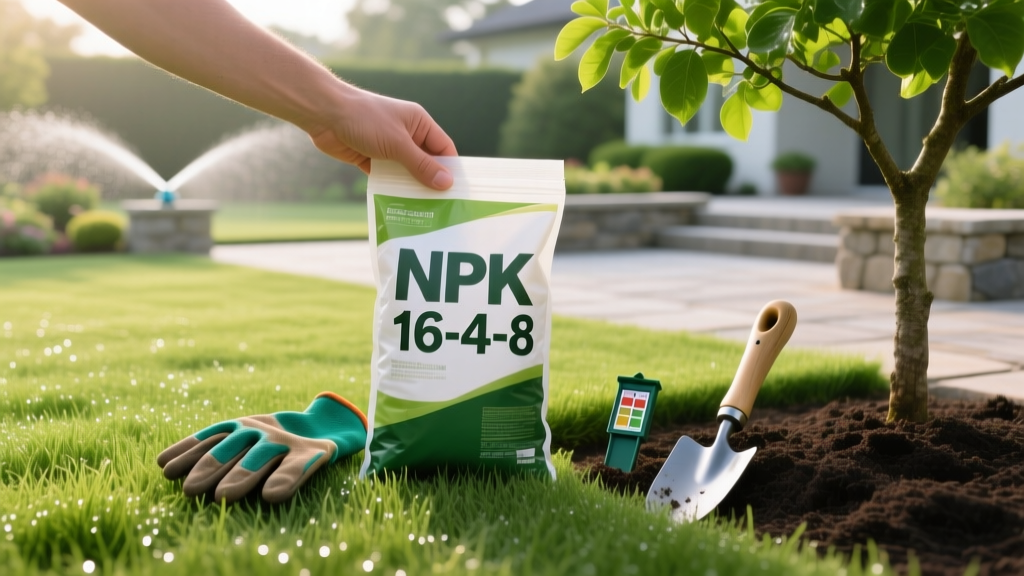
What Are the Three Numbers in Fertilizer? The NPK Ratio Explained
The Core Question: What Are the Three Numbers in Fertilizer?
When you walk down the lawn care aisle, every bag displays a prominent three-number sequence, such as 32-0-3 or 18-24-12. These three numbers represent the NPK ratio, which stands for the percentage by weight of the three primary macronutrients essential for turfgrass health: Nitrogen (N), Phosphorus (P), and Potassium (K).
Understanding what these three numbers in fertilizer mean is the difference between a thick, drought-resistant lawn and one that suffers from nutrient burn, weak roots, or severe weed invasion. The numbers always appear in the exact same order—N-P-K—and indicate the percentage of that specific nutrient contained within the bag. The remaining percentage of the bag consists of secondary nutrients (like calcium and sulfur), micronutrients (like iron and zinc), and inert filler materials that help distribute the nutrients evenly across your soil.
Quick NPK Cheat Sheet:
- First Number (N): Nitrogen – Drives upward blade growth and deep green color.
- Second Number (P): Phosphorus – Stimulates deep root development and seed germination.
- Third Number (K): Potassium – Builds cellular walls for drought, cold, and disease resistance.
Breaking Down the NPK Ratio: Nitrogen, Phosphorus, and Potassium
To make informed purchasing decisions, you must understand how each macronutrient functions within the soil profile and the grass plant itself.
Nitrogen (N): The Blade Builder
Nitrogen is the most critical nutrient for established lawns. It is the core component of chlorophyll, the compound responsible for photosynthesis and the dark green color of turf. When a lawn is nitrogen-deficient, it turns pale yellow (chlorosis) and growth stalls. However, not all nitrogen is created equal. High-quality fertilizers utilize slow-release nitrogen (such as methylene urea or sulfur-coated urea), which feeds the grass steadily over 8 to 12 weeks. Cheap fertilizers rely heavily on quick-release nitrogen (like urea or ammonium sulfate), which causes a rapid flush of growth followed by a crash, and increases the risk of fertilizer burn and groundwater leaching.
Phosphorus (P): The Root Engine
Phosphorus is vital for energy transfer within the plant (ATP) and is absolutely necessary for establishing new grass from seed or sod. However, established lawns rarely need additional phosphorus. In fact, due to the environmental impact of phosphorus runoff causing toxic algal blooms in local waterways, the Environmental Protection Agency (EPA) and many state governments have strictly banned phosphorus in standard lawn fertilizers. You will frequently see the middle number as a "0" (e.g., 32-0-3) unless you are buying a specialized "starter fertilizer" for new seed or have a soil test proving a severe deficiency.
Potassium (K): The Stress Shield
Potassium does not make your grass grow taller or greener; instead, it acts as the plant's immune and stress-management system. It regulates the opening and closing of stomata (pores on the leaf), which controls water loss. A lawn with adequate potassium will survive summer droughts, winter freezes, and fungal diseases far better than one lacking it. Fall "winterizer" fertilizers typically feature a high third number (e.g., 10-0-20) to harden the grass before dormancy.
Calculating Actual Nutrient Weight (The Math Most Homeowners Skip)
The biggest mistake homeowners make is applying fertilizer based on the bag's total weight rather than the actual nutrient weight. The NPK numbers are percentages. Knowing how to calculate the actual pounds of nitrogen in a bag dictates how far the bag will cover and how much it actually costs per application.
Step-by-Step Calculation Example:
- Identify Bag Weight and NPK: You buy a 50 lb bag of Scotts Turf Builder with an NPK of 32-0-3.
- Calculate Actual Nitrogen: Multiply the bag weight by the nitrogen percentage (expressed as a decimal).
50 lbs × 0.32 = 16 lbs of actual Nitrogen. - Determine Coverage: The standard agronomic recommendation for a single application is 1.0 lb of actual nitrogen per 1,000 square feet.
16 lbs ÷ 1.0 = 16,000 square feet of coverage. - Calculate Cost Efficiency: If the bag cost $40, your cost is $2.50 per 1,000 sq ft. Comparing this math against a cheaper 20-0-5 bag reveals which product actually offers better value per pound of nutrient.
According to Penn State Extension, applying more than 1 lb of quick-release nitrogen per 1,000 sq ft in a single application drastically increases the risk of turf burn and nutrient runoff. Always do the math before setting your spreader dial.
Matching the NPK Ratio to Your Season and Grass Type
Blindly applying a generic 10-10-10 fertilizer is a recipe for poor turf health and increased weed pressure. Your lawn's NPK requirements shift dramatically based on the season and whether you grow cool-season or warm-season grass.
| Season / Goal | Ideal NPK Ratio | Primary Function & Timing |
|---|---|---|
| Spring Green-Up (Cool-Season) | 32-0-3 or 28-0-3 | High nitrogen for blade growth as soil temps reach 55°F. Avoid high phosphorus. |
| New Seed / Overseeding | 18-24-12 | Starter fertilizer. High phosphorus drives rapid root establishment for new seedlings. |
| Summer Stress (Warm-Season) | 15-0-15 | Balanced N and K to support Bermuda/Zoysia growth while protecting against heat drought. |
| Fall Winterizer | 10-0-20 or 8-0-24 | Low nitrogen, high potassium to harden cell walls against winter frost and snow mold. |
Reading the Guaranteed Analysis: Beyond the Three Numbers
While the front of the bag shows the NPK ratio, the back of the bag contains the Guaranteed Analysis. This is where expert lawn care professionals look to determine the actual quality of the product.
Look specifically for the breakdown of the Nitrogen source. A premium fertilizer will list multiple nitrogen sources. For example, a high-quality bag might state:
- Total Nitrogen (N): 32%
- Ammoniacal Nitrogen: 4% (Quick release)
- Urea Nitrogen: 8% (Quick release)
- Water Insoluble Nitrogen (WIN): 20% (Slow release)
In this scenario, 20 out of the 32 parts of nitrogen are slow-release (approx. 62%). UMass Extension recommends that at least 50% of the nitrogen in a lawn fertilizer should be in a slow-release form to ensure steady feeding and minimize environmental leaching. If a bag simply lists "Urea Nitrogen: 32%" with no WIN, it is a cheap, quick-release product that will likely burn your lawn if applied during warm weather.
Warning: The Filler Factor
If you buy a 50 lb bag of 10-10-10 fertilizer, you are only getting 15 lbs of actual primary nutrients (5 lbs N, 5 lbs P, 5 lbs K). The remaining 35 lbs (70% of the bag) is inert filler, usually sand, limestone, or clay. This is why low-NPK organic fertilizers (like Milorganite at 6-4-0) require you to apply much heavier physical weights to the lawn compared to synthetic blends.
Soil Testing: The Only Way to Know Your Exact NPK Needs
Guessing your lawn's NPK requirements based on the season is a baseline strategy, but it is fundamentally flawed. The only way to know exactly what your soil lacks is through a professional laboratory soil test.
DIY home test kits using color-coded liquid drops are notoriously inaccurate and should be avoided. Instead, pull 5 to 7 soil cores from your lawn at a depth of 3 to 4 inches, mix them in a clean plastic bucket, and mail a sample to a university extension office (like Texas A&M or Penn State) or a private lab like Logan Labs (typically costing $25 to $40).
The resulting report will provide your exact Phosphorus (P) and Potassium (K) levels in parts per million (PPM), alongside your soil pH and cation exchange capacity (CEC). If your soil test shows your Phosphorus levels are already "Optimal" or "Excessive," applying a starter fertilizer with a high middle number is not only a waste of money, but it may also violate local environmental runoff ordinances. Let the lab data dictate the exact NPK ratio you purchase, transforming your lawn care from a guessing game into a precise science.

