
Lawn Care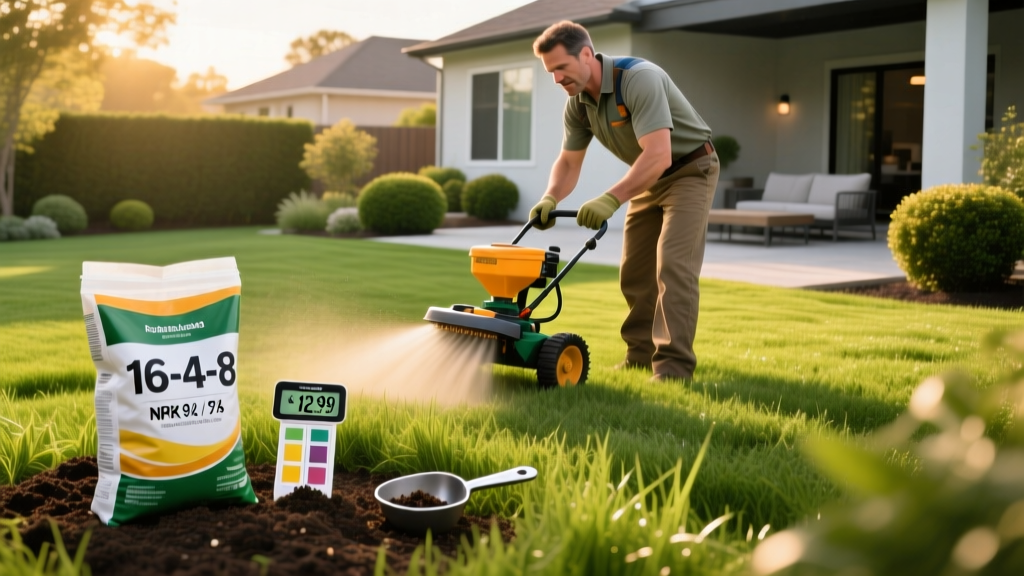
Fertilizing My Lawn: Exact NPK Ratios, Timing, and Product Costs
The Science of NPK: Decoding the Fertilizer Bag
When you are fertilizing my lawn, guessing the right product leads to wasted money, chemical burn, or nutrient runoff. Every commercial fertilizer bag displays a three-number NPK ratio representing the percentage by weight of Nitrogen (N), Phosphorus (P), and Potassium (K). Understanding how these macronutrients interact with your specific turfgrass species is the foundation of a dense, weed-resistant lawn.
Nitrogen (N) drives vegetative blade growth and chlorophyll production, giving your lawn its deep green color. Phosphorus (P) stimulates root development and is critical during seed germination or sod establishment. Potassium (K) regulates cellular water pressure, building resilience against drought, freezing temperatures, and disease.
Regulatory Alert: Due to severe algal bloom issues in watersheds, many states and municipalities now strictly prohibit the application of phosphorus to established lawns. Unless a soil test confirms a deficiency or you are actively overseeding, you must select a zero-phosphorus fertilizer (e.g., 32-0-4) to comply with local environmental regulations and avoid municipal fines.
Organic vs. Synthetic Nitrogen Sources
Not all nitrogen is created equal. The source of nitrogen dictates how quickly your grass absorbs it and how likely you are to experience fertilizer burn.
- Quick-Release Synthetics (Urea, Ammonium Sulfate): These provide an immediate flush of growth and rapid greening within 48 to 72 hours. However, they have a high salt index, meaning they can easily dehydrate grass blades (burn) if over-applied or left on dry turf. They also leach quickly through sandy soils.
- Slow-Release Synthetics (Methylenediurea/MDU, Sulfur-Coated Urea): These rely on soil microbial activity or moisture to break down the coating, feeding the lawn steadily over 6 to 10 weeks. They are the standard for premium granular lawn foods.
- Natural Organics (Milorganite, Feather Meal): Derived from biosolids or animal byproducts, these contain lower NPK concentrations and require warm soil temperatures (above 55°F) for microbes to mineralize the nutrients. They are exceptionally safe, virtually impossible to burn your lawn with, and improve long-term soil biology.
The Mehlich-3 Soil Test: Your Baseline Requirement
Applying fertilizer without a soil test is like prescribing medication without a diagnosis. The gold standard for turfgrass soil analysis is the Texas A&M AgriLife Extension Soil Testing Laboratory or your local university extension office using the Mehlich-3 extraction method. This test measures not just NPK, but crucial secondary nutrients like calcium, magnesium, and sulfur, alongside your soil's Cation Exchange Capacity (CEC) and pH.
If your soil pH falls below 6.0 or above 7.2, the grass roots physically cannot absorb the fertilizer you apply, regardless of the NPK ratio. A pH of 6.5 is the optimal target for maximizing nutrient availability. Expect to pay between $15 and $30 for a comprehensive university lab test, and apply the recommended lime or elemental sulfur amendments before your first fertilizer application of the season.
Cool-Season vs. Warm-Season: Your Custom Schedule
The timing of your applications must align with the biological growth cycles of your specific grass type. Cool-season grasses (Fescue, Kentucky Bluegrass, Ryegrass) grow aggressively in the spring and fall, while warm-season grasses (Bermuda, Zoysia, St. Augustine) peak during the heat of summer.
| Season | Cool-Season Grass Protocol | Warm-Season Grass Protocol |
|---|---|---|
| Early Spring | Light application (0.5 lbs N/1000 sq ft) only if lawn shows yellowing. Avoid heavy nitrogen to prevent disease. | Wait until 3 weeks after green-up. Apply 0.5 - 1.0 lbs N/1000 sq ft to fuel initial growth. |
| Late Spring | Apply 0.75 lbs N/1000 sq ft using slow-release nitrogen to sustain growth into early summer heat. | Heavy feeding. Apply 1.0 lbs N/1000 sq ft every 4-6 weeks during peak growing season. |
| Summer | Do NOT apply high nitrogen. Use liquid kelp or potassium-rich stress shields to survive heat dormancy. | Continue 1.0 lbs N/1000 sq ft monthly. Ensure deep, infrequent watering to prevent burn. |
| Early Fall | The most critical feeding. Apply 1.0 lbs N/1000 sq ft to fuel root growth and recovery from summer stress. | Taper off nitrogen. Apply a winterizer high in Potassium (e.g., 0-0-25) to prepare for dormancy. |
| Late Fall | Apply a final 1.0 lbs N/1000 sq ft (fast-release urea) right before the ground freezes for spring carryover. | Lawn is dormant. No fertilizer application. Focus on pre-emergent herbicides if needed. |
Top Fertilizer Picks and Real-World Costs (2026 Pricing)
Selecting the right product requires balancing your budget, soil needs, and application preferences. Below is a breakdown of industry-standard fertilizers with current retail pricing and specific use cases.
1. Scotts Turf Builder Lawn Food (32-0-4)
Cost: ~$38.00 for a 5,000 sq ft bag ($0.0076 per sq ft).
Best For: Routine maintenance on established cool and warm-season lawns. The 32% nitrogen content is heavily weighted toward MDU (slow-release), providing consistent feeding for up to 8 weeks without massive growth surges that require extra mowing.
2. Milorganite Slow-Release Nitrogen (5-2-0)
Cost: ~$24.00 for a 2,500 sq ft bag ($0.0096 per sq ft).
Best For: Homeowners with sandy soils, high heat environments, or those seeking an organic, pet-safe option. Because it is an organic biosolid, it will not burn your lawn even if you accidentally overlap spreader passes. It also contains 2.5% iron, which provides a deep, dark green color without forcing excessive blade growth.
3. Lesco Professional Starter Fertilizer (18-24-12)
Cost: ~$48.00 for a 5,000 sq ft bag ($0.0096 per sq ft).
Best For: Exclusively for overseeding or laying new sod. The high phosphorus content (24%) is legally restricted in many areas for established lawns but is vital for driving rapid root establishment in new seedlings. Apply on the exact day you drop your grass seed.
The 4-Step Calibration and Application Protocol
The most common cause of fertilizer striping (alternating dark and light green bands) and edge-burn is an improperly calibrated rotary spreader. Do not trust the generic settings printed on the fertilizer bag; they are approximations. Calibrate your specific spreader (e.g., Scotts EdgeGuard or Lesco Professional) using this protocol:
- Measure the Test Area: Mark off a 100-square-foot section of your driveway or a tarp (e.g., 10 feet by 10 feet).
- Weigh the Product: Calculate the exact weight of fertilizer needed for 100 sq ft based on the bag's application rate. If the bag covers 5,000 sq ft and weighs 14 lbs, you need 0.28 lbs (4.48 ounces) for your test area. Weigh this precisely on a digital kitchen scale.
- Run the Test: Pour the weighed product into the spreader. Set the dial to the manufacturer's suggested setting. Walk at your normal, steady pace (roughly 3 mph) over the 10-foot distance, turning the agitator on exactly at the start line and off at the end line.
- Adjust and Repeat: Weigh the leftover product. If you have product left, your spreader is set too low; if you ran out, it is set too high. Adjust the dial by half-steps and repeat until the 4.48 ounces is perfectly depleted over the 100 sq ft area.
Application Rule of Thumb: Always apply fertilizer to dry grass blades to prevent the granules from sticking to the foliage and causing localized chemical burns. Water the lawn immediately after application with roughly 0.25 inches of irrigation to wash the granules off the blades and into the soil profile where the roots can access them.
Troubleshooting: Burn, Stripes, and Runoff
Even with careful planning, environmental variables can disrupt your fertilization program. Here is how to diagnose and fix the most frequent turfgrass nutrition failures.
Symptom: Brown, crispy grass tips and white crust on the soil surface.
Diagnosis: Fertilizer burn caused by high salt index and lack of watering. The salts in the synthetic nitrogen are drawing moisture out of the grass roots via osmosis.
Fix: Immediately flood the affected area with 1 inch of water daily for 3 to 4 days to leach the excess salts deep below the root zone. Do not apply any further chemicals until the grass recovers.
Symptom: Alternating dark green and yellow-green stripes across the lawn.
Diagnosis: Spreader overlap error. The dark stripes are areas where the spreader pass overlapped, delivering double the intended nitrogen, while the yellow stripes are gaps where the spreader wheel tracks missed.
Fix: Use the 'half-rate, cross-hatch' method. Set your spreader to deliver exactly half the required rate. Walk the entire lawn in a North-South pattern, then apply the second half walking in an East-West pattern. This guarantees uniform coverage and eliminates striping.
'Nutrient runoff is a leading cause of nonpoint source water pollution. When fertilizing near storm drains, lakes, or streams, always utilize a drop spreader or engage the edge-guard feature on your rotary spreader to keep granules off impervious surfaces like concrete driveways, where they will wash directly into the municipal water supply.' — Environmental Protection Agency (EPA)
Frequently Asked Questions
Can I use liquid fertilizer instead of granular?
Liquid fertilizers (like those from Greene County Fertilizer Co. or Sunday) are excellent for applying micronutrients (iron, manganese) and biostimulants (kelp, humic acid) via foliar absorption. However, they lack the sheer macronutrient volume required to sustain a lawn's base NPK needs over a full season without requiring weekly applications. Use granular for your primary NPK feeding and liquid for targeted micronutrient corrections.
How long after fertilizing can I mow my lawn?
Wait at least 24 to 48 hours after applying granular fertilizer and watering it in. This allows the granules to fully dissolve and settle into the soil canopy. Mowing too soon can result in your mower's vacuum effect sucking up the undissolved fertilizer granules, throwing them into the clippings bag and robbing your lawn of the nutrients you just paid for.
Is it better to fertilize before or after rain?
Apply fertilizer just before a light, steady rain (about 0.25 to 0.5 inches) to naturally water the product into the soil. However, never apply fertilizer before a heavy downpour or thunderstorm. Intense rainfall will cause the granules to wash away, pooling in low spots (causing severe burn) and running off into storm drains, which violates local environmental protections outlined by the University of Maryland Extension and other agricultural authorities.

