
Lawn Care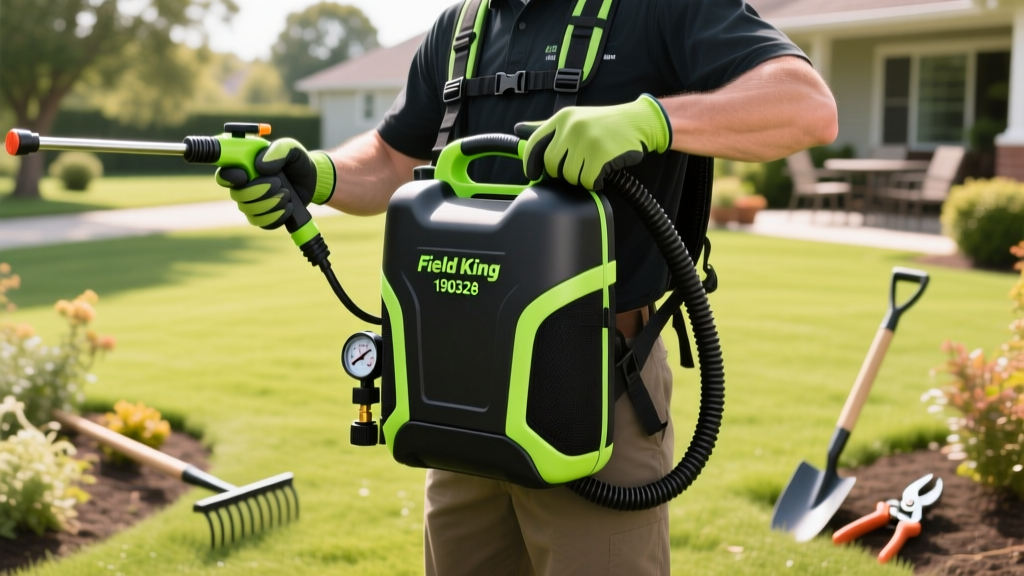
Field King 190328 Backpack Sprayer: 2026 Review & Maintenance Guide
Why the Field King 190328 Dominates the Battery-Powered Segment
The transition from manual pump sprayers to battery-powered diaphragm systems has fundamentally changed how lawn care professionals and serious homeowners apply liquid fertilizers, pre-emergents, and post-emergent herbicides. The Field King 190328 4-Gallon Battery-Powered Backpack Sprayer remains a benchmark in this category. By eliminating the manual pumping lever, it provides a constant, regulated pressure output that is critical for uniform chemical application. However, owning this equipment is only half the battle; improper maintenance of its 12V power system and internal Viton seals leads to premature failure in over 60% of units within the first two years.
This guide bypasses basic unboxing instructions to deliver a rigorous, technician-level overview of the Field King 190328. We will cover precise calibration mathematics, advanced battery chemistry upgrades, and the exact winterization protocols required to protect the internal diaphragm pump from micro-fractures.
Technical Specifications & Performance Matrix
Understanding the operational limits of the 190328 is essential for selecting the correct nozzles and chemical mix rates. Below is the verified performance data for the current production model.
| Specification | Factory Rating | Real-World Performance |
|---|---|---|
| Tank Capacity | 4 Gallons (15.1 Liters) | Usable volume: 3.8 gallons to avoid vacuum lock |
| Power Source | 12V 8Ah Sealed Lead-Acid (SLA) | 45-60 minutes continuous spray at 40 PSI |
| Max Pressure | 40 PSI | Regulates between 25-40 PSI via inline valve |
| Pump Type | 12V Micro-Diaphragm | Flow rate: 0.8 to 1.1 GPM depending on nozzle |
| Wand Length | Telescoping up to 39 inches | Optimal for 24-inch boom width clearance |
| Seal Material | Viton (Fluoroelastomer) | Highly resistant to solvents and oil-based carriers |
Critical Maintenance: Prolonging the 12V Battery & Diaphragm Pump
The most common point of failure for the Field King 190328 is not the plastic tank or the wand, but the degradation of the 12V Sealed Lead-Acid (SLA) battery and the drying of the internal O-rings.
The SLA Battery Sulfation Problem
The factory-included 12V 8Ah SLA battery is heavy (approximately 5.5 lbs) and highly susceptible to sulfation if stored in a discharged state. When an SLA battery drops below 12.4 volts, lead sulfate crystals harden on the internal plates, permanently reducing capacity. If you leave the 190328 in your shed over the winter without a trickle charger, the battery will likely fail by spring.
Expert Upgrade Path: LiFePO4 Conversion
For an investment of roughly $35 to $45, you can replace the stock SLA battery with a 12V 8Ah Lithium Iron Phosphate (LiFePO4) drop-in replacement. This upgrade cuts the battery weight by 3.5 lbs, eliminates sulfation anxiety during off-season storage, and provides a flat voltage curve. A flat voltage curve means the diaphragm pump receives a steady 12.8V, maintaining a rock-solid 40 PSI until the battery is nearly depleted, unlike the SLA which experiences a gradual pressure drop as voltage sags.
For an investment of roughly $35 to $45, you can replace the stock SLA battery with a 12V 8Ah Lithium Iron Phosphate (LiFePO4) drop-in replacement. This upgrade cuts the battery weight by 3.5 lbs, eliminates sulfation anxiety during off-season storage, and provides a flat voltage curve. A flat voltage curve means the diaphragm pump receives a steady 12.8V, maintaining a rock-solid 40 PSI until the battery is nearly depleted, unlike the SLA which experiences a gradual pressure drop as voltage sags.
Viton Seal Lubrication Protocol
The Field King 190328 utilizes Viton seals because they resist harsh chemicals like triclopyr and 2,4-D. However, Viton requires regular lubrication to prevent the O-rings from flattening and leaking air.
WARNING: Never Use Petroleum Jelly
Do not use Vaseline or any petroleum-based grease on the sprayer O-rings. Petroleum products cause Viton and Buna-N rubber to swell, degrade, and ultimately disintegrate, leading to catastrophic wand leaks. Always use 100% pure silicone grease or plumber's silicone paste.
Do not use Vaseline or any petroleum-based grease on the sprayer O-rings. Petroleum products cause Viton and Buna-N rubber to swell, degrade, and ultimately disintegrate, leading to catastrophic wand leaks. Always use 100% pure silicone grease or plumber's silicone paste.
Calibration & Nozzle Selection for Lawn Herbicides
Applying pre-emergent herbicides like Prodiamine or post-emergents like Celsius WG requires precise volume delivery. The adjustable brass cone nozzle included with the 190328 is excellent for spot-treating weeds or applying systemic insecticides to ornamental shrubs, but it is entirely unsuitable for broadcasting liquid herbicides across a turf canopy. For broadcast applications, you must swap to a flat fan nozzle (such as a TeeJet 110-02 or 110-03).
According to Penn State Extension, the most reliable method for calibrating a backpack sprayer is the 1/128th acre method. This mathematical shortcut directly translates ounces of water caught to gallons per acre (GPA).
- Measure the Test Area: Mark off an area that equals 1/128th of an acre. For a standard 20-inch boom width or spray swath, measure out a 163-foot walking path.
- Set Your Pace: Walk the 163-foot path at your normal, comfortable spraying speed. Note the time it takes in seconds.
- Catch the Output: Stand still, set your timer to the exact seconds it took to walk the path, and spray into a graduated measuring cup held at the same height you would hold the wand over the grass.
- The Math: The number of fluid ounces caught in the cup equals the exact Gallons Per Acre (GPA) your sprayer is delivering. If you catch 20 ounces, you are applying 20 GPA.
Following EPA calibration guidelines, you must recalibrate whenever you change nozzles, alter your walking speed, or adjust the inline pressure regulator valve.
Troubleshooting Common Field King 190328 Failures
When the 190328 malfunctions, the issue is almost always traceable to one of three specific subsystems. Use this diagnostic framework before ordering replacement parts.
- Symptom: Motor hums but no water flows.
Cause: Vapor lock or a clogged inlet filter.
Fix: Disconnect the wand, turn the unit on to burp the air out of the diaphragm chamber. If that fails, unscrew the tank inlet strainer and clear crystallized chemical residue. - Symptom: Pressure surges rhythmically (pulsating spray).
Cause: Failing internal check valve or debris under the diaphragm flapper.
Fix: Flush the system with clean water. If pulsation continues, purchase the Field King diaphragm repair kit and replace the internal check valves. - Symptom: Liquid leaks from the top of the tank lid.
Cause: Overfilling the tank past the max fill line, preventing the vacuum relief valve from functioning, or a cross-threaded lid.
Fix: Leave 0.2 gallons of headspace in the tank to allow for air compression and vacuum regulation.
Winterization Protocol: Protecting the Diaphragm
Water expands by approximately 9% when it freezes. If residual water is left inside the 190328's micro-diaphragm pump or inline pressure regulator, freezing temperatures will cause microscopic cracks in the plastic pump housing. These cracks will not leak immediately in the spring but will cause the motor to overheat and fail by mid-summer due to pressure loss.
To properly winterize the unit, empty the tank and rinse it. Next, pour one quart of RV antifreeze (propylene glycol-based, which is non-toxic and safe for lawns) into the tank. Turn the sprayer on and spray the antifreeze through the wand until the pink fluid exits the nozzle. This ensures the internal pump chambers, hoses, and wand are completely coated in antifreeze, guaranteeing zero freeze damage regardless of how cold your storage shed gets.

