Lawn Care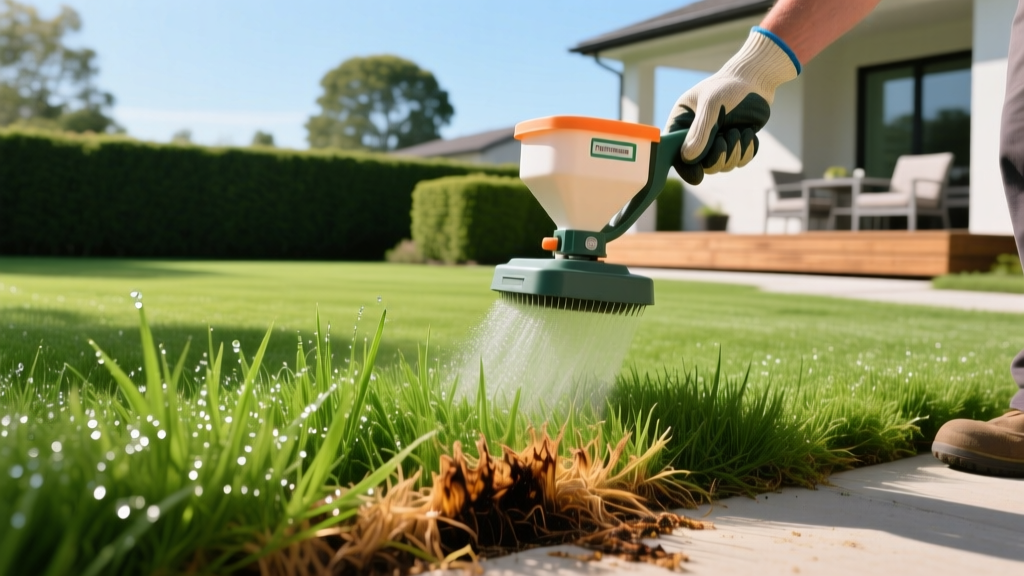
How to Stop Burning Fertilizer on Lawns: Recovery and Prevention
The Osmotic Science Behind Fertilizer Burn
When homeowners talk about burning fertilizer on their lawns, they are rarely dealing with actual heat or chemical combustion. Fertilizer burn is a physiological crisis driven by osmotic stress. Synthetic lawn fertilizers are composed of soluble mineral salts. When applied to the soil, these salts dissolve and dramatically increase the solute concentration of the soil solution.
Grass roots absorb water through osmosis—water naturally moves from areas of low solute concentration (inside the root) to areas of high solute concentration (the surrounding soil). If you over-apply a quick-release synthetic fertilizer, the soil becomes saltier than the root sap. The osmotic gradient reverses, actively pulling moisture out of the grass roots and into the soil. The result is rapid cellular dehydration, manifesting as scorched, yellow, or brown turf that mimics severe drought stress, even if the soil is physically wet.
⚠️ CRITICAL WARNING: The Overlap Trap
The most common cause of burning fertilizer damage occurs at the edges of the lawn or near driveways. When using a broadcast spreader without an edge guard, or failing to close the hopper during turns, the overlap zones receive double or triple the intended nitrogen and salt load. Always engage your spreader's edge guard and sweep up granules that land on hardscapes immediately.
Symptom Checker: Is It Fertilizer Burn or Something Else?
Before initiating a recovery protocol, you must confirm the diagnosis. Misidentifying a fungal pathogen as fertilizer burn and responding with heavy watering will exacerbate diseases like Brown Patch or Pythium Blight. Use this diagnostic matrix to verify the culprit.
| Symptom | Fertilizer Burn | Drought Stress | Brown Patch Fungus |
|---|---|---|---|
| Pattern | Stripes, arcs, or perimeter bands matching spreader paths | Uniform browning across entire lawn or high-sun zones | Irregular circular patches (1-5 feet) with dark smoke rings |
| Timeline | Appears 24 to 72 hours after application | Develops gradually over 1-2 weeks of no rain | Expands rapidly during hot, humid mornings |
| Leaf Blade | Crispy, bleached white/yellow from tip down; easily shatters | Folded or rolled leaves; purplish tint before browning | Tan lesions with dark borders; distinct rot at the sheath |
| Root Health | Roots are white but severely stunted or shriveled | Roots are deep, healthy, but soil is bone dry | Roots may rot off easily at the crown |
For authoritative diagnostic frameworks, turfgrass pathologists at the NC State University Turfgrass Program emphasize checking the application timeline and spatial distribution before treating the soil.
Step-by-Step Recovery Protocol for Burned Lawns
If you have confirmed salt toxicity, time is the critical variable. You must flush the salts below the root zone before cellular death becomes permanent. Follow this 14-day rehabilitation sequence.
Phase 1: Aggressive Leaching (Days 1–3)
Your immediate goal is to push the soluble salts past the top 6 inches of soil where the primary root mass resides.
- Water Volume: Apply 1 to 1.5 inches of water per day for three consecutive days. Use empty tuna cans placed across the burned zone to measure exact output.
- Cycle and Soak: Do not apply this water all at once, or you will cause surface runoff and soil erosion. Break it into three 20-minute cycles separated by 30-minute absorption windows.
- Mowing Pause: Do not mow the lawn during this phase. The grass is highly stressed, and mechanical tracking from mower wheels will cause secondary physical damage to the brittle crowns.
Phase 2: Soil Amendment and Chelation (Days 4–14)
Once the bulk of the salts are leached, you must repair the soil structure and neutralize residual sodium and chloride ions.
- Apply Pelletized Gypsum (Calcium Sulfate): Gypsum provides calcium, which displaces sodium ions attached to clay particles, allowing them to be flushed away. Apply at a rate of 10 lbs per 1,000 square feet. As of 2026, a standard 40 lb bag of Espoma Organic Gypsum costs approximately $18–$22 and covers 4,000 sq ft.
- Liquid Humic Acid Treatment: Apply a liquid humic and fulvic acid blend (such as Simple Lawn Solutions Liquid Humic Acid, approx. $32 per 32 oz bottle). Humic substances act as natural chelators, binding to excess heavy metals and salts while stimulating microbial activity to rebuild the rhizosphere.
- Foliar Kelp Extract: Spray a liquid seaweed/kelp extract directly on the foliage. Kelp contains natural cytokinins and auxins (plant growth hormones) that force the grass to generate new root nodes and lateral shoots, bypassing the damaged root tips.
💡 Pro Tip: The Core Aeration Accelerator
If the burn is severe and the soil is compacted, rent a core aerator on Day 5. Pulling 3-inch plugs creates direct channels for the leaching water and gypsum to reach deep into the subsoil, cutting recovery time in half.
Preventative Application Frameworks
Preventing burning fertilizer damage requires understanding the Salt Index (SI) of your chosen products. The Salt Index measures the osmotic pressure a fertilizer creates in the soil solution relative to sodium nitrate (which is set at a baseline of 100). According to guidelines published by the University of Minnesota Extension, selecting low-SI products is paramount for applications during high-temperature summer months.
Comparing Nitrogen Sources by Salt Index
| Fertilizer Product / Source | N-P-K Ratio | Salt Index (SI) | Burn Risk Profile |
|---|---|---|---|
| Urea (Quick Release) | 46-0-0 | 75.0 | Extreme |
| Ammonium Sulfate | 21-0-0 | 69.0 | High |
| Scotts Turf Builder | 32-0-4 | ~20.0 | Moderate |
| Methylene Urea (Slow Release) | 38-0-0 | 8.0 | Low |
| Milorganite (Biosolid) | 6-4-0 | 1.5 | Negligible |
The Nitrogen Math: Calibrating Your Spreader
Most burning fertilizer incidents happen because homeowners misinterpret the N-P-K ratio on the bag, leading to massive over-application of actual nitrogen. Here is the exact formula to calculate your application rate:
Target Rate: 1.0 lb of Nitrogen per 1,000 sq ft.
Product Used: 24-0-6 Fertilizer (24% Nitrogen).
Calculation: 100 ÷ 24 = 4.16 lbs of product required per 1,000 sq ft.
Action: Weigh out exactly 4.16 lbs, set your spreader to a low setting, and walk a 1,000 sq ft test area. If you run out of product before finishing the area, open the setting slightly. If you have product left over, close the setting.
Frequently Asked Questions
Can I just water the lawn once heavily to fix fertilizer burn?
No. A single heavy watering event often results in surface runoff, especially on compacted soils or sloped lawns. The water will sheet away before it can percolate deep enough to leach the salts below the 6-inch root zone. You must use the 'cycle and soak' method over 3 consecutive days to force downward water movement.
Will the brown grass turn green again?
Leaf blades that have fully desiccated and turned crispy brown are dead tissue; they will not revert to green. However, if the crown (the white, firm base of the grass plant at the soil line) is still intact and hydrated, the plant will push new green shoots from the center within 10 to 14 days of starting the leaching and humic acid protocol.
Is it safe to use Milorganite in the peak of summer?
Yes. Because Milorganite is a heat-dried biosolid with a Salt Index of only 1.5, it relies on soil microbes to break down its nitrogen. It will not cause osmotic stress or burning fertilizer damage, even if applied during 95°F heat waves without immediate irrigation, making it the safest summer nitrogen source for stressed cool-season lawns.