
Lawn Care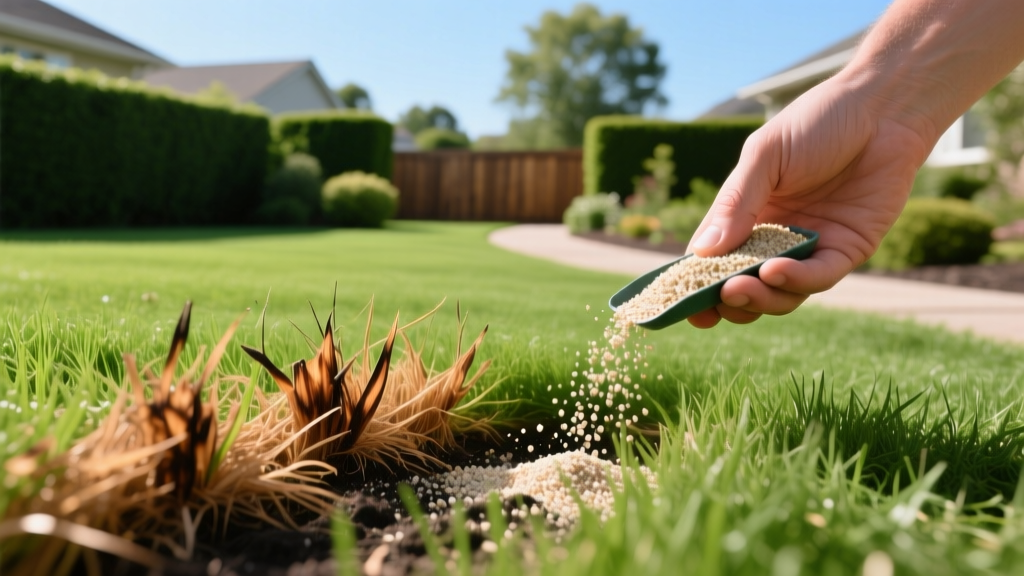
How to Fix Burnt Grass with Fertilizer: Recovery Steps
The Science of Fertilizer Burn: Osmotic Stress and Salt Index
When you encounter burnt grass with fertilizer, you are witnessing osmotic stress in real time. Fertilizer burn is not a chemical scorching of the leaf blade; it is a severe moisture deficit at the root level caused by a sudden spike in soil salinity. When synthetic, quick-release fertilizers dissolve, they release soluble salts into the soil solution. If the concentration of these salts outside the grass roots exceeds the concentration inside the root cells, water is drawn out of the plant through osmosis, effectively dehydrating the turf from the inside out.
The severity of this reaction depends on the fertilizer's Salt Index (SI). According to turfgrass agronomy standards, the SI of sodium nitrate is set at 100 as a baseline. Common lawn fertilizers vary wildly in their burn potential:
- Urea (46-0-0): SI of 75. High burn risk if not watered in immediately.
- Ammonium Sulfate (21-0-0): SI of 69. Moderate to high burn risk, commonly used for acidic soil correction.
- Potassium Chloride (0-0-60): SI of 116. Extremely high burn risk; rarely applied directly to established turf without heavy dilution.
- Methylene Urea (Slow-Release): SI of 15-25. Very low burn risk due to gradual microbial breakdown.
Quick-Release vs. Slow-Release: Quick-release nitrogen (like urea) provides immediate greening but spikes soil salinity within 24 hours. Slow-release nitrogen (like polymer-coated urea or methylene urea) costs approximately 30% to 50% more per bag but releases nutrients over 6 to 12 weeks, virtually eliminating the risk of fertilizer burn when applied at standard rates.
Diagnosing True Fertilizer Burn vs. Drought or Fungus
Before initiating a recovery protocol, verify that the damage is actually from fertilizer. Burnt grass with fertilizer typically manifests within 24 to 48 hours of application and strictly follows the physical pattern of the spreader passes. Overlapping spreader tracks will show double-burn (dark brown, dead crowns), while the center of the pass may only show yellowing (chlorosis). Compare your lawn's symptoms against other common stressors:
| Condition | Visual Pattern | Onset Speed | Crown Condition |
|---|---|---|---|
| Fertilizer Burn | Distinct streaks, stripes, or geometric shapes matching equipment width. | 24 to 48 hours post-application. | Brown and brittle in overlap zones; yellow in single-pass zones. |
| Drought Stress | Uniform dull-green to grayish hue; footprints remain visible on turf. | 3 to 7 days of no rainfall/irrigation. | Green and firm; dormant but alive. |
| Dollar Spot Fungus | Scattered silver-dollar-sized circular patches; cobweb-like mycelium at dawn. | Progresses over several days during high humidity. | Lesions on individual blades with distinct brown borders. |
Step-by-Step Recovery Protocol for Burnt Grass
Recovering a lawn from severe salt toxicity requires a phased approach to flush the soil profile, restore cation balance, and replace dead tissue. Follow this exact timeline to maximize turf survival.
Phase 1: Leaching the Soil (Days 1 to 5)
The immediate priority is to push soluble salts below the active root zone (typically 6 to 8 inches deep). Do not apply a light sprinkle, as this only moves salts into the upper root zone, worsening the osmotic stress.
- Measure Output: Place 3 to 5 straight-sided catch cans (or empty tuna cans) across the burnt zones.
- Apply Heavy Irrigation: Water the lawn until the catch cans collect exactly 1 inch of water. This typically requires 60 to 90 minutes with standard pop-up spray heads.
- Repeat Daily: Apply 1 inch of water daily for 4 to 5 consecutive days. This delivers 4 to 5 inches of total water, sufficient to leach sodium and chloride salts deep into the subsoil where they cannot harm roots.
- Monitor Runoff: If your soil is heavy clay and water begins pooling or running off before the 1-inch mark is reached, split the watering into two 0.5-inch cycles separated by a 2-hour absorption window.
Phase 2: Soil Amendment and Aeration (Days 6 to 14)
Once the salts are leached, the soil structure and cation exchange capacity (CEC) need stabilization. High-salt fertilizers often leave behind residual sodium, which destroys soil aggregation and causes compaction.
- Apply Pelletized Gypsum: Broadcast calcium sulfate (gypsum) at a rate of 50 lbs per 1,000 square feet. The calcium ions will displace sodium ions on the soil clay particles, allowing the sodium to be flushed away in subsequent waterings while improving soil porosity. A standard 50 lb bag of gypsum costs approximately $15 to $22 at major home improvement centers.
- Core Aeration: If the burn resulted in severe crown death and soil crusting, run a core aerator over the affected zones. Pulling 2-to-3-inch plugs breaks up the surface seal created by the salt and fertilizer residue, allowing oxygen to reach surviving rhizomes.
Phase 3: Overseeding and Resuming Nutrition (Days 15 and Beyond)
Perform the 'pull test' on the brown grass. If the turf pulls up easily with no white root attachment, the crowns are dead and the area must be renovated.
- Remove Debris: Use a stiff thatching rake to aggressively remove the dead brown blades and expose the soil surface.
- Seed Selection: For cool-season lawns, use a mix of Perennial Ryegrass (for 5-to-7-day rapid germination and soil stabilization) and Turf-Type Tall Fescue (for deep-rooted drought resistance). Apply seed at 5 to 8 lbs per 1,000 square feet.
- Starter Fertilizer: Apply a low-nitrogen, high-phosphorus starter fertilizer (e.g., 10-18-10) at the rate specified on the bag. The phosphorus is critical for new root development, and the low nitrogen prevents a secondary burn event on the delicate seedlings.
Preventative Application Rates and Equipment Calibration
Preventing burnt grass with fertilizer is vastly more cost-effective than the recovery process. The primary cause of burn is not the product itself, but miscalibrated spreaders and excessive application rates of quick-release nitrogen.
According to turfgrass management guidelines from institutions like the University of Minnesota Extension, cool-season lawns should receive no more than 0.5 to 0.75 lbs of actual quick-release nitrogen per 1,000 square feet in a single application. To calculate this, divide 100 by the first number on the fertilizer bag's NPK ratio. For a 20-0-10 fertilizer, 100 divided by 20 equals 5. This means you apply exactly 5 lbs of physical product per 1,000 square feet to deliver 1 lb of nitrogen. To deliver a safe 0.5 lb rate, you would set your spreader to apply 2.5 lbs of product per 1,000 square feet.
Furthermore, always consult the Royal Horticultural Society or local extension guidelines for seasonal timing. Applying high-nitrogen fertilizers during peak summer heat (above 85°F) drastically increases osmotic stress because the grass's transpiration rate is already maxed out. Stick to early spring and early fall applications for cool-season grasses, and late spring through summer for warm-season varieties like Bermuda or Zoysia.
Frequently Asked Questions
Will watering immediately after fertilizing prevent burn?
Yes, watering in granular fertilizer with 0.25 inches of water immediately after application washes the prills off the grass blades and into the soil, preventing leaf-tip burn. However, if the total application rate of quick-release nitrogen was too high, surface watering will not prevent root-level osmotic stress; you must still adhere to the 0.5 to 0.75 lbs per 1,000 sq ft maximum limit.
Can I use liquid fertilizer to avoid burning my lawn?
Liquid fertilizers actually carry a higher immediate burn risk than granular if not properly diluted, because the salts are already in solution and immediately available to the plant tissue. If using liquid urea or ammonium sulfate, you must strictly follow the dilution ratios on the label and apply during the early morning or late evening when temperatures are below 75°F.
How long does it take for fertilizer burn to show up?
Leaf tip yellowing can appear within 12 to 24 hours under hot, sunny conditions. Severe, crown-killing brown streaks typically manifest between 24 and 48 hours post-application, particularly in areas where the spreader was overlapped or where the spreader was left stationary while the hopper gate was open.

