
Lawn Care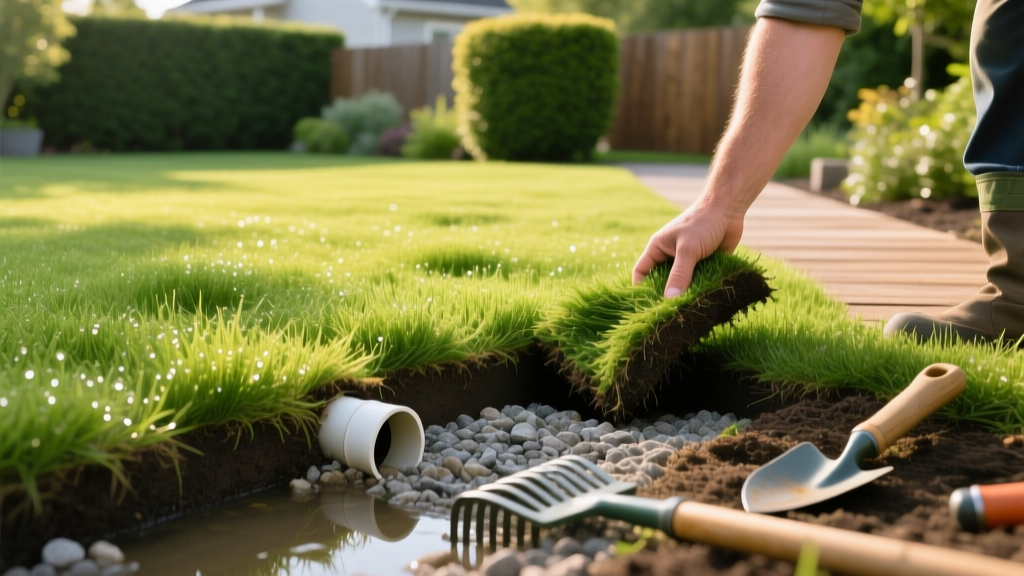
How to Fix Chronically Wet Grass and Improve Lawn Drainage
The Mechanics of Waterlogged Turf
Chronically wet grass is rarely just a surface nuisance; it is a symptom of failed soil hydrology. When lawn soil remains saturated for more than 24 hours after a rainfall, pore spaces fill entirely with water, displacing oxygen. This triggers anaerobic conditions, causing root asphyxiation and the rapid proliferation of sulfate-reducing bacteria, which produce the hydrogen sulfide gas responsible for the "rotten egg" smell in poorly drained lawns. Solving wet grass requires moving beyond temporary surface fixes and addressing the underlying soil profile, drainage gradients, and turf selection.
⚠ Fungal Vector Warning: Mowing wet grass is the primary mechanical vector for turf diseases. Wet grass blades bend rather than shear, resulting in jagged tears that lose 20-30% more water to evaporation and serve as direct entry points for Rhizoctonia solani (brown patch) and Pythium blight. Furthermore, mower tires hydroplane on wet turf, creating micro-ruts that compact the top 3 inches of soil and reduce future water infiltration rates by up to 40%.
Diagnostic Matrix: Identifying Your Moisture Problem
Before purchasing drainage materials, you must identify the exact failure point in your lawn's hydrology. Use this diagnostic framework to determine the correct intervention.
| Surface Symptom | Underlying Cause | Primary Intervention |
|---|---|---|
| Water pools for >4 hours post-rain | Clay pan or severe subsoil compaction | Deep-tine aeration + angular sand topdressing |
| Turf feels spongy, squishes underfoot | Excessive thatch (>0.75") or high water table | Power raking (dethatching) + subsurface French drain |
| Constant dampness despite full sun | Improper grading (negative slope toward home) | Re-grading with laser level + swale installation |
| Wet grass localized under tree canopies | Canopy interception blocking evaporation | Crown thinning/limbing + shade-tolerant wet cultivars |
Soil-Level Interventions: Topdressing and Aeration
If your wet grass issue stems from heavy clay soils that resist infiltration, mechanical aeration paired with specific topdressing materials will permanently alter the soil structure.
The Topdressing Protocol
Do not use play sand or beach sand. These particles are rounded by water erosion and will pack tightly, worsening compaction. You must use masonry sand (ASTM C144 standard), which features angular particles that physically wedge clay aggregates apart, creating permanent macropores.
- Mix Ratio: 70% masonry sand to 30% finely screened compost (by volume).
- Application Depth: Exactly 1/4 inch. Applying more will smother the existing crown tissue.
- Material Math: A 1/4 inch layer over 5,000 square feet requires roughly 104 cubic feet (3.8 cubic yards) of mix. At 2026 bulk pricing of $45-$60 per cubic yard, expect to spend $170-$230 on materials.
Aeration Depth Comparison
Standard core aeration only penetrates 3 to 4 inches, which is insufficient if your compaction layer (the clay pan) sits deeper. According to turfgrass researchers at the NC State Turfgrass Program, deep-tine aeration is required for chronically saturated sites.
- Core Aeration: 3-4 inch depth. Removes soil plugs. Best for annual maintenance and thatch management. Cost: ~$15-$20 per 1,000 sq ft.
- Deep-Tine Aeration: 10-14 inch depth. Uses solid tines to fracture deep compaction layers without bringing clay to the surface. Cost: ~$45-$65 per 1,000 sq ft.
Selecting Moisture-Tolerant Cultivars
If drainage modifications are structurally impossible due to property lines or budget constraints, you must adapt the biology to the environment. Standard Kentucky Bluegrass (Poa pratensis) will succumb to root rot in saturated soils within 48 hours. Transition to these moisture-tolerant alternatives:
- Rhizomatous Tall Fescue (RTF): Cultivars like 'Bullseye' or 'Goliath' possess deep, aggressive root systems that tolerate periodic waterlogging while maintaining a dark green color. RTF seed costs approximately $12-$15 per pound.
- Rough Bluegrass (Poa trivialis): The undisputed champion of wet, heavily shaded sites. It thrives in saturated soils where Tall Fescue fails. Drawback: It has a distinct lime-green color that contrasts with surrounding turf, and it goes dormant quickly in high summer heat.
- Creeping Bentgrass (Agrostis stolonifera): Used on golf course putting greens, specific cultivars like 'Penncross' tolerate wet feet exceptionally well but require intensive maintenance, including frequent mowing at heights below 1 inch and strict fungicide schedules.
Installing a Subsurface French Drain
When the University of Minnesota Extension recommends subsurface drainage for lawns with high water tables, the French drain is the standard solution. However, 80% of DIY installations fail within three years due to improper material selection. Follow this exact specification:
- Trench Dimensions: Dig a trench 18 inches deep and 12 inches wide. Maintain a minimum slope of 1/8 inch per foot (1% grade) toward the discharge point.
- Base Layer: Lay 2 inches of 3/4-inch washed drain rock. Never use gravel with "fines" (stone dust), as the fines will wash into the pipe and clog the perforations.
- Pipe Selection: Use 4-inch SDR-35 rigid PVC pipe, not flexible corrugated black pipe (which crushes under soil load and traps sediment in its ridges). Drill 1/2-inch holes every 6 inches.
- Orientation Myth: Place the pipe with the holes facing DOWN. Water rises in the gravel bed and enters the bottom of the pipe. This prevents silt from washing directly into the pipe cavity.
- Geotextile Wrap: Wrap the pipe and gravel entirely in a non-woven geotextile fabric (e.g., Mirafi 140N). Do not use woven weed barrier; it lacks the necessary flow rate and will blind off with clay particles.
- Backfill: Cover with washed rock to 2 inches below grade, fold the fabric over the top, and cap with native topsoil and sod.
Lawn Care FAQ: Wet Grass Edge Cases
Can I use a lawn roller to flatten ruts caused by mowing wet grass?
No. Rolling wet soil exacerbates compaction, pushing soil particles closer together and destroying the macropores required for oxygen exchange. Instead, wait for the soil to dry to a "plastic" state (moist but not sticky), then use a garden fork to manually lever the compacted ruts upward, followed by a light topdressing of masonry sand.
Will gypsum break up my wet, heavy clay lawn?
Gypsum (calcium sulfate) only improves drainage in sodic soils (soils with high exchangeable sodium), which are rare in most residential lawns outside of arid, irrigated regions. For standard heavy clay soils, gypsum provides zero structural benefit. Rely on mechanical deep-tine aeration and angular sand topdressing instead.
How do I know when it is safe to mow after a heavy rain?
Perform the "footprint test." Step onto the lawn and observe your footprint. If the grass blades spring back immediately and no water seeps into the footprint, the surface tension is low enough to mow. If the footprint remains visible for more than 15 minutes, or if water pools in the depression, the soil shear strength is too low; mowing will cause severe turf tearing and soil rutting.

