
Lawn Care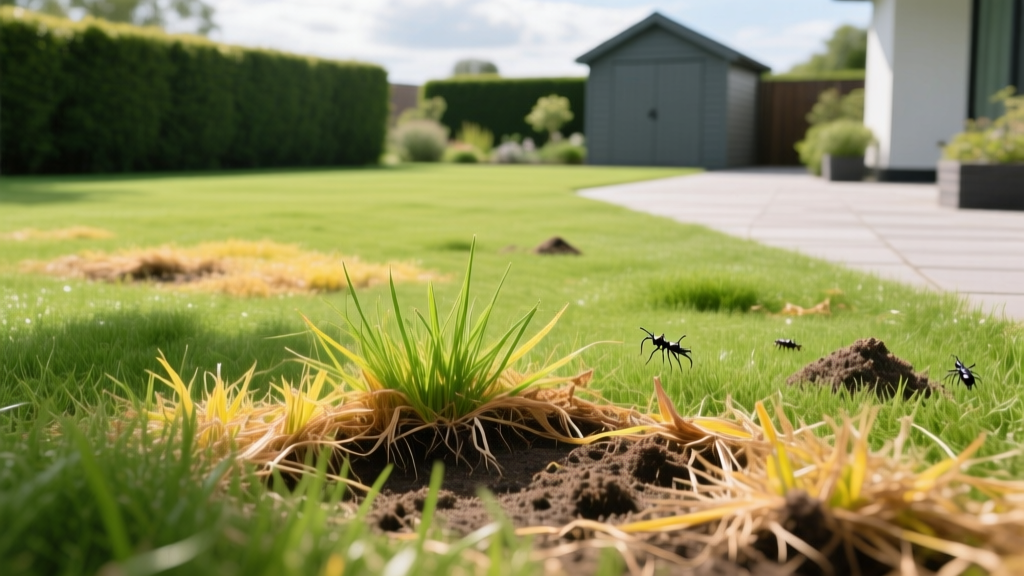
Why Does My Grass Die in Patches? Diagnosis & Recovery
When sections of your lawn turn brown and brittle, the instinct is often to increase watering or dump nitrogen fertilizer on the area. This reactive approach frequently accelerates the decline. Grass dies in patches due to specific, localized stressors—ranging from subsurface insect feeding to fungal pathogens and severe soil compaction. Accurately identifying the failure mode is the only way to stop the spread and restore the turf.
This guide provides a clinical, step-by-step diagnostic and treatment protocol to identify why your grass is dying and how to execute a targeted recovery.
The 4-Step Diagnostic Protocol for Dying Grass
Step 1: The "Tug Test" and Root Inspection
The first step in diagnosing dead patches is determining where the structural failure is occurring. Grab a handful of the dying grass at the edge of the brown patch and pull upward with moderate force.
- If the grass pulls up easily like a loose carpet: The root system has been severed from the crown. This is the primary indicator of white grub feeding or severe mole activity.
- If the grass breaks off at the soil line or crown: The roots are anchored, but the crown is rotting. This points to a fungal disease like Brown Patch (Rhizoctonia solani) or Pythium Blight.
- If the grass resists pulling but is visibly thinning and browning from the tip down: The plant is experiencing environmental stress, typically drought, compaction, or localized hydrophobic soil (dry spot).
Warning: The Watering Trap
If your grass is dying from a fungal pathogen, increasing your irrigation schedule will create the exact high-humidity, wet-canopy environment the fungus needs to spread. Never add water to a dying patch until you have ruled out disease via the tug test and visual crown inspection.
If your grass is dying from a fungal pathogen, increasing your irrigation schedule will create the exact high-humidity, wet-canopy environment the fungus needs to spread. Never add water to a dying patch until you have ruled out disease via the tug test and visual crown inspection.
Step 2: Soil Moisture and Compaction Audit
If the tug test indicates environmental stress, test the soil's physical properties. Take a standard 6-inch flat-head screwdriver and push it into the soil at the edge of the dying patch. If you cannot push it in to the handle with moderate body weight, your soil bulk density exceeds 1.4 g/cm³. At this level of compaction, oxygen is depleted, water cannot infiltrate, and roots suffocate, causing the grass above to die off in localized, high-traffic zones.
Symptom-to-Cause Diagnostic Matrix
Use this matrix to cross-reference your visual observations with the underlying biological or physical cause.
| Visual Symptom | Root/Crown Condition | Primary Culprit | Immediate Action Required |
|---|---|---|---|
| Irregular brown patches, peeling sod | Roots chewed off, C-shaped white larvae visible in top 2 inches of soil | White Grubs (Japanese Beetle/Masked Chafer) | Apply curative Trichlorfon insecticide |
| Circular brown spots with dark smoke rings on margins | Crown is mushy, roots are dark and rotted | Brown Patch Fungus (Rhizoctonia solani) | Apply Propiconazole fungicide, reduce watering |
| Browning in high-traffic areas or along sidewalks | Roots are shallow, horizontal, and stunted; soil is hard | Severe Soil Compaction | Core aeration and topdressing |
| Localized dry, grayish-blue wilting spots | Roots are intact but bone dry; soil repels water | Hydrophobic Soil / Localized Dry Spot | Apply soil surfactant/wetting agent |
Step 3: Targeted Treatment Application
Protocol A: Curative Grub Eradication
If grubs are actively feeding and killing your grass in late summer or early fall, preventative products like Imidacloprid will not work fast enough. You must use a curative insecticide. According to Penn State Extension, the standard curative active ingredient is Trichlorfon (commonly sold as Dylox 6.2 G).
- Application Rate: 1.5 to 2.0 lbs per 1,000 square feet.
- Cost: Approximately $45 to $55 for a 30 lb bag covering 10,000 sq ft.
- Critical Execution Step: Trichlorfon degrades rapidly in sunlight and alkaline water. You must water the granules in immediately with exactly 0.5 inches of irrigation to move the chemical into the thatch-soil interface where the grubs are feeding. Failure to water it in within 2 hours will result in a 50% or greater loss of efficacy.
Protocol B: Fungicide Application for Brown Patch
For fungal diseases, systemic fungicides are required to stop the pathogen from destroying the plant's cellular structure. As noted by the University of Minnesota Extension, rotating active ingredients prevents pathogen resistance.
- Active Ingredient: Propiconazole 14.3 (e.g., Honor Guard PPZ) or Azoxystrobin.
- Application Rate: 0.73 fl oz per 1,000 sq ft for early intervention; increase to 1.1 fl oz per 1,000 sq ft if the disease is actively spreading.
- Cost: $30 to $40 for a 16 oz bottle.
- Cultural Control: Switch to deep, infrequent watering. Apply 0.5 inches of water twice a week in the early morning (between 4:00 AM and 6:00 AM) so the grass canopy dries completely before nightfall.
Step 4: Soil Renovation and Overseeding
Once the biological threat (grubs or fungus) is neutralized, or the physical threat (compaction) is addressed, the dead patches must be renovated. Grass will not spontaneously regenerate from dead crowns.
- Mechanical Aeration: For compacted zones, use a hollow-tine core aerator. The machine must extract plugs that are 0.5 inches wide and 3 inches deep, spaced no more than 4 inches apart. Leave the plugs on the lawn; as they break down over 2-3 weeks, the soil microbes within them will help decompose the thatch layer.
- Seedbed Preparation: Rake the dead patches aggressively with a steel tine rake to remove dead thatch and expose the bare soil. Seed-to-soil contact is non-negotiable for germination.
- Seed Selection and Rate: Use a high-quality, endophyte-enhanced Tall Fescue blend (such as Jonathan Green Black Beauty Ultra) for cool-season lawns, or a vegetative Bermuda/Sod for warm-season repairs. Apply seed at a rate of 6 to 8 lbs per 1,000 square feet for patch repair.
- Topdressing: Apply a 1/4-inch layer of screened compost or peat moss over the seed to retain moisture and protect against bird predation.
Expert Renovation Tip: Avoid applying high-nitrogen synthetic fertilizers to newly seeded patches. The salt index of synthetic nitrogen can desiccate delicate new roots. Instead, use a starter fertilizer high in phosphorus (e.g., a 10-18-10 NPK ratio) at 1 lb of nitrogen per 1,000 sq ft to stimulate rapid root establishment.
Preventative Maintenance Calendar
To stop grass from dying in future seasons, implement this proactive maintenance schedule:
- Early Spring (Soil Temps 50°F+): Apply pre-emergent crabgrass control (Prodiamine) to prevent summer weed competition that stresses turf.
- Early Summer (June 1 - June 15): Apply preventative grub control (Imidacloprid or Chlorantraniliprole) before eggs hatch. This costs roughly $15 per 5,000 sq ft and eliminates the need for harsh curative chemicals later.
- Late Summer (August): Perform the "tuna can test" to measure irrigation output. Place 3 empty tuna cans across your lawn zones, run your sprinklers for 30 minutes, and measure the water depth. Adjust your run times to deliver exactly 1.0 to 1.5 inches of water per week.
- Early Fall (September): Core aerate and overseed the entire lawn. Fall provides the optimal soil-to-air temperature ratio for cool-season grass root development before winter dormancy.
By following this diagnostic matrix and adhering to precise application rates, you can halt turf decline and restore a uniform, healthy lawn canopy without wasting resources on misdiagnosed treatments.

