
Lawn Care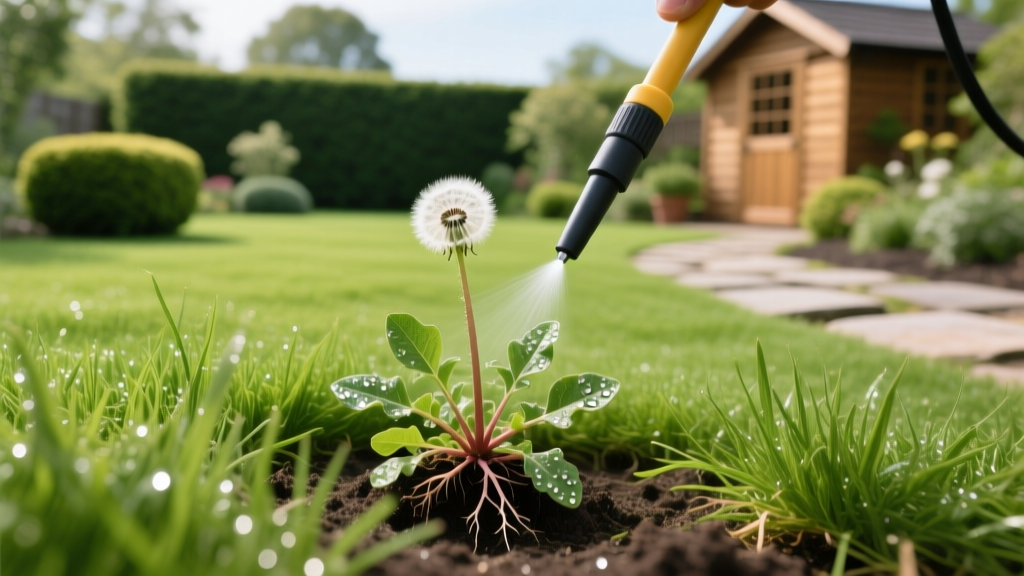
How to Fix a Lawn Full of Weeds: Species-Specific Spot-Treatment Guide
When you step outside and realize you have a lawn full of weeds, the immediate instinct is often to grab a hose-end sprayer and blanket the entire yard with a non-selective herbicide. This is a catastrophic mistake that will kill your turfgrass alongside the invaders. According to the UC Statewide IPM Program, effective weed management requires precise identification and targeted chemical interventions rather than broad-spectrum eradication.
Spot-treating specific weed species preserves your existing turf, reduces chemical runoff, and saves money. Below is a professional-grade triage and spot-treatment framework to reclaim your yard without starting from scratch.
The Weed Triage Decision Matrix
Before mixing any chemicals, you must categorize the weeds dominating your lawn. Herbicides are highly specific; a broadleaf killer will not touch a grassy weed, and a sedge herbicide will ignore both. Use this matrix to select the correct active ingredient.
| Weed Category | Common Species | Active Ingredient Required | Pro-Grade Product Example | Turf Safety |
|---|---|---|---|---|
| Broadleaf | Dandelion, Clover, Plantain, Thistle | 2,4-D, MCPP, Dicamba, Carfentrazone | SpeedZone Broadleaf Herbicide | Safe for most cool/warm-season grasses |
| Grassy Weeds | Crabgrass, Goosegrass, Poa Annua | Quinclorac, Fluazifop, Fenoxaprop | QuinKill Max, Ornamec | Highly dependent on turf type (read label) |
| Sedges | Yellow Nutsedge, Purple Nutsedge, Kyllinga | Halosulfuron-methyl, Sulfentrazone | SedgeHammer+, Blindside | Safe for most established turfgrasses |
Protocol 1: Broadleaf Weed Spot-Treatment
Broadleaf weeds are the most common culprits in a lawn full of weeds. Modern professional formulations have moved beyond basic 2,4-D by adding carfentrazone-ethyl, which accelerates the burn-down process from 14 days to just 48 hours.
Mixing and Application Rates
- Product: SpeedZone (or generic equivalent containing carfentrazone).
- Rate: 1.5 fluid ounces per 1,000 square feet.
- Carrier Volume: Mix with 1 to 2 gallons of water per 1,000 sq ft to ensure adequate coverage without excessive runoff.
- Adjuvant: Add a Non-Ionic Surfactant (NIS) at 0.25% v/v (approximately 1/2 teaspoon per gallon of water). This breaks the surface tension of the waxy leaf cuticle.
⚠️ Volatilization Warning: Never apply products containing Dicamba or 2,4-D when ambient temperatures exceed 85°F. At high temperatures, these chemicals vaporize and drift through the air, causing severe phytotoxicity (leaf cupping and twisting) to nearby ornamental trees, shrubs, and garden beds.
Protocol 2: Grassy Weed Eradication
Grassy weeds are notoriously difficult to spot-treat because they are biologically similar to your desired turf. The Texas A&M AgriLife Extension notes that selective post-emergent grassy weed control requires strict adherence to turfgrass compatibility charts.
Targeting Crabgrass and Goosegrass
For cool-season lawns (Fescue, Kentucky Bluegrass) and Bermuda grass, Quinclorac is the gold standard. However, quinclorac is highly toxic to St. Augustine and Centipede grasses. If you have those warm-season varieties, you must use Fluazifop (e.g., Ornamec) or rely on manual extraction and pre-emergent strategies.
💡 The MSO Secret: When spot-treating mature crabgrass (3+ tillers) with Quinclorac, swap your standard NIS for a Methylated Seed Oil (MSO). MSO penetrates the thick, hairy sheaths of mature crabgrass far more effectively than standard surfactants, increasing kill rates by up to 40%.
Protocol 3: Sedge and Tough Perennials
Homeowners frequently mistake nutsedge for grass, leading to failed treatments. Sedges have solid, triangular stems ('sedges have edges') and grow significantly faster than surrounding turf in mid-summer.
The SedgeHammer Protocol
Halosulfuron-methyl (sold as SedgeHammer) is a systemic herbicide that translocates down into the weed's tubers (nutlets). Standard broadleaf herbicides only burn the top growth, allowing the sedge to resprout in weeks.
- Dosage: One 0.025 oz water-soluble bag treats up to 1,000 sq ft (costs roughly $3.00 per application).
- Timing: Apply when nutsedge is actively growing and has reached the 3-to-8 leaf stage. Do not mow for 2 days before and 2 days after application.
- Patience Required: Halosulfuron is slow-acting. The sedge will stop growing immediately, but visible yellowing and necrosis will take 10 to 14 days. Do not reapply prematurely.
Equipment Calibration for Spot-Treatment
The biggest failure point in DIY weed control is poor equipment calibration. Hose-end sprayers are entirely unsuitable for spot-treatment due to inconsistent mixing ratios. You must use a 1-gallon or 2-gallon polyethylene pump sprayer equipped with a flat fan nozzle (such as a TeeJet 8004VS).
- Cone Nozzles: Deliver too much volume in the center and too little on the edges, leading to herbicide overdose and turf burn.
- Flat Fan Nozzles: Provide a uniform, even distribution pattern essential for calculating exact chemical doses per square foot.
- Pressure: Pump the sprayer to 40 PSI. Higher pressures create fine mist droplets that are prone to wind drift.
The 30% Threshold Rule: When to Stop Spot-Treating
Spot-treatment is highly effective, but it has a mathematical limit. If your lawn consists of more than 30% to 40% weed coverage, the economics and labor of spot-spraying no longer make sense. Furthermore, leaving massive bare patches after killing widespread weeds will only invite a secondary invasion of worse weeds or soil erosion.
If you cross the 30% threshold, transition from a spot-treatment strategy to a total renovation strategy:
- Apply a non-selective herbicide (Glyphosate) to the entire area.
- Wait 14 days for total vegetation kill.
- Scalp the dead material, perform core aeration, and heavily overseed (or lay new sod) during your region's optimal growing window.
Troubleshooting: Why Did the Weed Turn Red but Not Die?
If you applied an iron-based organic herbicide (like FeHEDTA) and the weeds turned black or red but are still rooted, you have only achieved top-growth burn. Iron-based herbicides are contact-only and lack systemic translocation. You must apply a second dose 14 days later, or switch to a synthetic systemic option (like Trimec) to ensure the chemical reaches the taproot.

