
Lawn Care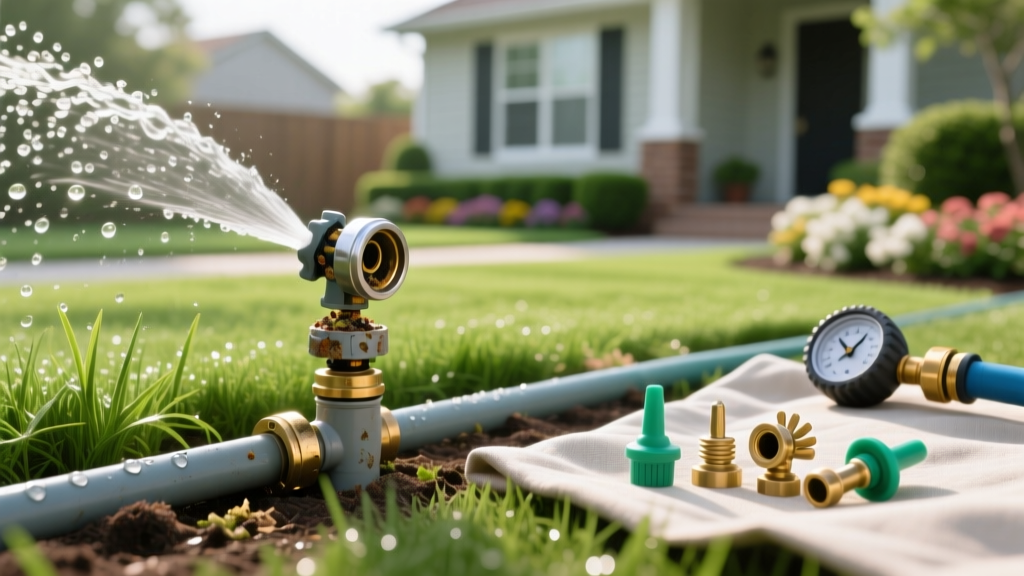
How to Fix a Low Water Pressure Sprinkler System & Select Nozzles
The Diagnostic Baseline: Static vs. Dynamic Pressure
A low water pressure sprinkler system rarely stems from a single failing component; it is usually a mismatch between your home's water supply and the hydraulic demand of your irrigation zones. To troubleshoot accurately, you must distinguish between static and dynamic pressure. Static pressure is the PSI measured when all water in the home is turned off. Dynamic pressure is the PSI measured while a specific sprinkler zone is actively running.
Purchase a hose-thread pressure gauge (such as the Rain Bird P2A, typically $12-$18). Screw it onto an outdoor spigot to measure static pressure, then screw it onto a sprinkler head equipped with a pitot tube adapter to measure dynamic pressure. If your static pressure reads 65 PSI but drops to 22 PSI dynamically, you do not have a municipal supply issue—you have a flow restriction or zone overload.
Warning: Never attempt to bypass your home's Pressure Reducing Valve (PRV) to boost irrigation pressure without checking your municipal water codes. Exceeding 80 PSI inside your home's plumbing can void appliance warranties and burst supply lines.
5 Hidden Culprits Behind Sprinkler Pressure Drops
Once you confirm a severe dynamic pressure drop, isolate the failure point using this decision framework:
1. Zone Overload (The GPM Mismatch)
Every water meter has a maximum Gallons Per Minute (GPM) capacity. A standard 5/8-inch municipal meter safely delivers about 10 GPM. If your zone features eight spray nozzles emitting 1.5 GPM each, the zone demands 12 GPM. The supply cannot meet the demand, and pressure crashes. Calculate the total GPM of all heads on the failing zone and compare it to your meter's capacity.
2. Failing or Misadjusted Pressure Reducing Valve (PRV)
Most modern homes use a PRV (like the Watts LFN55BM1) to protect indoor plumbing from high municipal pressure. These valves are typically factory-set to 50 PSI. If the internal diaphragm is fouled with calcium scale, or if the adjustment bolt was turned counter-clockwise, your entire property may be restricted to 35 PSI. Use a wrench to turn the adjustment bolt clockwise, testing the pressure gauge after every quarter-turn until you reach 60-65 PSI.
3. Clogged Nozzle Filters
High-efficiency rotary nozzles rely on internal filtration. The Hunter MP Rotator, for example, features a built-in 150-micron filter screen at the base of the nozzle. If your water supply contains sediment or iron ochre, this screen clogs rapidly, choking flow to the turbine. Unscrew the nozzle, pull the filter out with needle-nose pliers, and flush it with a hose.
4. Valve Diaphragm Degradation
If only one specific zone suffers from low pressure, inspect the anti-siphon or inline valve (e.g., Hunter PGV-101). Over time, the rubber diaphragm can blister or the solenoid bleed port can clog with debris, preventing the valve from opening 100%. This creates a severe bottleneck. Rebuilding the valve with a $12 diaphragm kit usually restores full flow.
5. Polyethylene Pipe Kinks or Root Intrusion
If your system uses flexible polyethylene (poly) pipe rather than rigid PVC, heavy vehicle traffic or aggressive tree roots (especially from silver maples or willows) can crush the pipe underground. Use a thin steel probe rod to check the soil above the mainline leading to the failing zone. If you hit a soft void or a hard obstruction where the pipe should be, you will need to excavate and splice in a new section using barbed insert fittings and stainless steel hose clamps.
Best Sprinkler Heads for Low Water Pressure
If your property simply suffers from low static pressure (e.g., 30-35 PSI from a private well or rural municipal tap), standard pop-up spray heads will produce a fine mist that evaporates before hitting the soil. According to the EPA WaterSense program, matching precipitation rates to soil intake rates is critical for efficiency. You must switch to low-pressure, low-flow rotary nozzles.
| Nozzle Model | Optimal PSI | Min Operating PSI | Flow Rate (GPM) | Best Application |
|---|---|---|---|---|
| Hunter MP2000 | 40 PSI | 25 PSI | 0.31 - 0.51 | Medium radius (13-21 ft), clay soils |
| Rain Bird R-VAN | 38 PSI | 26 PSI | 1.5 - 2.4 | High wind areas, tight corners |
| Toro Precision | 30 PSI | 20 PSI | 1.0 - 1.5 | Direct replacement for fixed sprays |
As noted by the University of Minnesota Extension, reducing flow rates allows the soil to absorb water without runoff, which is especially vital when operating at the lower end of a nozzle's pressure spectrum. When operating an MP Rotator at 25 PSI, expect the radius to shrink by roughly 15% compared to its 40 PSI specification.
Hardware Solutions: Boosting Pressure and Flow
If you have optimized your nozzles and cleared all obstructions but still lack the pressure to run adequate zones, you must intervene with hardware upgrades.
Zone Splitting (The Most Cost-Effective Fix)
If a zone demands 12 GPM but your supply only provides 8 GPM, split the zone in half. This requires trenching a new lateral line, adding a new valve (e.g., Hunter PGV-101, ~$25), and updating your controller wiring to run the two halves sequentially. This drops the dynamic GPM demand to 6 GPM per zone, instantly restoring dynamic pressure to match your static pressure.
Installing a Booster Pump
For properties relying on low-pressure well tanks or rural co-op water, a dedicated irrigation booster pump is the ultimate solution. The Grundfos CM3-4 or Davey Water Products D15A are industry standards, typically costing between $600 and $900 fully installed. These centrifugal pumps mount directly after your backflow preventer and pull water from the mainline, boosting dynamic pressure by 30 to 45 PSI without over-pressurizing your home's indoor plumbing.
Pro Tip: When installing a booster pump, always wire a flow sensor or pressure switch to the pump controller. If a mainline breaks and the pump runs dry, it will destroy the impeller in under three minutes. A $40 flow sensor will automatically kill the pump if GPM exceeds the zone's programmed maximum.
Frequently Asked Questions
Can I use a smaller pipe to increase sprinkler pressure?
No. This is a common hydraulic misconception. While a smaller pipe increases water velocity, it drastically increases friction loss, which reduces overall flow volume (GPM). Your sprinkler heads require both adequate pressure and volume to pop up and rotate. Always match or exceed the mainline pipe diameter (usually 1-inch PVC or Poly) when extending zones.
Why does my pressure drop only when the washing machine runs?
This indicates your irrigation system is sharing a restricted mainline with your indoor plumbing. If your home's main shutoff valve is a 3/4-inch gate valve that is only partially open, or if your water meter is undersized, high-demand appliances will steal flow from the irrigation zone. Ensure your main shutoff is a full-port ball valve and is completely open.
Do smart controllers fix low water pressure?
Smart controllers (like the Rachio 3 or Hunter Hydrawise) cannot create pressure. However, they feature 'cycle and soak' programming. If your low pressure results in poor coverage, a smart controller can run the zone for 5 minutes, wait 30 minutes for the soil to absorb the water, and repeat. This prevents pooling and runoff, maximizing the utility of whatever low pressure you have available.

