
Lawn Care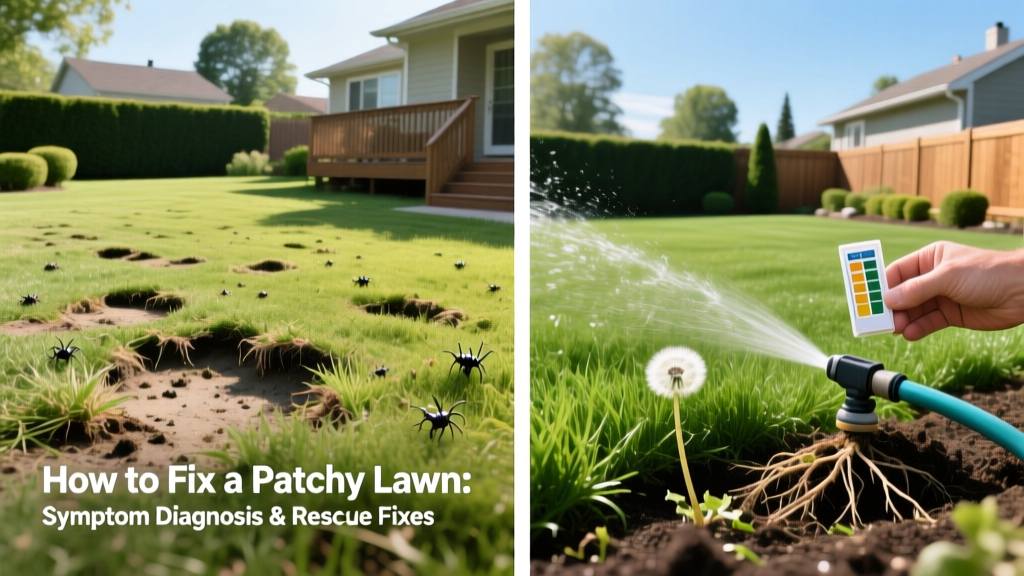
How to Fix a Patchy Lawn: Symptom Diagnosis & Rescue Fixes
A patchy lawn is rarely caused by a single factor; it is usually a cascading failure of soil health, moisture management, or pathogen pressure. Homeowners often default to throwing down random bags of fertilizer or grass seed, which only masks the underlying issue and wastes money. To permanently rescue thinning or dead turf, you must first accurately diagnose the specific failure mode. This guide provides a clinical diagnostic matrix and exact, actionable rescue protocols using current industry-standard treatments and precise application rates.
The Patchy Lawn Diagnostic Matrix
Before purchasing any amendments, perform a physical inspection of the bare or thinning areas. Match your visual symptoms and soil clues to the matrix below to identify the primary culprit.
| Visual Symptom | Soil / Root Clue | Primary Culprit | Immediate Rescue Action |
|---|---|---|---|
| Irregular yellow/brown rings; leaves pull easily | Sod rolls back like a carpet; white C-shaped grubs visible | White Grubs / Insect Damage | Curative application of Trichlorfon (Dylox) |
| Circular brown patches with dark smoke rings on edges | Soil is moist; thatch layer exceeds 0.5 inches | Brown Patch Fungus | FRAC 11 + FRAC 3 fungicide rotation |
| General thinning; water pools or runs off | Screwdriver cannot penetrate past 2 inches | Severe Soil Compaction | Core aeration + liquid surfactant |
| Uniform yellowing; moss or weeds dominating | Soil pH test reads below 5.5 or above 7.8 | Nutrient Lockout / pH Imbalance | Targeted lime or elemental sulfur application |
| Scalped, jagged grass tips; overall pale color | Soil is hard; mower blades are dull | Mechanical Stress / Dull Blades | Sharpen blades; raise mowing height 0.5 inches |
Rescue Fix 1: Breaking Hydrophobic Compaction
If water pools on your lawn or runs off into the street during irrigation, your soil is likely hydrophobic and compacted. Core aeration physically removes 2-to-3-inch soil plugs, but for severe compaction in clay-heavy soils, mechanical aeration must be paired with a wetting agent to break surface tension.
The Dual-Action Protocol
- Core Aerate: Rent a walk-behind core aerator (e.g., Ryan Lawnaire). Make two passes in perpendicular directions to achieve 15-20 holes per square foot.
- Apply Surfactant: Within 24 hours of aeration, apply a professional-grade wetting agent like Aqua-Aid Cascade Plus or Exel LG. Apply at a rate of 3 oz per 1,000 square feet.
- Topdress: Drag a leveling rake to break apart the aeration cores, allowing the organic matter to filter back into the holes and improve soil structure.
Pro Tip: Never use solid-tine spike aerators on clay soils. Spikes simply compress the soil laterally, creating a harder pan layer just beneath the surface and worsening the patchy lawn symptoms over time.
Rescue Fix 2: Eradicating Fungal Pathogens
Fungal diseases like Brown Patch (common in Tall Fescue and Bermuda) and Dollar Spot (common in Kentucky Bluegrass) thrive in high humidity and warm nights. According to the NC State Extension TurfFiles, relying on a single fungicide chemistry will quickly lead to pathogen resistance. You must rotate active ingredients based on their FRAC (Fungicide Resistance Action Committee) codes.
The FRAC Rotation Strategy
For an active outbreak causing severe patchiness, initiate a 30-day curative rotation:
- Week 1 (FRAC 11): Apply Heritage G (Azoxystrobin) at 2 to 4 lbs per 1,000 sq ft. This is a strobilurin that stops spore germination and provides systemic protection.
- Week 3 (FRAC 3): Apply Banner Maxx or Clearcast (Propiconazole) at 1 to 2 fl oz per 1,000 sq ft. This DMI fungicide halts active mycelial growth inside the plant tissue.
Warning: Do not apply nitrogen-heavy fertilizers when a fungal outbreak is active. Excess nitrogen forces rapid, weak leaf growth that is highly susceptible to fungal penetration, turning a minor patchy spot into a lawn-wide epidemic.
Rescue Fix 3: Curative Grub and Insect Control
If your patchy lawn features turf that detaches easily from the soil, you likely have a white grub infestation feeding on the root zone. As noted by Penn State Extension, preventative treatments (like Chlorantraniliprole) are useless once grubs reach their third-instar stage in late summer or early fall. You need a fast-acting curative insecticide.
Executing the Curative Kill
Use a product containing Trichlorfon (commonly sold as Dylox 6.2G). Apply at a rate of 3 lbs per 1,000 square feet. Trichlorfon degrades rapidly in high-pH soils, so it must be watered in immediately with at least 0.5 inches of irrigation to move the active ingredient into the root zone where the grubs are feeding. Expect a 24-to-48-hour kill rate. Once the grubs are dead, the turf will still be dead; you must proceed to the overseeding protocol below to rebuild the canopy.
Rescue Fix 4: Correcting Nutrient Lockout and pH
Throwing 10-10-10 fertilizer on a patchy lawn with a pH of 4.8 is a waste of resources. At extreme pH levels, essential macronutrients like phosphorus and potassium bind to soil particles and become unavailable to the roots. Send a soil sample to a lab like Logan Labs or your local university extension. Request the SMP Buffer pH test, which dictates exactly how much buffering capacity your soil has.
The Amendment Math
- To Raise pH (Acidic Soil): Apply pelletized calcitic lime. As a baseline, 50 lbs per 1,000 sq ft will raise soil pH by approximately 0.5 points. Do not exceed 50 lbs per 1,000 sq ft in a single application; split higher doses across spring and fall.
- To Lower pH (Alkaline Soil): Apply elemental sulfur. Expect to apply 10 to 15 lbs per 1,000 sq ft to lower pH by 1.0 point. Sulfur requires microbial oxidation to work, meaning it takes 3 to 6 months to see a shift in soil chemistry.
The 14-Day Overseeding Protocol for Bare Spots
Once the underlying pest, disease, or soil issue is neutralized, you must fill the bare patches. Broadcasting seed by hand over existing thatch yields a germination rate of less than 10%. Use this high-yield protocol for maximum seed-to-soil contact.
Step-by-Step Seedbed Preparation
- Scalp the Area: Lower your mower deck to 1.5 inches and bag the clippings to expose the bare soil.
- Mechanical Grooving: Use a slit-seeder (power seeder) set to a depth of 1/4 inch. Run it over the patchy areas twice in perpendicular directions.
- Seed Selection: Choose a premium seed mix with zero weed seed and >90% germination. For cool-season lawns, use a blend of Turf-Type Tall Fescue and 10% Kentucky Bluegrass for rhizome spreading.
- Pre-Emergent Weed Control: Mix Tenacity (Mesotrione) at 1/2 teaspoon per 1,000 sq ft with a non-ionic surfactant and spray the seeded area. This is one of the only pre-emergents safe for use at the time of seeding cool-season grasses, preventing crabgrass from outcompeting your new seedlings.
- Starter Fertilizer: Apply a high-phosphorus starter fertilizer (e.g., 18-24-12) at 4 lbs per 1,000 sq ft to drive rapid root development.
- Moisture Management: Water the patched areas lightly 3 to 4 times a day for 5 minutes each session to keep the top 1/2 inch of soil constantly moist until germination occurs (typically 7-14 days for fescue).
Diagnosing a patchy lawn requires moving past guesswork and treating the specific biological or mechanical failure. By systematically ruling out compaction, pathogens, and pH lockout before deploying targeted seed and chemical treatments, you ensure long-term turf density and eliminate recurring seasonal bare spots.

