
Lawn Care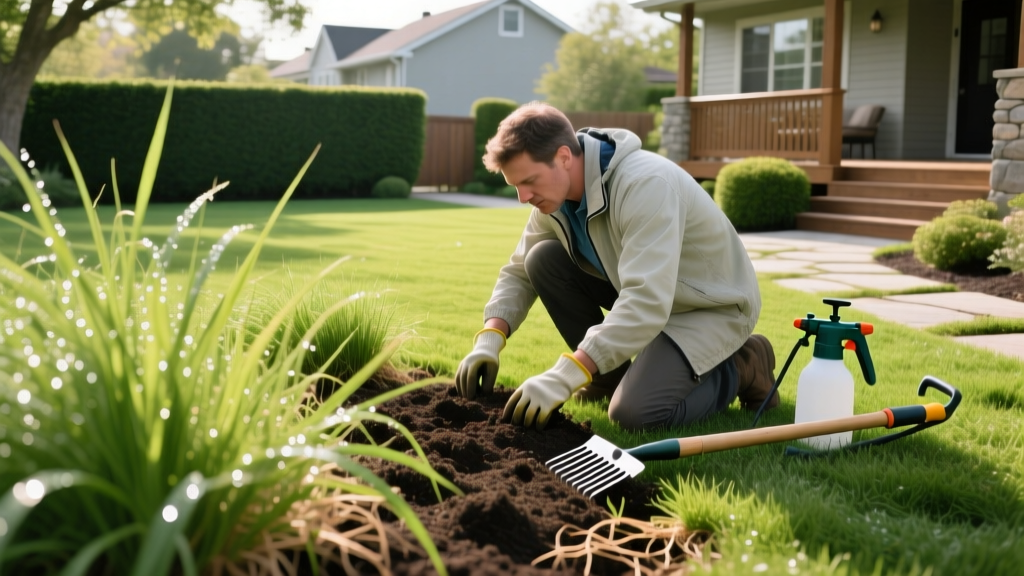
Why Is My Grass Stringy? Step-by-Step Fix and Maintenance Guide
The Anatomy of Stringy Grass: Diagnosing the Root Cause
A lawn that feels like a tangled mat of wiry, fibrous stems rather than a soft carpet is suffering from structural degradation. "Stringy grass" is not a single disease but a physiological symptom. When turfgrass experiences chronic stress, improper cutting mechanics, or invasive competition, it responds by producing lignified (woody) cell walls and thick stolons to survive. This results in blades that resist mower blades, feel rough to the touch, and lay flat in unsightly, stringy clumps.
Before applying fertilizers or herbicides, you must isolate the exact mechanical or biological trigger. Use the diagnostic matrix below to identify the specific cause of your lawn's stringy texture.
Diagnostic Matrix: Identifying the Stringy Grass Trigger
| Primary Cause | Visual Symptom | Tactile Feel | Peak Season |
|---|---|---|---|
| Thatch Buildup (>0.5") | Thin, pale, wiry blades; spongy base | Tough, fibrous strings; sponge-like ground | Late Summer |
| Seed Head Flush | Thick, pale-green fibrous stalks | Rough, highly resistant to mowing | Late Spring |
| Wiry Weeds (Nimblewill/Wiregrass) | Pale green, creeping mats with visible runners | Wire-like stolons; tough, narrow leaves | Year-round |
| Dull Mower Blades | Frayed, white/brown tips on grass blades | Shredded, stringy leaf tissue | Anytime |
Phase 1: Mechanical Thatch Removal and Soil Fracturing
Thatch is a layer of dead and living shoots, stems, and roots that develops between the zone of green vegetation and the soil surface. According to Penn State Extension, a thatch layer exceeding 0.5 inches prevents water and nutrients from reaching the root zone. More importantly, it forces grass roots to grow upward into the thatch layer rather than downward into the soil. Because thatch dries out rapidly, the grass experiences chronic micro-droughts, triggering the production of tough, stringy cell walls as a survival mechanism.
Warning: Do Not Scalp the Lawn
When dethatching, avoid the temptation to lower your mower deck to "scalp" the lawn. Removing the entire leaf canopy exposes the soil to UV radiation, germinates dormant weed seeds (like crabgrass), and shocks the turf. Always maintain at least 1.5 inches of leaf tissue during mechanical intervention.
Step-by-Step Dethatching Procedure
- Measure the Thatch: Use a flat-edged spade to cut a 3-inch deep wedge into the lawn. Measure the brown, spongy layer between the green grass and the dark soil. If it exceeds 0.5 inches, proceed to scarification.
- Equipment Selection: For lawns under 5,000 sq ft, use an electric scarifier like the Sun Joe AJ801E 13-inch Electric Scarifier. For larger properties, rent a gas-powered core aerator and dethatcher combo from a local equipment yard.
- Calibrate the Tines: Set the scarifier blades to penetrate exactly 1/8 inch into the soil surface. This fractures the soil crust and pulls up the stringy thatch without severing the primary crown of the turfgrass.
- Execute in Two Passes: Make your first pass in a North-South direction, and your second pass East-West. Rake and remove all extracted debris immediately to prevent it from smothering the remaining grass.
Phase 2: Chemical Eradication of Wiry Invasive Grasses
If your diagnostic check revealed creeping, wire-like stolons, you are likely dealing with Nimblewill or Wiregrass (unwanted Bermudagrass in cool-season zones). These weeds are inherently "stringy" and will choke out desirable turf. Standard broadleaf herbicides like 2,4-D will not affect them because they are grassy weeds.
Targeted Herbicide Application Protocol
To eradicate wiry grassy weeds without destroying a cool-season lawn (Tall Fescue, Kentucky Bluegrass, or Perennial Ryegrass), utilize Fluazifop-p-butyl (commonly sold as Ortho Grass B Gon for consumers) or Mesotrione (sold as Tenacity for professionals).
- Fluazifop Application: Apply at a rate of 1 fl oz per 1,000 sq ft. Mix with a non-ionic surfactant at 0.25% v/v (volume to volume). The surfactant is non-negotiable; wiry weeds possess a thick, waxy cuticle that will cause water-based herbicides to bead up and roll off the leaf surface.
- Timing: Apply when the wiry weeds are actively growing and soil temperatures are consistently between 65°F and 85°F. Avoid applications during summer drought stress, as the weeds will not translocate the chemical to their roots.
- Expectation Management: The stringy weeds will turn white, then brown, over 14 to 21 days. A second application may be required 21 days after the first for mature, established patches.
Phase 3: Corrective Mowing and Blade Calibration
A dull mower blade does not cut grass; it shreds it. This shredding action leaves the leaf tips frayed and stringy. These damaged tips rapidly lose moisture, turn white or brown, and create an entry point for fungal pathogens like Dollar Spot and Brown Patch. According to UMass Extension, proper mowing mechanics are the most critical factor in maintaining turf density and preventing stemmy, stringy regrowth.
The 30-Degree Sharpening Rule
Remove your mower blade and secure it in a vise. Use a metal file or an angle grinder to restore the cutting edge to a precise 30-degree bevel. Do not sharpen the blade to a razor edge (like a kitchen knife); a razor edge will roll and dull within the first hour of hitting microscopic soil silica. A 30-degree bevel provides the optimal balance of sharpness and structural durability to cleanly slice through tough, fibrous seed heads and summer-thickened leaf tissue.
After sharpening, balance the blade on a nail driven into a wall. If one side dips, file the heavy side until it sits perfectly horizontal. An unbalanced blade vibrates at high RPMs, tearing the grass and causing premature wear to the mower's spindle bearings.
Phase 4: Nutrient Loading for Lush Tissue Regeneration
Once the thatch is removed, weeds are treated, and the mower is calibrated, you must push the lawn to produce soft, lush, vegetative leaf tissue to replace the tough, stringy growth. This requires a specific nitrogen-to-potassium ratio.
Expert Insight: "To transition turf from a stressed, lignified state back to a lush, carpet-like density, you need a steady supply of slow-release nitrogen paired with adequate potassium. Potassium regulates the stomata and improves turgor pressure within the plant cells, physically softening the leaf tissue and eliminating that rigid, stringy feel."
Fertilizer Selection and Calculation
Select a fertilizer with a 3-1-2 or 4-1-2 N-P-K ratio, such as Lesco Professional 16-4-8 with 50% slow-release nitrogen (methylene urea or sulfur-coated urea).
- Target Rate: Apply exactly 1.0 lb of actual nitrogen per 1,000 sq ft.
- Math: Divide 100 by the first number on the bag (16).
100 / 16 = 6.25. - Application: Set your rotary spreader to dispense 6.25 lbs of product per 1,000 sq ft. Walk at a consistent pace of 3 mph, overlapping wheel tracks by 2 inches to prevent striping.
- Watering: Apply 0.25 inches of irrigation immediately after application to wash the prills off the leaf surface and into the soil profile, preventing foliar burn.
Frequently Asked Questions
Why does my grass get stringy specifically in the spring?
Spring stringiness is almost always caused by a "seed head flush." Cool-season grasses, particularly Annual Bluegrass (Poa annua) and Perennial Ryegrass, produce fibrous, silicate-reinforced seed stalks in late spring. These stalks are highly resistant to mower blades and tend to bend rather than cut, leaving a stringy, unkempt appearance. The fix is to raise your mowing height by 0.5 inches during the flush and ensure your mower blade is freshly sharpened to a 30-degree bevel.
Can I just scalp the stringy grass to reset it?
No. Scalping (cutting below the lowest green leaf node) removes the plant's photosynthetic engine and exposes the crown to lethal heat and UV radiation. The grass will either die or respond to the severe trauma by producing even thicker, more fibrous, and stringy survival tissue. Always adhere to the "one-third rule," removing no more than 33% of the leaf blade in a single mowing session.
Does soil pH affect the texture of my grass?
Yes. Highly acidic soil (pH below 5.5) locks up calcium and magnesium. Calcium is a primary structural component of plant cell walls (calcium pectate). Without adequate calcium, grass cell walls become weak, irregular, and prone to collapsing, which can manifest as a tangled, stringy mat rather than upright, rigid blades. Conduct a soil test and apply pelletized lime at the recommended rate (usually 30-50 lbs per 1,000 sq ft) to bring the pH into the optimal 6.2 to 6.8 range.

