
Lawn Care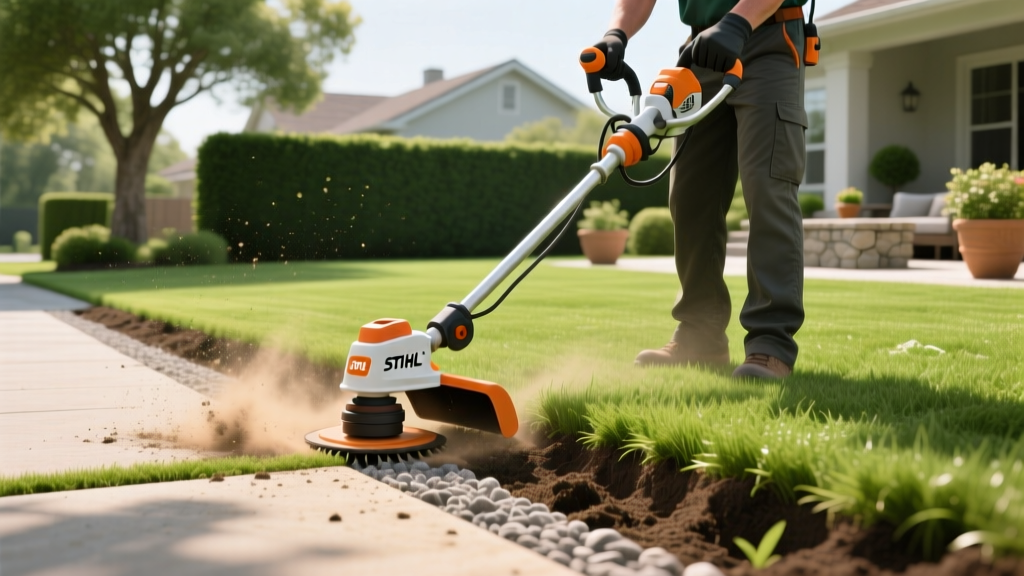
Fixing Trenching Issues: STIHL Edger Accessories for Common Problems
The Mechanics of a Perfect Edge: Why Accessories Matter
A jagged, uneven, or shallow lawn edge is rarely the fault of the operator alone; it is usually a symptom of mechanical mismatch. When using professional-grade equipment like the STIHL FSA 86 R battery trimmer or the gas-powered FS 94 R, relying on out-of-the-box configurations often leads to lateral instability, rapid line degradation, and operator fatigue. According to turf management guidelines from the University of Minnesota Extension, consistent edging not only improves aesthetic curb appeal but prevents aggressive rhizomatous grasses from invading hardscapes and garden beds. To achieve this consistency, diagnosing the specific failure mode of your trenching attempt and applying the correct STIHL edger accessories is mandatory. Below is a diagnostic framework for the four most common edging failures and the exact hardware required to solve them.
⚠️ Safety Diagnostic: Before swapping accessories, always disconnect the battery (AP System) or pull the spark plug boot on gas models. Steel edger blades store kinetic tension and can cause severe lacerations during removal if the gearbox is not fully stopped.
Problem 1: Lateral Instability and "Wobbly" Trench Lines
Diagnosis: Missing Guide Wheels and Worn Depth Skids
If your trench line looks like a seismograph reading rather than a straight vector, the issue is lateral instability. When operators attempt to edge using only the trimmer head's guard as a visual guide, micro-tremors in the hands translate directly into the soil. Furthermore, if the factory plastic depth skid is worn down by more than 20%, the cutting head will naturally dip into softer topsoil, creating an uneven depth profile.
Solution: STIHL Edge Guide Wheel Kits
The definitive fix for lateral wobble is installing a dedicated guide wheel. For most STIHL brushcutters and trimmers (including the FS 56, FS 94, and FSA 86), the STIHL Edge Guide Wheel Kit (Part #4140 790 9400) is the required accessory. Priced around $65 to $75, this kit replaces the standard deflector shield with a heavy-duty polymer wheel that tracks physically inside the existing trench or against the concrete curb.
- Installation Specifics: Remove the standard debris guard. Mount the wheel bracket using the provided M6 hex bolts, ensuring the locking washer is seated flush against the gearbox housing.
- Depth Calibration: Adjust the wheel's vertical axis so the trimmer line or blade sits exactly 1.5 inches below the soil surface. This prevents the blade from striking buried irrigation lines or shallow landscape lighting wires.
Problem 2: Rapid Line Shredding on Hardscapes
Diagnosis: Polymer Melting and Profile Mismatch
When edging along concrete driveways or asphalt paths, standard round nylon trimmer line will shred, melt, and snap within minutes. This occurs because the centrifugal force at 7,000+ RPM presses the round line flat against the cured concrete. The friction generates heat exceeding the melting point of standard copolymer nylon (approx. 420°F), causing the line to fuse to the guard or snap at the spool eyelet.
Solution: Polygonal Profiles and Titanium Co-Extrusions
To solve hardscape shredding, you must change the aerodynamic and friction profile of the line. STIHL's Titanium Trimmer Line (.095" or 2.4mm) features a co-extruded core with a titanium-reinforced outer shell, increasing shear resistance by up to 40% compared to standard lines. More importantly, you must use a pentagon or square profile. The sharp edges of a polygonal line slice through grass and bounce off concrete at an angle, drastically reducing surface-area friction and heat buildup.
| Line Profile | Material / Tech | Best Surface Application | Approx. Cost (2026) |
|---|---|---|---|
| Round | Standard Copolymer | Open lawn trimming (No hardscapes) | $12 - $15 |
| Square / Pentagon | Reinforced Nylon | Concrete borders, asphalt edges | $22 - $26 |
| Twisted | Titanium Co-Extruded | Heavy overgrowth, rocky soil berms | $28 - $32 |
Problem 3: Shallow Trenches and Overgrown Soil Berms
Diagnosis: Using String Heads for Deep Soil Cutting
String trimmers are designed for horizontal cutting of fibrous plant tissue. They are fundamentally incapable of cutting vertical, 2-inch deep soil berms where grass rhizomes have established dense root networks. Attempting to force a .105" line into compacted clay soil will result in immediate line breakage, gearbox overheating, and a shallow, ineffective trench.
Solution: The KombiSystem Steel Edger Blade
For deep trenching and redefining overgrown edges, string must be abandoned in favor of steel. If you utilize the STIHL KombiSystem (such as the KM 131 R powerhead), the FC-KM Edger Attachment equipped with an 8-inch (200mm) Steel Edger Blade is the mandatory solution. The steel blade physically slices through soil and roots, creating a clean, vertical 2.5-inch deep trench.
💡 Expert Technique Tip: When using the 8-inch steel blade, never engage the throttle to maximum RPM before the blade touches the soil. Advance the edger slowly at 3/4 throttle. Pushing the blade too fast through wet clay will bog down the engine or trigger the battery management system (BMS) overload protection on AP System models.
Problem 4: Debris Blowback and Operator Fatigue
Diagnosis: Poor Weight Distribution and Missing Deflection Guards
Edging requires precise, micro-adjustments to the cutting head. If the operator is fighting the static weight of a gas-powered FS 94 R (approx. 13.9 lbs without fuel), shoulder fatigue sets in within 15 minutes. This fatigue causes the operator to rest the gearhead on the ground, ruining the edge depth. Furthermore, steel blades throw heavy clods of dirt and gravel at high velocities. As noted by OSHA's landscaping safety guidelines, high-velocity debris poses a severe risk of ocular and facial injury, making proper shielding non-negotiable.
Solution: Harness Systems and Upgraded Deflectors
To eliminate fatigue-induced wobble, transfer the equipment's weight from the operator's wrists and lower back to the skeletal core using the STIHL ADVANCE Pro Universal Harness (Part #48094900200). Priced around $85, this harness features a quick-release carabiner and padded lumbar support, allowing the operator to "float" the edger head precisely along the trench line using only finger tension.
For debris management, ensure the STIHL Heavy-Duty Debris Deflector (Part #4144 790 9401) is securely mounted. Unlike the standard clear plastic shields that crack under UV exposure and impact, the heavy-duty polymer deflector is angled specifically to direct soil and gravel downward into the trench, rather than backward toward the operator's shins.
Preventative Maintenance Matrix for Edger Accessories
Accessories only solve problems if they are maintained. Use the following diagnostic checklist to prevent mid-job failures.
- Guide Wheel Axle: Clean with compressed air and apply a drop of STIHL Multipurpose Grease (Part #0781 120 1117) every 10 hours of use to prevent soil-lock.
- Steel Blade Inspection: Check the 8-inch blade for micro-fractures along the mounting arbor. If the blade wobbles more than 1mm when spun by hand, the gearbox bearing is failing, not the blade.
- Spool Tension Spring: If using an AutoCut head for edging, ensure the internal tension spring is not corroded. A weak spring causes line over-feed, which strikes the concrete guard and snaps the line at the base.
By correctly diagnosing the physical failure causing your uneven edges and deploying the specific STIHL accessories engineered to counteract those forces, you transform a frustrating, labor-intensive chore into a precise, mechanical operation. Invest in the guide wheels, upgrade to polygonal titanium lines, and utilize steel blades for deep soil—the results will be immediately visible in the geometry of your lawn.

