
Lawn Care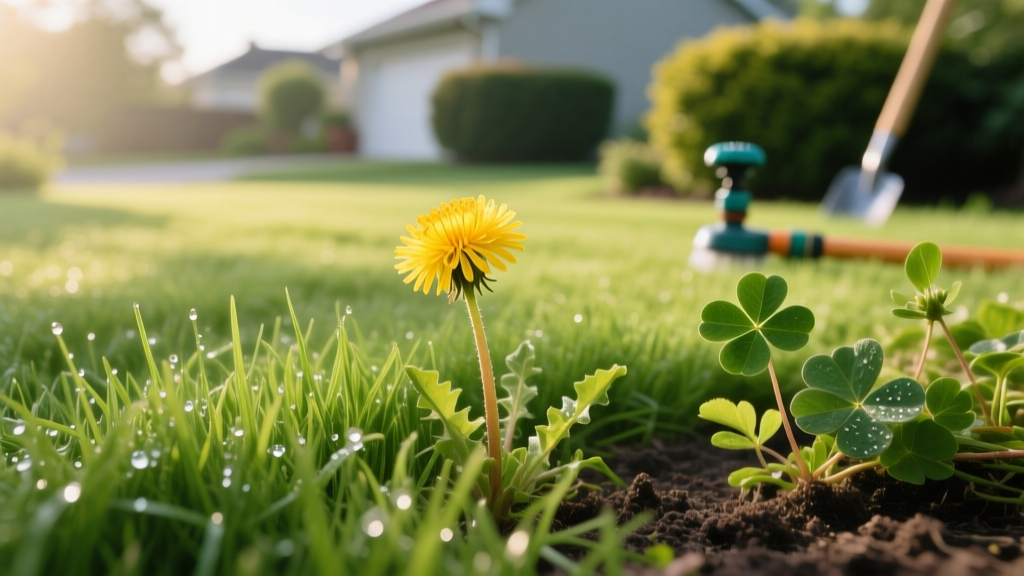
Flowers or Weeds? Identifying and Spot-Treating Blooming Lawn Invaders
The line between a desirable wildflower and an invasive turf weed is entirely defined by human intent and ecological competition. When homeowners ask whether the bright blooms dotting their yard are flowers or weeds, the answer depends on the plant's growth habit, its impact on turfgrass density, and your specific lawn care goals. Broadleaf weeds like dandelions, wild violets, and creeping Charlie produce vibrant flowers that attract early-season pollinators, yet their aggressive root systems and shading effects can severely thin out cool- and warm-season turfgrasses.
Blanket-spraying an entire lawn to eliminate a few flowering invaders is an outdated, ecologically harmful practice that wastes chemicals and damages soil biology. Modern turf management relies on precise spot-treatment protocols. This guide provides exact identification metrics, specific herbicide active ingredients, and manual extraction techniques to manage blooming lawn invaders without compromising your turf's health.
The Botanical Gray Area: When Flowers Become Weeds
In turfgrass science, a weed is simply a plant growing where it is not wanted. However, from a physiological standpoint, flowering broadleaf plants compete with grass for sunlight, water, and soil nutrients. Plants like white clover (Trifolium repens) fix atmospheric nitrogen, which can actually benefit the soil, leading many eco-conscious homeowners to intentionally integrate it into their turf. Conversely, plants like wild violet (Viola sororia) possess waxy, heart-shaped leaves and thick rhizomes that actively choke out fescue and bluegrass, offering no agronomic benefit to the lawn.
Expert Insight: Before treating, assess the density of the blooms. If flowering plants cover less than 10% of your lawn and your turfgrass remains dense, consider leaving them to support early spring pollinator populations. If they exceed 15% coverage or are creating bare patches in the turf, initiate spot-treatment.
Identification Matrix: Common Blooming Lawn Invaders
Accurate identification dictates the chemical and mechanical strategy required for eradication. Misidentifying a grassy weed as a broadleaf weed, or confusing two similar broadleaf species, will result in failed treatments and wasted money. Use this matrix to identify the most common flowering invaders.
| Species | Flower Traits | Leaf Structure | Root System | Primary Active Ingredient |
|---|---|---|---|---|
| Dandelion (Taraxacum officinale) | Bright yellow, turning to white puffballs | Deeply lobed, basal rosette | Deep taproot (up to 10 inches) | 2,4-D + Dicamba |
| Creeping Charlie (Glechoma hederacea) | Small, bluish-purple, funnel-shaped | Scalloped edges, creeping stems | Shallow fibrous with nodes | Triclopyr + MCPP |
| Wild Violet (Viola sororia) | Purple/white, 5 distinct petals | Heart-shaped, waxy cuticle | Thick, fleshy rhizomes | Triclopyr + Surfactant |
| White Clover (Trifolium repens) | White/pink spherical clusters | Trifoliate (three leaflets) | Stolons (above ground runners) | Quinclorac + 2,4-D |
| Black Medic (Medicago lupulina) | Small yellow, tight clusters | Trifoliate, center leaflet on long stalk | Taproot with lateral branches | Dicamba + MCPP |
Chemical Spot-Treatment Protocols
Spot-treating requires a dedicated 1-gallon or 2-gallon hand-pump sprayer. Never use a hose-end sprayer for spot treatments, as the lack of precision will lead to herbicide drift and unintended turf damage. According to EPA guidelines on safe pest control, targeted application minimizes environmental runoff and reduces chemical exposure.
Selecting the Right Formulation for Your Grass Type
The active ingredient that safely kills broadleaf weeds in Kentucky bluegrass will severely damage St. Augustine grass. You must match the herbicide to your specific turf species.
- Cool-Season Lawns (Fescue, Bluegrass, Ryegrass): Use a product containing a 3-way or 4-way blend of 2,4-D, dicamba, MCPP, and carfentrazone (e.g., SpeedZone). Mix at a rate of 1.5 fluid ounces per gallon of water. This formulation provides rapid visual burndown (within 24 hours) due to the carfentrazone.
- Warm-Season Lawns (Bermuda, Zoysia, St. Augustine): Use a formulation based on thiencarbazone, iodosulfuron, and dicamba (e.g., Celsius WG). Mix at 0.05 ounces per gallon. This is highly effective on tough weeds like wild violet and creeping Charlie without causing phytotoxicity to sensitive warm-season grasses.
The Surfactant Requirement
Flowering weeds like wild violets and plantains have evolved a thick, waxy cuticle on their leaves to retain moisture. If you spray standard herbicide on these leaves, the droplets will bead up and roll off onto the soil. You must add a non-ionic surfactant (such as Hi-Yield Spreader Sticker) at a rate of 0.25% v/v (roughly 1/4 teaspoon per gallon of mixed herbicide). The surfactant breaks the surface tension of the water, allowing the chemical to spread flat across the waxy leaf and penetrate the plant tissue.
Application Warning: Never spot-treat flowering weeds when temperatures exceed 85°F (29°C). High heat causes herbicides to vaporize and drift, which can cause severe curling and stunting in nearby desirable plants, garden vegetables, and even your own turfgrass.
Organic and Mechanical Extraction Alternatives
For homeowners managing small infestations or maintaining organic landscapes, chemical herbicides are unnecessary. Mechanical and organic spot-treatments require more labor but eliminate the risk of chemical drift.
Precision Manual Extraction
Pulling dandelions by hand rarely works because the taproot snaps, leaving the crown intact to regenerate. Use a stand-up weeding tool, such as the Fiskars Uprooting Weeder (Model 9520).
- Water the target area deeply the night before to soften the soil profile.
- Position the stainless steel claws of the weeder directly over the basal rosette of the weed.
- Step on the foot platform to drive the claws 4 inches into the soil.
- Lever the handle back to pop the entire taproot out of the ground.
Horticultural Vinegar (Acetic Acid)
Standard 5% kitchen vinegar is ineffective against mature broadleaf weeds. You must use 20% to 30% acetic acid horticultural vinegar. This acts as a non-selective contact desiccant, burning the foliage on contact.
Protocol: Spray directly onto the center of the weed on a hot, sunny day. The acid destroys the cell membranes, causing the plant to desiccate within hours. Because it is non-selective, use a cardboard shield to protect surrounding grass blades. Note that acetic acid does not translocate to the roots, so perennial weeds with deep taproots may require 2 to 3 repeat applications spaced 5 days apart.
Post-Treatment Turf Recovery
Successfully killing a flowering weed leaves a void in the turf canopy. If left bare, this spot will be immediately colonized by new weed seeds blown in by the wind. Penn State Extension turfgrass programs emphasize that bare soil is the primary catalyst for secondary weed infestations.
Within 48 hours of the weed turning brown and dying, use a hand rake to scarify the bare soil. Apply a high-quality, weed-free turfgrass seed that matches your existing lawn. For cool-season lawns, use a mix of turf-type tall fescue and Kentucky bluegrass. Top-dress the seed with 1/4 inch of compost, and water lightly twice daily for 14 days until germination is complete. A dense, vigorously growing turf canopy is the ultimate biological barrier against future flowering invaders.
Frequently Asked Questions
Will mowing kill flowering weeds before they drop seeds?
Mowing prevents seed maturation, but it does not kill the plant. Weeds like creeping Charlie and white clover grow prostrate (flat against the ground), allowing them to easily survive standard 3-inch mowing heights. Furthermore, many broadleaf weeds can flower and set seed even when cut as low as 1.5 inches. Mowing is a preventative measure, not an eradication strategy.
Is it safe to compost pulled flowering weeds?
Only if the weeds have not yet produced seeds, and only if your compost pile consistently reaches internal temperatures of 140°F to 160°F. Most home compost bins fail to reach these thermophilic temperatures. If you pull weeds that have already flowered or gone to seed, dispose of them in municipal yard waste bags to prevent reintroducing the seeds into your garden later.

