
Lawn Care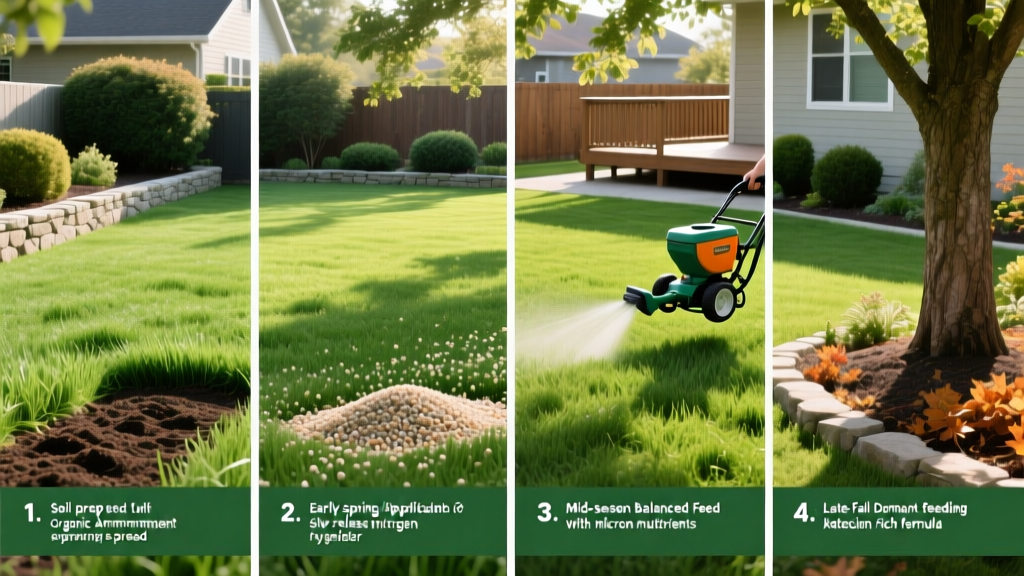
Designing a 4-Step Lawn Fertilizer Program for Cool-Season Grasses
Most homeowners treat turf nutrition as a guessing game, grabbing whatever brightly colored bag is on sale at the hardware store. This random approach leads to nutrient lockout, excessive thatch, and heightened susceptibility to summer diseases. A scientifically sound lawn fertilizer program for cool-season grasses—such as Kentucky Bluegrass, Tall Fescue, and Perennial Ryegrass—requires precise nitrogen (N), phosphorus (P), and potassium (K) ratios timed to the plant's natural biological growth cycles.
Cool-season grasses experience two primary growth flushes: a vigorous surge in spring and a massive root-building phase in autumn. During the heat of summer, they enter a semi-dormant state to survive stress. Your feeding schedule must align with these physiological realities. According to Penn State Extension, the annual nitrogen target for established cool-season lawns is between 2.5 and 3.5 pounds per 1,000 square feet, distributed strategically across the growing season.
The Foundation: Why Soil Testing Dictates Your NPK Ratios
Before purchasing a single granule of fertilizer, you must understand your soil's Cation Exchange Capacity (CEC) and base saturation. CEC measures your soil's ability to hold onto positively charged nutrients (cations) like potassium, calcium, and magnesium.
Pro Tip: The CEC Application Rule
If your soil test reveals a low CEC (under 10 meq/100g, typical of sandy soils), nutrients leach rapidly. You must split your lawn fertilizer program into 4 or 5 lighter applications. If your CEC is high (above 20 meq/100g, typical of heavy clays), the soil acts like a sponge, allowing you to use fewer, heavier applications without risking groundwater leaching.
If your soil test reveals a low CEC (under 10 meq/100g, typical of sandy soils), nutrients leach rapidly. You must split your lawn fertilizer program into 4 or 5 lighter applications. If your CEC is high (above 20 meq/100g, typical of heavy clays), the soil acts like a sponge, allowing you to use fewer, heavier applications without risking groundwater leaching.
Furthermore, soil pH dictates nutrient availability. If your pH drops below 6.0, phosphorus binds with iron and aluminum, becoming completely unavailable to the grass roots regardless of how much you apply. Always apply dolomitic lime in the fall if your test indicates a pH below 6.2, aiming for the 6.5 to 6.8 sweet spot.
Decoding the 4-Step Cool-Season Lawn Fertilizer Program
This framework assumes an established lawn in a transitional or northern climate zone. Adjust timings by 2-3 weeks depending on your specific USDA hardiness zone.
Step 1: Early Spring (Late March to Mid-April) — The Root Awakening
As soil temperatures consistently hit 50°F, the grass breaks dormancy. The goal here is not to push massive top growth, which depletes carbohydrate reserves and weakens the plant before summer. Instead, focus on root development and weed prevention.
- Target Rate: 0.5 to 0.75 lbs of Nitrogen per 1,000 sq ft.
- Ideal NPK Ratio: High potassium, low nitrogen (e.g., 10-0-20 or a 0-0-7 pre-emergent carrier).
- Product Strategy: If crabgrass is an issue, use a fertilizer carrier containing mesotrione (like Scotts Tenacity) or a standard dithiopyr pre-emergent. Avoid high-nitrogen starter fertilizers in spring unless you are patching bare spots, as excess spring nitrogen invites dollar spot and brown patch fungi later in the year.
Step 2: Late Spring (Late May to Early June) — The Growth Surge
This is the final feeding before the summer stress period. The grass is actively growing and requires sustained nutrition, but fast-release nitrogen will cause a rapid flush of succulent tissue that burns easily in July heat.
- Target Rate: 0.75 to 1.0 lbs of Nitrogen per 1,000 sq ft.
- Ideal NPK Ratio: 20-0-10 or 24-0-11.
- Product Strategy: Mandate slow-release nitrogen. Look for Polymer-Coated Urea (PCU) or Sulfur-Coated Urea (SCU) on the ingredient label. These granules release nitrogen gradually via osmosis or microbial breakdown over 8 to 12 weeks, carrying the lawn through early summer without forcing excessive growth.
Step 3: Early Fall (Late August to Mid-September) — The Recovery & Overseeding Phase
Autumn is the most critical window in any cool-season lawn fertilizer program. Soil temperatures are still warm, but air temperatures are cooling, triggering aggressive rhizome and root expansion. This is also the optimal time for core aeration and overseeding.
- Target Rate: 1.0 lbs of Nitrogen per 1,000 sq ft.
- Ideal NPK Ratio: 18-24-12 or 15-20-15 (Starter Fertilizer).
- Product Strategy: If overseeding, phosphorus (the middle number) is non-negotiable for seedling root establishment. Use a dedicated starter fertilizer like Lesco Professional Starter (18-24-12). Note: Many states restrict phosphorus use unless a soil test proves a deficiency or you are actively establishing new seed. Check your local University Extension guidelines for phosphorus regulations.
Step 4: Late Fall (Late October to November) — The Winterizer
Often misunderstood, the "winterizer" application is not meant to keep the grass green through snow. It is designed to be absorbed by the roots and stored as carbohydrates for the following spring's initial green-up, bypassing the need for heavy spring feeding.
- Target Rate: 0.75 to 1.0 lbs of Nitrogen per 1,000 sq ft.
- Ideal NPK Ratio: 32-0-10 or 28-0-10.
- Product Strategy: Unlike Step 2, you want fast-release nitrogen here. Look for Urea or Ammonium Sulfate as the primary nitrogen source. Apply this when the grass has stopped growing top growth but is still green (usually right after the final mow of the season). The roots will pull the fast-acting nitrogen into storage before the ground freezes.
Product Matrix: Matching Nitrogen Sources to Your Program
Understanding the nitrogen source on the back of the bag separates professionals from amateurs. Here is a breakdown of common nitrogen carriers and how they fit into your program.
| Nitrogen Source | Release Speed | Burn Potential | Best Application Window |
|---|---|---|---|
| Urea (46-0-0) | Fast (1-3 days) | High | Late Fall (Winterizer) |
| Ammonium Sulfate (21-0-0) | Fast (1-2 days) | Moderate-High | Late Fall / Spring Green-up |
| Sulfur-Coated Urea (SCU) | Slow (8-12 weeks) | Low | Late Spring / Early Summer |
| Polymer-Coated Urea (PCU) | Slow (10-16 weeks) | Very Low | Late Spring (Premium choice) |
| Milorganite (Biosolids) | Slow (Microbial) | None | Anytime (Great for soil biology) |
Calculating Exact Application Rates (The Math)
Never guess your spreader settings based on the bag's generic coverage claims. Calculate the exact pounds of product needed per 1,000 square feet to hit your target nitrogen rate.
Formula: (Target lbs of N / % Nitrogen in bag) × 100 = lbs of product per 1,000 sq ft
Real-World Example:
Your late fall program calls for 1.0 lb of Nitrogen per 1,000 sq ft. You purchased a 32-0-10 Winterizer (32% Nitrogen).
1.0 ÷ 0.32 = 3.12.
You must apply exactly 3.12 pounds of product per 1,000 square feet. Weigh this amount out on a bathroom scale, set your spreader to a low setting, and walk the area until the exact weight is dispersed. This guarantees mathematical precision and eliminates fertilizer burn.
Common Program Failure Modes & Troubleshooting
Even with the right products, environmental factors can derail your lawn fertilizer program. Watch for these specific edge cases:
- Urea Volatilization: If you apply fast-release urea in late spring and fail to water it in within 48 hours, the nitrogen converts to ammonia gas and escapes into the atmosphere. You lose up to 30% of your nitrogen investment. Always irrigate 0.25 inches immediately after applying urea-based products.
- Luxury Consumption & Disease: Applying more than 1.0 lb of N per 1,000 sq ft in a single spring application forces the grass to absorb more nitrogen than it needs (luxury consumption). This results in thin, weak cell walls that are highly susceptible to Pythium blight and Brown Patch when summer humidity spikes.
- The Phosphorus Runoff Trap: Applying high-phosphorus starter fertilizers to sloped lawns right before heavy rain events contributes to eutrophication in local waterways. If your lawn slopes toward a storm drain, use a phosphorus-free fertilizer and rely on core aeration to improve root depth instead.
Building a successful turf nutrition strategy is an exercise in biological timing and chemical precision. By anchoring your decisions to soil test data, utilizing slow-release technologies during stress periods, and executing precise mathematical spreader calibration, you will cultivate a deeply rooted, drought-resilient lawn that outperforms neighborhood guesswork every season.

