
Lawn Care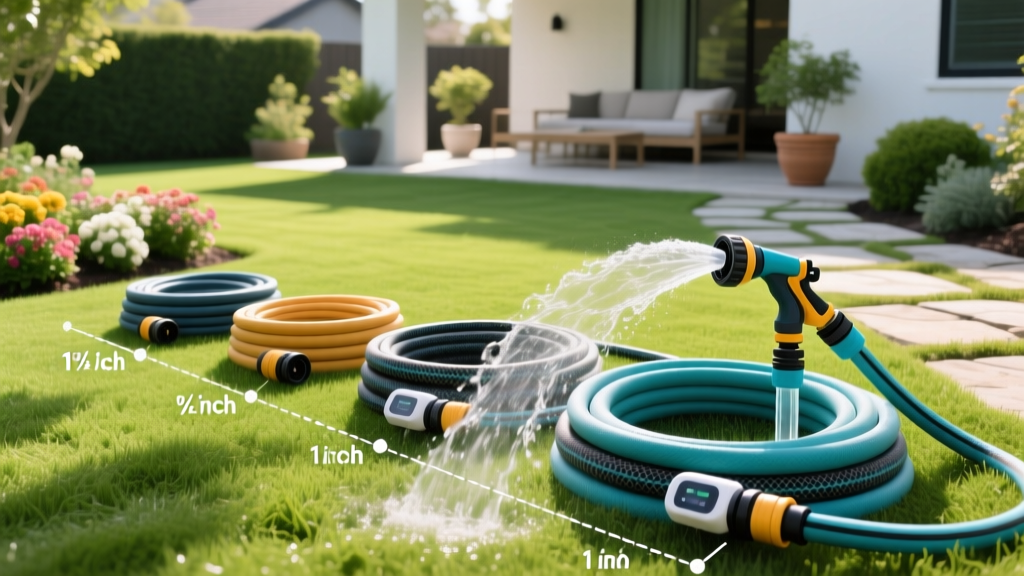
Garden Hose Dimensions Standard: Sizing for Lawn Irrigation
Decoding the Garden Hose Dimensions Standard
Most homeowners select a garden hose based on color, brand recognition, or price, entirely ignoring the engineering specifications that dictate water delivery. Understanding the garden hose dimensions standard is critical for lawn care professionals and serious turf enthusiasts. A mismatched hose restricts flow, starves impact sprinklers of the pressure needed to rotate, and causes uneven irrigation that leads to localized drought stress or fungal overgrowth.
The standard for residential and commercial garden hoses in North America is governed by specific thread, diameter, and pressure tolerances. According to the EPA WaterSense Outdoor Irrigation guidelines, optimizing water delivery efficiency starts at the spigot. If your hose cannot deliver the required Gallons Per Minute (GPM) at the necessary Pounds per Square Inch (PSI), your entire irrigation strategy fails before the water even reaches the grass.
⚠️ CRITICAL THREAD WARNING: GHT vs. NPT
The garden hose thread (GHT) standard is a 3/4-inch diameter, straight (non-tapered) thread with 11.5 threads per inch (TPI). It is designated as ANSI/ASME B1.20.7. Do not confuse this with National Pipe Thread (NPT), which is tapered. GHT relies on a rubber gasket for the seal, not thread deformation. Never use Teflon tape on GHT connections; it will cause the gasket to unseat and result in persistent leaks.
Inner Diameter: The True Driver of Flow Rate
While the outer diameter of a hose dictates its kink-resistance and durability, the inner diameter (I.D.) determines its hydraulic capacity. The garden hose dimensions standard categorizes I.D. into four primary tiers. Upgrading from a 1/2-inch to a 5/8-inch hose increases the cross-sectional area by roughly 56%, drastically reducing friction loss and increasing maximum flow.
| Inner Diameter | Max Flow (50 ft at 60 PSI) | Best Application | Typical 2026 Price (50ft) |
|---|---|---|---|
| 1/2 inch | ~12 GPM | Hand watering, soaker hoses, small balconies | $15 - $25 |
| 5/8 inch | ~22 GPM | Standard oscillating sprinklers, general lawn care | $30 - $45 |
| 3/4 inch | ~40 GPM | Large turf rotors, multiple sprinklers, long runs | $50 - $75 |
| 1 inch | ~70+ GPM | Commercial agriculture, high-volume transfer | $90 - $140 |
For standard residential lawns utilizing oscillating or pulsating sprinklers, a 5/8-inch hose is the baseline requirement. Most impact sprinklers require a minimum of 4 to 6 GPM to function correctly, but they perform optimally and cover their maximum advertised radius at 12 to 15 GPM. A 1/2-inch hose will choke the sprinkler, reducing the throw radius by up to 30% and creating a donut-shaped dry zone in the center of your lawn.
Length and Pressure Drop: The Hidden Irrigation Killer
The University of Minnesota Extension emphasizes that uniform water distribution is key to deep root growth. However, water pressure degrades as it travels through a hose due to friction against the inner wall. This phenomenon, known as pressure drop, is heavily influenced by the garden hose dimensions standard you select.
Calculating Friction Loss in Long Runs
If your home's spigot outputs 60 PSI, you will not have 60 PSI at the end of a 100-foot hose. The smaller the diameter, the more severe the pressure drop.
- 50-foot 5/8-inch hose: Loses roughly 3 to 5 PSI at standard flow rates.
- 100-foot 5/8-inch hose: Loses roughly 8 to 12 PSI.
- 100-foot 1/2-inch hose: Loses a massive 25 to 35 PSI, potentially dropping your working pressure below the threshold required to activate gear-drive rotor sprinklers.
💡 Pro Tip: The Daisy-Chain Rule
If you must run a hose over 100 feet to reach a backyard irrigation zone, always use a 3/4-inch hose for the main trunk line, and step down to a 5/8-inch hose only for the final 25 feet connecting to the sprinkler. This preserves the PSI across the long distance while keeping the hose lightweight near the sprinkler head.
Material Specifications and Burst Pressure Ratings
Dimensions are only half the equation; the material dictates whether the hose can withstand the pressure without expanding or rupturing. The garden hose dimensions standard also encompasses burst pressure ratings, which indicate the maximum PSI the hose can handle before catastrophic failure.
Material Breakdown for 2026
- Vinyl (PVC): Burst pressure typically 150–200 PSI. Highly susceptible to UV degradation and kinking. Not recommended for dragging across hot concrete or leaving in direct sunlight.
- Polyurethane (PU): Burst pressure 300–350 PSI. Lightweight, highly kink-resistant, and drinking-water safe. The best choice for maneuverability around delicate garden beds.
- EPDM Rubber: Burst pressure 400–500+ PSI. Heavy, extremely durable, and capable of handling hot water up to 160°F. The industry standard for commercial landscaping and heavy-duty residential use.
Matching Hose Dimensions to Lawn Care Tasks
To build an efficient watering program, match your hose dimensions to the specific hydraulic demands of the task:
- Soaker Hoses and Drip Irrigation: Use a 1/2-inch mainline. Drip emitters require very low GPM (often less than 1 GPM per emitter). A larger hose will cause excessive pressure that can blow out drip fittings.
- Oscillating Sprinklers: Use a 5/8-inch hose. These sprinklers rely on water volume to drive the internal turbine gears. Insufficient GPM will cause the sprinkler to stall in one position, drowning a single patch of grass.
- Large Gear-Drive Rotors: Use a 3/4-inch hose. Rotors designed for large turf areas require high PSI to pop up and rotate. A 3/4-inch hose ensures minimal pressure drop over long distances.
- Pressure Washing Hardscapes: Use a 5/8-inch or 3/4-inch hose to feed the pressure washer pump. Starving the pump of inlet water volume causes cavitation, which will destroy the pump's internal seals.
Frequently Asked Questions
Does a larger diameter hose increase water pressure?
No. A larger diameter hose does not increase the source pressure (PSI) generated by your municipal supply or well pump. However, it drastically reduces friction loss, meaning it preserves the existing pressure over longer distances. It also increases the total volume of water (GPM) that can flow through the hose at any given time.
Can I use a standard garden hose for hot water?
Standard vinyl and polyurethane hoses will soften, expand, and potentially burst if exposed to water exceeding 100°F. If you need to run hot water (e.g., for washing equipment or thawing frozen pipes), you must purchase a hose specifically rated for hot water, which is typically constructed of heavy-duty EPDM rubber with reinforced synthetic yarn plies.
Why does my hose connection leak even when tightened?
GHT (Garden Hose Thread) connections are sealed by a flat rubber or silicone gasket inside the female coupling, not by the threads themselves. If the gasket is missing, cracked, or hardened by UV exposure, the connection will leak regardless of how tightly you screw it together. Replace the gasket annually as part of your spring irrigation maintenance routine.

