
Lawn Care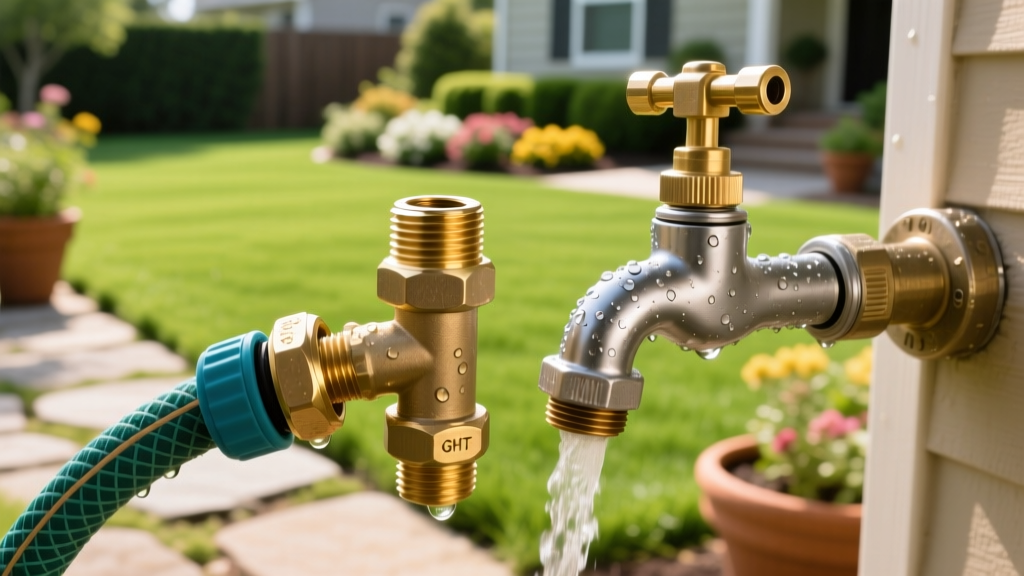
What Size Garden Hose Fittings to Buy: GHT vs NPT Guide
The Short Answer: Standard Residential Sizing
If you are connecting a standard residential garden hose to an outdoor spigot, the universal fitting size is 3/4-inch Garden Hose Thread (GHT). The male end (threads on the outside) attaches to the faucet, while the female end (threads on the inside with a rubber gasket) connects to the hose. However, confusion arises because the outer thread size of the fitting (3/4-inch GHT) is entirely independent of the inner diameter (ID) of the hose itself, which typically ranges from 1/2-inch to 3/4-inch. Understanding this distinction is the first step to avoiding leaks, restricted water flow, and cross-threaded plumbing disasters.
GHT vs. NPT: The Most Common (and Costly) Mistake
The most frequent error homeowners make when buying adapters for drip irrigation systems, pressure washers, or fertilizer injectors is confusing Garden Hose Thread (GHT) with National Pipe Thread (NPT). While both may be labeled as "3/4-inch," their engineering geometries are fundamentally incompatible.
According to thread specifications documented by Plumbing Supply Co., GHT is a straight (parallel) thread with an outer diameter (OD) of exactly 1.0625 inches and 11.5 threads per inch (TPI). NPT, conversely, is a tapered thread designed to wedge tightly to create a mechanical seal. Forcing a 3/4-inch NPT male fitting into a 3/4-inch GHT female swivel will strip the threads, crack the brass housing, and result in a catastrophic leak under standard 60 PSI municipal water pressure.
| Feature | GHT (Garden Hose Thread) | NPT (National Pipe Thread) |
|---|---|---|
| Thread Geometry | Straight (Parallel) | Tapered (Wedges tighter) |
| Standard OD (3/4") | 1.0625 inches | 1.050 inches (at base) |
| Threads Per Inch | 11.5 TPI | 14 TPI |
| Sealing Method | Rubber O-ring / Gasket | PTFE Tape / Pipe Dope |
| Primary Use Case | Hoses, Spigots, Sprayers | Hard plumbing, PVC, Iron |
How Hose Inner Diameter (ID) Affects Fitting Flow
While the external threads connecting to your spigot are universally 3/4-inch GHT, the internal barb of the fitting must match your hose's Inner Diameter (ID). Bottlenecking occurs when a homeowner uses a restrictive fitting on a high-capacity hose, or vice versa. The University of Minnesota Extension notes that proper flow volume is critical for efficient lawn irrigation and preventing pump cavitation in pressure washers.
Flow Rate Benchmarks (at 60 PSI)
- 1/2-inch ID Hose: Delivers approximately 9 Gallons Per Minute (GPM). Best for light hand-watering and small balcony gardens.
- 5/8-inch ID Hose: Delivers approximately 17 GPM. The residential standard, offering the best balance of weight, kink-resistance, and flow for standard oscillating sprinklers.
- 3/4-inch ID Hose: Delivers approximately 23+ GPM. Required for commercial landscaping, large turf areas, and high-draw equipment like pressure washers and sewer jetters.
Expert Tip: If you are running a 5/8-inch hose, ensure your replacement fittings are labeled "5/8-inch barb x 3/4-inch GHT." Using a 1/2-inch barb fitting on a 5/8-inch hose will choke your flow rate by nearly 40%.
Material Showdown: Brass, Aluminum, and Plastic
Fitting longevity is dictated by material science, UV exposure, and local water chemistry. In 2026, the market is dominated by three primary materials, each with distinct failure modes.
1. Solid Brass (Premium Choice)
Brass fittings, such as the Dramm #17025BR Solid Brass Hose Fitting (retailing around $9 to $14), offer the highest crush resistance and thread durability. However, not all brass is created equal. Cheaper imported brass fittings are susceptible to dezincification, a corrosion process where zinc leaches out of the alloy when exposed to slightly acidic municipal water, leaving a porous, brittle copper shell. Always look for fittings stamped with DZR (Dezincification Resistant) or certified as lead-free (compliant with NSF/ANSI 372 standards) if connecting to potable water lines.
2. Anodized Aluminum (Mid-Tier)
Aluminum fittings are lightweight and resist rust, but they are highly vulnerable to galvanic corrosion. If you leave an aluminum fitting threaded onto a brass spigot in a damp environment, the dissimilar metals will create a micro-battery, fusing the two together permanently. Brands like Melnor produce high-quality anodized aluminum quick-connects ($4 to $7), but they must be disconnected and stored dry during winter months.
3. ABS Plastic (Budget/Light Duty)
Plastic fittings cost $2 to $4 and are entirely immune to galvanic corrosion. However, UV degradation makes them brittle after one or two seasons of direct sunlight. Furthermore, plastic male threads will easily cross-thread and strip if over-tightened on a metal female spigot. Reserve plastic fittings strictly for seasonal, light-duty tasks like attaching a soaker hose to a nearby rain barrel.
Step-by-Step: Identifying and Fixing Leaky Connections
A leaking fitting is rarely a thread issue; it is almost always a gasket or torque issue. Follow this diagnostic sequence before replacing your hardware.
- Inspect the Rubber Gasket: Female GHT fittings rely on a flat rubber washer to create a seal, not the threads themselves. If the washer is flattened, cracked, or missing, water will spray from the collar. Replace it with a standard 5/8" ID x 3/4" OD rubber hose washer.
- Remove PTFE (Teflon) Tape: Never use plumber's tape on GHT threads. Because GHT is a straight thread, tape adds bulk that prevents the fitting from seating deeply enough to compress the rubber gasket. Worse, the outward pressure of the tape can crack female brass swivels.
- Check for Cross-Threading: If the fitting turns easily for the first two rotations but suddenly binds, stop immediately. You are cross-threading. Back it out, align the threads perfectly straight, and restart. Forcing it will permanently destroy the male spigot threads.
- Evaluate Spigot Wear: If the fitting is new and the gasket is fresh, but a leak persists at the top of the threads, the male threads on your home's outdoor spigot may be worn down or bent. In this case, you must replace the sillcock (spigot) rather than the hose fitting.
Quick-Connect Systems: Sizing and Compatibility
Quick-connect systems (like those from Gardena or Nelson) simplify tool changes but introduce internal flow restrictions. The external connection to the hose remains standard 3/4-inch GHT, but the internal quick-release mechanism typically narrows the water pathway to roughly 3/8-inch or 1/2-inch.
Warning for Irrigation Systems: Do not use standard quick-connect adapters to feed drip irrigation manifolds or multi-zone sprinkler timers. The internal flow restrictor will cause a massive pressure drop, resulting in uneven sprinkler coverage and failing to trigger automatic anti-siphon valves properly. Always use direct, unrestricted brass GHT-to-NPT adapters for automated manifold plumbing.
By matching the correct 3/4-inch GHT geometry to your specific hose ID and choosing DZR brass for permanent connections, you eliminate the vast majority of watering system failures. Always verify the thread standard (GHT vs NPT) before purchasing adapters for specialized lawn care equipment to protect both your hardware and your home's water pressure.

