
Lawn Care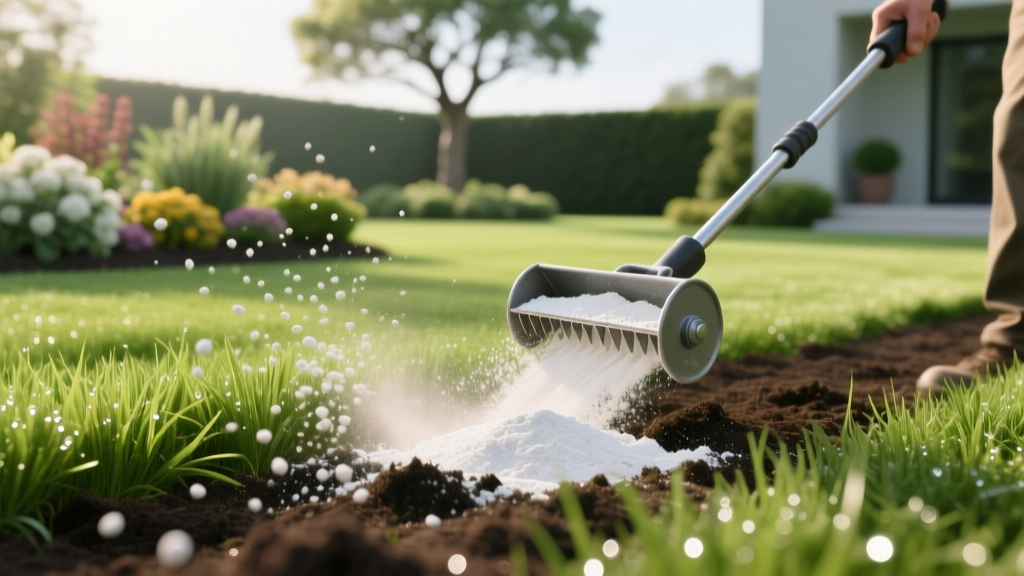
Gardening with Lime: Calcitic vs Dolomitic Soil Amendment Guide
The Hidden Chemistry of Soil Acidity
When turfgrass struggles to absorb nitrogen, phosphorus, or potassium, the culprit is rarely a lack of fertilizer; it is almost always soil pH. Most cool-season and warm-season turfgrasses thrive in a slightly acidic to neutral range of 6.0 to 7.0. When pH drops below 5.5, aluminum and manganese become toxic to grass roots, while essential macronutrients bind tightly to soil particles and become unavailable. Gardening with lime is the most effective, cost-efficient method to neutralize this acidity and restore nutrient bioavailability.
However, blindly dumping agricultural limestone onto a lawn without understanding soil chemistry leads to wasted money, micronutrient lockout, and damaged turf. To successfully amend your soil, you must understand the distinction between active acidity and reserve acidity, and choose the correct mineral composition for your specific soil profile.
Expert Insight: A standard $15-$30 soil test from a university extension lab in 2026 provides two critical numbers: Soil pH (active acidity) and Buffer pH (reserve acidity). Never calculate lime application rates using Soil pH alone.
Calcitic vs. Dolomitic Lime: Which Do You Need?
The term 'lime' in gardening refers to calcium-rich minerals used to raise soil pH. The two primary amendments available to homeowners are calcitic lime and dolomitic lime. Choosing the wrong type can induce severe magnesium or calcium imbalances in your soil's Cation Exchange Capacity (CEC).
| Feature | Calcitic Lime | Dolomitic Lime |
|---|---|---|
| Chemical Composition | Calcium Carbonate (CaCO3) | Calcium-Magnesium Carbonate (CaMg(CO3)2) |
| Calcium Content | High (~38% Ca) | Moderate (~20% Ca) |
| Magnesium Content | Negligible (< 2% Mg) | High (~11% Mg) |
| Best Used When | Soil test shows adequate/high Magnesium levels. | Soil test shows Magnesium deficiency (< 10% base saturation). |
| Average Cost (40 lb bag) | $12.00 - $18.00 | $16.00 - $24.00 |
According to Penn State Extension, applying dolomitic lime to soils that already have sufficient magnesium can lead to soil structure degradation. Excess magnesium competes with calcium for binding sites on clay particles, causing clay flocculation to break down, resulting in compacted, poorly drained soil. Always let your soil test's magnesium base saturation percentage dictate your purchase.
Top Product Recommendations for 2026
- Espoma Organic Garden Lime (Calcitic): A highly reliable, finely ground pelletized option that minimizes dust and breaks down efficiently with moisture. Ideal for standard lawn applications.
- Jonathan Green Mag-I-Cal Plus (Dolomitic/Calcitic Blend): Formulated specifically for turfgrass, this product includes calcium humates to stimulate microbial activity while adjusting pH. Priced around $32.99 for a 45 lb bag covering up to 5,000 sq ft.
- Pennington Fast Acting Lime: Utilizes AST (Advanced Soil Technology) to increase the surface area of the lime particles, yielding faster pH adjustments in a single season, though at a premium price point.
Calculating Exact Application Rates Using Buffer pH
The most common mistake homeowners make when gardening with lime is applying a generic 'one-size-fits-all' rate. The amount of lime required to raise your soil pH by one full point depends entirely on your soil's Cation Exchange Capacity (CEC) and its Buffer pH.
Active Soil pH measures the hydrogen ions currently floating in the soil water. Buffer pH measures the hydrogen ions hiding in the soil's 'reserves' (bound to clay and organic matter). Sandy soils have low reserve acidity; clay soils have massive reserve acidity.
Step-by-Step Application Framework
- Identify your Target pH: For Kentucky Bluegrass, Tall Fescue, and Bermudagrass, target a pH of 6.5.
- Locate your Buffer pH Index: Look at your lab report. You will see a Buffer pH number (usually between 6.0 and 7.0).
- Cross-Reference the Lab's Lime Requirement Chart: Do not guess. UMass Amherst Extension provides standard charts. For example, if your target is 6.5, your active pH is 5.2, and your Buffer pH is 6.4, the chart will dictate exactly how many tons per acre (or lbs per 1,000 sq ft) are required.
- Convert to Lawn Measurements: If the chart recommends 4 tons per acre, divide by 43.56 to get the rate per 1,000 square feet. (4 tons/acre = ~183 lbs per 1,000 sq ft).
Critical Limit: Never apply more than 50 to 60 lbs of lime per 1,000 square feet in a single application. High concentrations of calcium carbonate can cause salt shock and induce severe iron chlorosis (yellowing) in turfgrass. If your soil test requires 150 lbs per 1,000 sq ft, split the application into three separate treatments spaced 6 to 8 weeks apart.
Timing, Techniques, and Synergies
Lime is highly insoluble and moves downward through the soil profile at a rate of roughly one inch per month. Because of this sluggish movement, timing and incorporation are critical for success.
When to Apply
The optimal window for gardening with lime on established lawns is late fall, immediately after the final mowing of the season. Freeze-thaw cycles during winter help work the pelletized lime into the soil surface. Spring applications are acceptable but will not alter the root-zone pH in time for the peak summer growing season.
Application Technique
Use a rotary broadcast spreader for even distribution. Drop spreaders often leave visible striping patterns due to overlapping errors. For aeration synergy, apply lime immediately after core aeration. The aeration holes provide a direct conduit for the lime to bypass the thatch layer and reach the root zone, cutting the reaction time in half.
Fertilizer Incompatibilities
Never apply lime simultaneously with ammonium-based or urea-based nitrogen fertilizers. When calcium carbonate reacts with soluble nitrogen, it triggers a chemical reaction called ammonia volatilization, releasing your expensive nitrogen into the atmosphere as a gas. Wait at least 14 days between liming and applying synthetic nitrogen.
Troubleshooting Common Lime Failures
Symptom: Turf turns pale yellow two weeks after liming.
Cause: Micronutrient lockout. Raising the pH too quickly causes iron and manganese to precipitate out of the soil solution. This is especially common in high-pH soils or when over-applying lime.
Fix: Apply a liquid chelated iron spray (e.g., 6% Fe-EDDHA) at a rate of 3 oz per 1,000 sq ft to bypass the soil and deliver iron directly to the grass blades. Reduce future lime applications by 25%.
Symptom: Soil pH hasn't changed 6 months after application.
Cause: Using 'pulverized' or 'powdered' agricultural lime instead of pelletized, or applying to a thick thatch layer without watering it in. Powdered lime often blows away or clumps on the surface, while pelletized lime requires heavy irrigation to break down.
Fix: Ensure you are buying 'prilled' or 'pelletized' lime with a high Calcium Carbonate Equivalent (CCE) of 90% or higher. Always irrigate the lawn with 0.25 inches of water immediately after spreading to initiate the breakdown process.

