
Lawn Care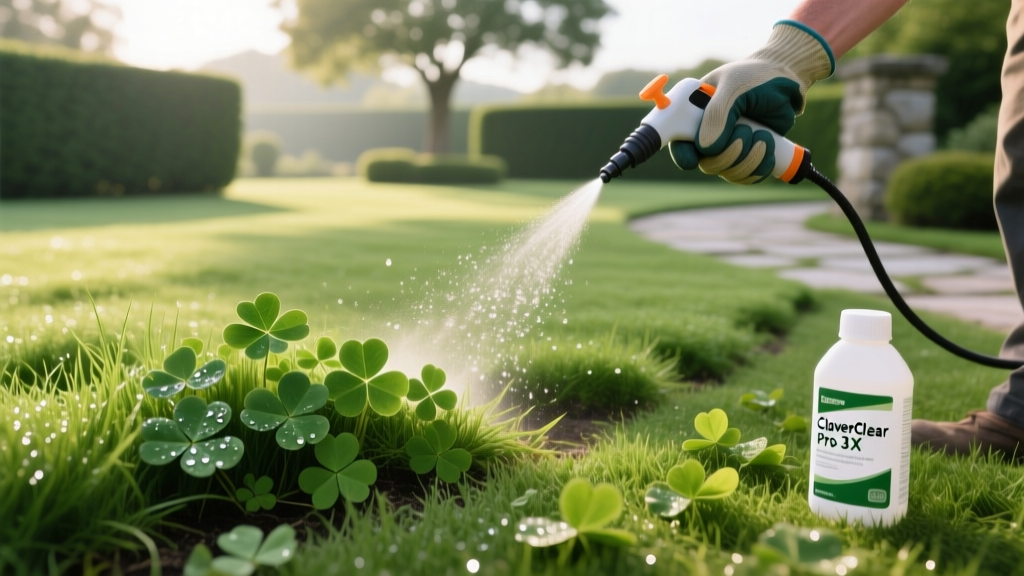
Getting Rid of Clover in Lawn: Spot-Treatment & Herbicide Guide
The Soil Health Connection: Why Clover Invades
Clover (Trifolium spp.) is a perennial broadleaf weed that thrives in turfgrass environments suffering from nitrogen deficiency. Unlike standard grasses, clover is a legume capable of atmospheric nitrogen fixation via symbiotic Rhizobium bacteria in its root nodules. When your soil lacks available nitrogen, turfgrass thins out, and clover exploits the vacant canopy space. According to Purdue University's Turfgrass Weed ID database, white clover is particularly aggressive in soils with a pH between 6.0 and 7.0, making standard residential lawns an ideal host.
💡 Soil Indicator Insight: Finding clover in your lawn is a biological indicator of low soil nitrogen. While spot-treating the existing weeds is necessary, failing to correct the underlying nitrogen deficit guarantees a secondary invasion within 60 to 90 days.
Identifying Your Clover Species
Accurate identification dictates your herbicide selection and application timing. While all clovers share the characteristic trifoliate (three-leaf) structure, their growth habits vary significantly.
| Species | Scientific Name | Growth Habit | Key Identifier |
|---|---|---|---|
| White Clover | Trifolium repens | Creeping stolons, roots at nodes | White/pinkish ball-shaped flowers; watermarked 'V' on leaves |
| Red Clover | Trifolium pratense | Upright, bushy, deep taproot | Purple/red flower heads; hairy stems and leaves |
| Hop Clover | Trifolium campestre | Low-growing, branching taproot | Small yellow flowers that turn brown, resembling dried hops |
Selective Herbicide Spot-Treatment Protocols
Getting rid of clover in lawn environments requires a selective, post-emergent broadleaf herbicide. Standard 2,4-D formulations alone are notoriously ineffective against mature white clover due to its waxy leaf cuticle and extensive stolon network. You must use a 3-way or 4-way herbicide blend containing 2,4-D, Dicamba, and MCPP (Mecoprop), ideally with the addition of Carfentrazone-ethyl for rapid burndown.
Grass-Type Herbicide Safety Matrix
Applying the wrong chemical to warm-season grasses can cause severe phytotoxicity. Use this matrix to select the correct active ingredient profile for your specific turfgrass.
| Turfgrass Type | Safe Active Ingredients | Commercial Product Example | Critical Warning |
|---|---|---|---|
| Cool-Season (Fescue, KBG, Ryegrass) | 2,4-D, Dicamba, MCPP, Carfentrazone | SpeedZone (PBI-Gordon) | Do not apply when temps exceed 85°F to prevent volatilization. |
| Warm-Season (Bermuda, Zoysia) | 2,4-D, Dicamba, Quinclorac | Trimec Southern | Avoid application during spring green-up transition. |
| St. Augustine / Centipede | Atrazine, Penoxsulam | Certainty (Penoxsulam) | DANGER: 2,4-D causes severe stunting and chlorosis in St. Augustine. |
Step-by-Step Mixing and Application (SpeedZone Protocol)
For cool-season and standard warm-season lawns, a 4-way product like SpeedZone provides visible clover wilting within 24 hours. Follow these exact parameters for a 2-gallon pump sprayer targeting 2,000 square feet of isolated clover patches:
- Measure the Herbicide: Add 3.0 fluid ounces of SpeedZone concentrate to the sprayer tank.
- Add Surfactant: Clover leaves possess a hydrophobic waxy cuticle. Add 0.5 teaspoons (approx. 2.5 ml) of a Non-Ionic Surfactant (NIS) to break surface tension and ensure the herbicide penetrates the leaf tissue.
- Dilute: Fill the tank with 2 gallons of clean water and agitate thoroughly.
- Application: Spray until the clover leaves are uniformly wet, but not to the point of runoff. Dripping herbicide wastes chemical and increases soil residual toxicity.
- Timing: Apply in the early morning when temperatures are between 65°F and 80°F, and wind speeds are below 5 mph to prevent drift onto desirable ornamental broadleaf plants.
Organic Alternatives: Iron HEDTA Applications
For homeowners seeking non-synthetic routes, or those managing lawns near sensitive waterways, Chelated Iron (FeHEDTA) is the premier organic spot-treatment. According to research cited by the University of Minnesota Extension, broadleaf weeds absorb iron more rapidly than grasses, leading to localized oxidative stress and cellular necrosis, while the turfgrass simply turns a temporary, deep green.
⚠️ Iron HEDTA Trade-offs: Products like Fiesta Turf Weeder require a heavier application rate (typically 3.3 fl oz per 1,000 sq ft) and mandate a two-pass system. You must apply the first coat, wait 21 days for the initial top-growth to necrotize, and apply a second coat to kill the exposed root crown. Expect to spend roughly $45 per gallon of concentrate.
Post-Treatment Recovery and Prevention
Eradicating the physical weed leaves a void in the turf canopy. If this void is not filled, wind-blown clover seeds will germinate in the exact same location within weeks.
- Overseeding: Three weeks after the clover has completely browned and died, rake out the dead thatch. Overseed the bare patches with a turf-type tall fescue or Kentucky bluegrass blend matching your existing lawn. Keep the seed moist until germination.
- Nitrogen Correction: Implement a fertilization schedule delivering 2.5 to 3.5 lbs of Nitrogen per 1,000 sq ft annually for cool-season grasses. Use a slow-release methylene urea or sulfur-coated urea (SCU) to provide a steady nutrient drip, outcompeting any residual clover seedlings.
- Mowing Height Adjustment: Raise your mower deck to 3.0 or 3.5 inches. Clover requires high light penetration to establish stolons. A taller grass canopy shades the soil surface, biologically suppressing clover germination.
Troubleshooting Treatment Failures
If your clover returns after chemical application, diagnose the failure using these common edge cases:
- Symptom: Leaves curled and cupped, but the plant is still green after 14 days.
Cause: Application occurred during a drought stress period. The clover shut down its stomata to conserve water, preventing the systemic herbicide from translocating to the roots. Fix: Water the lawn deeply 24 hours before your next application. - Symptom: Clover died, but new seedlings appeared immediately.
Cause: You treated in late summer when mature plants were dying naturally, leaving behind a massive seed bank. Fix: Apply a pre-emergent like Isoxaben in early fall to stop seed germination. - Symptom: Grass turned white/yellow alongside the clover.
Cause: Herbicide drift or application during high heat (above 85°F), causing the 2,4-D ester formulation to vaporize and drift onto surrounding turf. Fix: Switch to an amine-based formulation for summer applications.
Successfully getting rid of clover in lawn environments requires more than a single spray. By combining a targeted 3-way or 4-way herbicide protocol with aggressive nitrogen fertilization and canopy shading, you alter the soil ecology to permanently favor turfgrass over leguminous weeds. For further identification and regional management strategies, consult the University of California Statewide IPM Program guidelines on clover management.

