
Lawn Care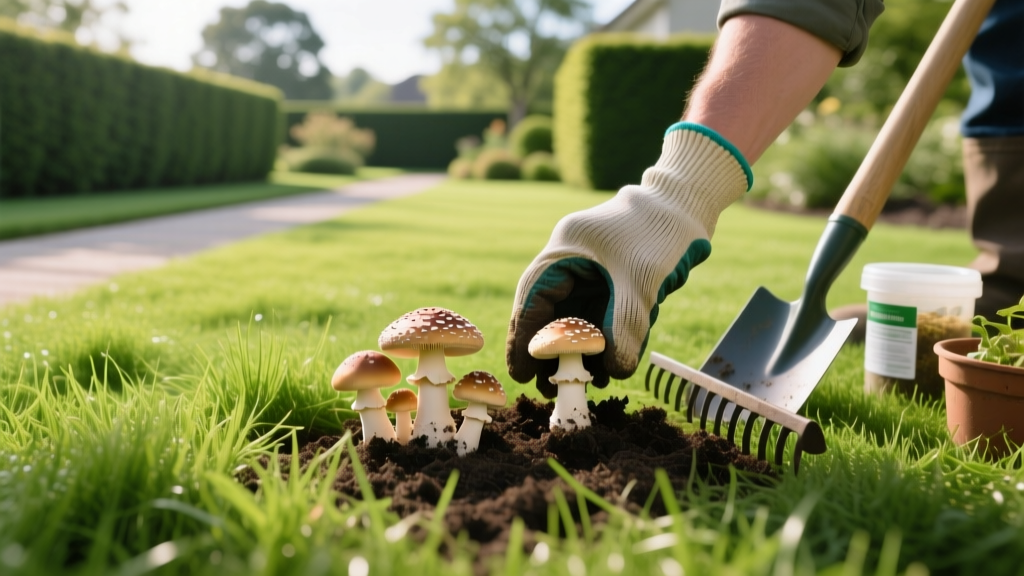
Getting Rid of Mushrooms on Lawn: Step-by-Step Procedures
Mushrooms in your yard are the visible fruiting bodies of a vast, underground fungal network (mycelium). While most saprophytic mushrooms are harmless and actually aid in breaking down organic matter, their presence is a primary indicator of excessive soil moisture, poor drainage, and thick thatch layers. Getting rid of mushrooms on lawn requires a systematic approach that alters the microenvironment, making it inhospitable for fungal fruiting. Below is a comprehensive, step-by-step maintenance protocol to eradicate lawn mushrooms and address the underlying agronomic causes.
Phase 1: Immediate Physical Removal and Site Assessment
Before altering the soil environment, you must remove the existing fruiting bodies to prevent the release of new spores. While this does not kill the underlying mycelium, it halts the immediate reproductive cycle.
- Manual Extraction: Wear waterproof gardening gloves and pull the mushrooms from the base of the stem. Do not simply kick them over; remove the entire stalk.
- Proper Disposal: Place the extracted mushrooms in a sealed plastic trash bag. Never add them to your home compost pile, as standard residential compost bins rarely reach the 140°F to 160°F temperatures required to kill fungal spores.
- Mowing Protocol: If the infestation is widespread, mow the lawn using a bagging attachment. Set your mower deck to the standard height for your grass type (e.g., 3.5 inches for Tall Fescue, 1.5 inches for Bermudagrass) to ensure you are only catching the mushroom caps without scalping the turf.
Phase 2: Correcting Soil Moisture and Drainage
Fungi require consistent moisture to fruit. According to Penn State Extension, overwatering and compacted soils are the leading catalysts for mushroom outbreaks. Modifying your irrigation strategy is the most critical long-term solution.
Implementing Deep and Infrequent Watering
Transition from daily light watering to deep, infrequent irrigation. Lawns require approximately 1 to 1.5 inches of water per week, applied in 1 or 2 sessions. This forces grass roots to grow deeper (6 to 8 inches into the soil profile) while allowing the top 1 to 2 inches of soil and thatch to dry out completely between waterings, depriving surface mycelium of the moisture needed to produce mushrooms.
Upgrading Irrigation Hardware
Install a smart irrigation controller, such as the Rachio 3 or Rain Bird ESP-TM2, paired with a wireless soil moisture sensor. These devices automatically skip scheduled watering cycles when the soil volumetric water content (VWC) exceeds 30%, preventing the accidental over-saturation that triggers fungal blooms.
⚠️ Warning: Identifying Fairy Rings
Not all mushrooms are harmless saprophytes. If your mushrooms are growing in a distinct circle or arc, accompanied by a ring of dead, hydrophobic grass (Type 1) or a ring of hyper-green, rapidly growing grass (Type 2), you are dealing with a Fairy Ring. Fairy rings are caused by aggressive basidiomycete fungi that can severely damage turf roots. Standard moisture control will not cure a fairy ring; it requires targeted chemical intervention (detailed in Phase 4).
Phase 3: Thatch Reduction and Soil Aeration
Thatch is a layer of dead and living shoots, roots, and stems that develops between the green vegetation and the soil surface. When thatch exceeds 0.5 inches in thickness, it acts like a sponge, trapping moisture against the soil surface and providing an all-you-can-eat buffet for mycelium.
Step-by-Step Dethatching and Aeration
According to University of Minnesota Turf Science, reducing the organic food source and alleviating soil compaction are mandatory for permanent mushroom control.
| Procedure | Best Time to Apply | Mechanism of Action | Target Thatch Depth |
|---|---|---|---|
| Power Raking (Dethatching) | Early Fall (Cool-season) / Late Spring (Warm-season) | Physically tears out and removes the sponge-like organic layer. | > 0.5 inches |
| Core Aeration | During peak growing season | Extracts 3-inch soil plugs, breaking up compaction and accelerating thatch decomposition via soil microbes. | 0.25 - 0.5 inches |
| Liquid Aeration | Anytime soil is not frozen | Uses Ammonium Lauryl Sulfate to fracture soil colloids, improving water infiltration without removing physical thatch. | < 0.25 inches |
Execution Tip: For severe mushroom infestations, perform core aeration followed immediately by a heavy raking to remove the extracted plugs and the disrupted thatch. Leaving the plugs on the lawn will simply reintroduce the fungal food source back to the surface.
Phase 4: Chemical and Biological Interventions
Standard contact fungicides (like copper sulfate or basic chlorothalonil) are largely ineffective against saprophytic lawn mushrooms. The mycelium network lives deep within the thatch and soil profile, far below the reach of surface sprays. Furthermore, applying broad-spectrum fungicides can harm beneficial soil bacteria that naturally compete with and suppress mushroom growth.
When to Use Systemic Fungicides
Chemical intervention is strictly reserved for Fairy Rings or severe turf-damaging fungal pathogens. If you have confirmed a Type 1 or Type 2 Fairy Ring, you must use a systemic, preventative fungicide containing Azoxystrobin (e.g., Syngenta Heritage SC) or Flutolanil (e.g., ProStar).
- Application Rate: Apply Azoxystrobin 23.0% SC at a rate of 0.4 to 0.8 fluid ounces per 1,000 square feet.
- Carrier Volume: Mix with 2 to 4 gallons of water per 1,000 square feet to ensure the chemical penetrates through the thatch and reaches the root zone where the fairy ring mycelium resides.
- Surfactant: Add a non-ionic surfactant (NIS) at 0.25% v/v to break the surface tension of the hydrophobic soil typically found inside Type 1 fairy rings.
- Timing: Apply in early spring or late fall when soil temperatures at a 2-inch depth are between 55°F and 70°F. Water in immediately with 0.25 inches of irrigation.
Phase 5: Ongoing Maintenance to Prevent Regrowth
Once the physical environment is corrected and existing mushrooms are removed, ongoing maintenance ensures the mycelium remains dormant and eventually starves.
Nitrogen Management
Fungi thrive in carbon-heavy, nitrogen-poor environments. By applying a high-quality, slow-release nitrogen fertilizer (such as a 32-0-4 formulation with methylene diurea), you stimulate aggressive turfgrass growth. The dense grass canopy will shade the soil surface, reducing moisture retention, while the added nitrogen accelerates the breakdown of thatch by soil bacteria, effectively outcompeting the fungi for resources.
Buried Wood and Debris Removal
If mushrooms persistently return to the exact same localized spot despite proper watering and aeration, there is likely buried organic matter feeding the mycelium. This is common in new construction lawns where builders bury stumps, roots, or construction lumber. Use a soil probe or shovel to excavate the top 12 inches of soil in the affected area, remove all decaying wood, and backfill with a sandy loam topsoil mix before laying new sod.
Annual Soil Testing
Maintain a soil pH between 6.0 and 6.5 for cool-season grasses, and 5.5 to 6.0 for warm-season grasses. Highly alkaline soils (pH > 7.2) can inhibit the beneficial bacteria that decompose thatch, indirectly favoring fungal dominance. Apply elemental sulfur at a rate of 1 pound per 1,000 square feet to lower pH if your annual soil test indicates alkalinity.

