
Lawn Care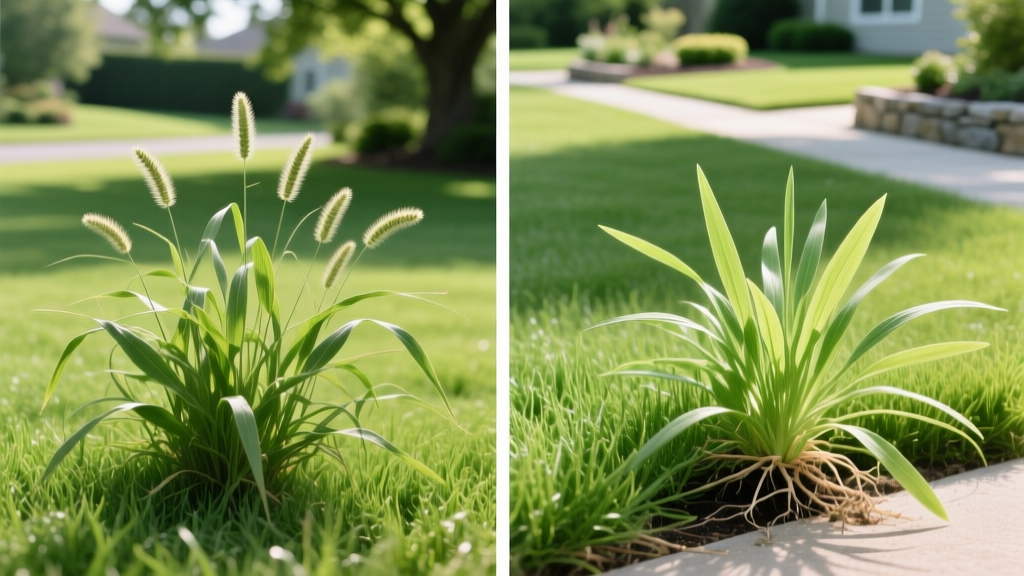
Goosegrass vs Crabgrass: Identification and Spot-Treatment Guide
The Core Differences: Goosegrass vs Crabgrass Identification
Misidentifying summer annual grassy weeds leads to failed herbicide applications and wasted chemical costs. While crabgrass (Digitaria sanguinalis) and goosegrass (Eleusine indica) both invade thin, stressed turf during the heat of summer, their botanical structures and chemical resistances differ drastically. According to NC State Extension turfgrass specialists, accurate identification at the seedling and mature stages is the prerequisite for selecting the correct post-emergent active ingredient.
The 'Folded vs. Rolled' Field Test: Pull a single weed stem from the soil. If the youngest emerging leaf is folded inside the sheath (folded vernation) and the base of the stem is distinctly white or silver, you have goosegrass. If the leaf emerges rolled (rolled vernation) and the stem base is green or purplish with fine hairs, it is crabgrass.
| Feature | Crabgrass (Digitaria) | Goosegrass (Eleusine) |
|---|---|---|
| Vernation | Rolled | Folded |
| Stem Base Color | Green to purplish, hairy | Silver/white, smooth |
| Soil Temp Emergence | 55°F (at 2-inch depth) | 60°F - 65°F (at 2-inch depth) |
| Growth Habit | Sprawling, roots at nodes | Prostrate but rarely roots at nodes |
| Seedhead Structure | Finger-like spikes (3-8) | Zipper-like spikes (2-6), windmill shape |
Why Goosegrass Evades Standard Pre-Emergents
Homeowners often apply pre-emergent herbicides like prodiamine or dithiopyr in early spring, only to see goosegrass erupt in July. This failure occurs because goosegrass germinates three to four weeks later than crabgrass, requiring soil temperatures of 60°F to 65°F at a 2-inch depth. By the time goosegrass seeds germinate, the chemical barrier of a standard spring pre-emergent application has often degraded below the lethal threshold, especially in warm, sandy soils where microbial breakdown accelerates.
Furthermore, University of California IPM guidelines note that goosegrass possesses a thicker leaf cuticle and a more robust root system than crabgrass, making it highly tolerant to standard post-emergent chemicals like MSMA (which is largely restricted to professional golf turf anyway) and basic 2,4-D blends.
Targeted Post-Emergent Spot-Treatment Protocols
When pre-emergents fail, spot-treating with the correct post-emergent active ingredient is mandatory. Broadcast spraying entire lawns with selective grassy weed killers is inefficient and stresses desirable turf. Use a dedicated 2-gallon backpack sprayer calibrated for precision application.
Crabgrass Eradication Strategy
Crabgrass is highly susceptible to Quinclorac (commonly sold as Drive XLR8). Quinclorac mimics plant hormones, causing rapid, uncontrolled growth that tears the weed's vascular tissue apart.
- Mixing Rate: 0.75 fluid ounces of Quinclorac 4L per 1,000 square feet.
- Adjuvant Requirement: You must include a Methylated Seed Oil (MSO) at 0.5% v/v (approx. 1.3 oz per gallon of water) to penetrate the leaf surface.
- Timing: Apply when crabgrass is in the 1-to-3 tiller stage. Mature crabgrass with visible seedheads will require a second application 14 to 21 days later.
- Turf Safety: Safe for Kentucky Bluegrass, Fescue, and Bermudagrass. Do not apply to St. Augustine or Centipedegrass.
Goosegrass Eradication Strategy
Goosegrass laughs at Quinclorac. To kill it, you need Fenoxaprop-p-ethyl (Acclaim Extra) for cool-season lawns, or Foramsulfuron (Revolver) for warm-season lawns.
- Cool-Season Lawns (Fescue, Bluegrass): Use Fenoxaprop-p-ethyl at 0.3 to 0.4 fl oz per 1,000 sq ft. Add a Non-Ionic Surfactant (NIS) at 0.25% v/v. Fenoxaprop inhibits lipid biosynthesis, slowly starving the goosegrass over 14 to 21 days.
- Warm-Season Lawns (Bermuda, Zoysia): Use Foramsulfuron at 0.1 oz per 1,000 sq ft. This is a premium, high-cost chemical (often exceeding $350 per gallon), but it is the only reliable selective option for mature goosegrass in warm-season turf without causing severe phytotoxicity.
Warning: Temperature Limits for Spot-Treatment
Do not apply Fenoxaprop or Quinclorac when ambient air temperatures exceed 85°F. High heat increases the volatility of the herbicide and the open stomata of your desirable turf, leading to severe chemical burn on your actual lawn. Spray strictly in the early morning when temperatures are below 80°F.
Do not apply Fenoxaprop or Quinclorac when ambient air temperatures exceed 85°F. High heat increases the volatility of the herbicide and the open stomata of your desirable turf, leading to severe chemical burn on your actual lawn. Spray strictly in the early morning when temperatures are below 80°F.
Sprayer Calibration for Precision Spot-Treatment
The most common failure mode in DIY spot-treatment is poor sprayer calibration, resulting in under-dosing (which breeds chemical resistance) or over-dosing (which kills the surrounding desirable grass).
- Nozzle Selection: Swap the standard cone nozzle on your backpack sprayer for a TeeJet 11002 Flat Fan nozzle. This provides an even, 110-degree spray pattern that prevents overlapping hot-spots.
- Pressure Control: Maintain exactly 40 PSI. If your sprayer lacks a pressure gauge, pump until you feel firm resistance and maintain a steady walking speed of 3 miles per hour (roughly 120 feet in 27 seconds).
- Output Verification: Spray water into a bucket for exactly 12.5 seconds. If you collect 16 ounces of water, your sprayer is calibrated to deliver 1 gallon per 1,000 square feet, matching the carrier rate required for the herbicide rates listed above.
Cultural Remediation: Fixing the Soil Trigger
Herbicides only treat the symptom. NC State Extension explicitly links goosegrass infestations to severe soil compaction and low soil oxygen levels. Goosegrass thrives in high-traffic, compacted areas where desirable turf roots cannot penetrate.
Core Aeration and Topdressing Costs
If goosegrass is present in your lawn, your soil bulk density is likely too high. You must perform core aeration in the early fall (for cool-season grasses) or late spring (for warm-season grasses).
- Professional Aeration Cost: Expect to pay $150 to $250 per 5,000 square feet for professional double-pass core aeration.
- DIY Aeration Cost: Renting a walk-behind core aerator costs roughly $80 to $120 for four hours. Do not use spike aerators; they exacerbate compaction by creating a hardpan layer just below the spike depth.
- Topdressing: Immediately after aeration, apply a 1/4-inch layer of coarse compost or screened topsoil. This fills the aeration holes with organic matter, permanently altering the soil structure and making the environment hostile to future goosegrass germination.
Frequently Asked Questions
Can I mix Quinclorac and Fenoxaprop together to kill both weeds at once?
No. Mixing these two active ingredients in the same tank can cause chemical antagonism, where the Quinclorac rapidly accelerates the plant's metabolism, effectively detoxifying the Fenoxaprop before it can kill the goosegrass. Treat crabgrass first with Quinclorac, wait 10 days, and then treat remaining goosegrass with Fenoxaprop.
Will pulling goosegrass by hand work?
Hand-pulling is only effective if the soil is heavily saturated and you extract the entire fibrous root system. Goosegrass has a deep, tough taproot compared to crabgrass. If you snap the weed off at the crown, the basal meristem will simply push out new tillers within 5 to 7 days, rendering your effort useless.
Does goosegrass die in the winter?
Yes, both crabgrass and goosegrass are summer annuals. They will naturally yellow and die after the first hard frost in autumn. However, a single mature goosegrass plant can produce up to 140,000 seeds before frost. Relying on winter kill without executing a fall pre-emergent or cultural remediation strategy guarantees a worse infestation the following spring.

