
Lawn Care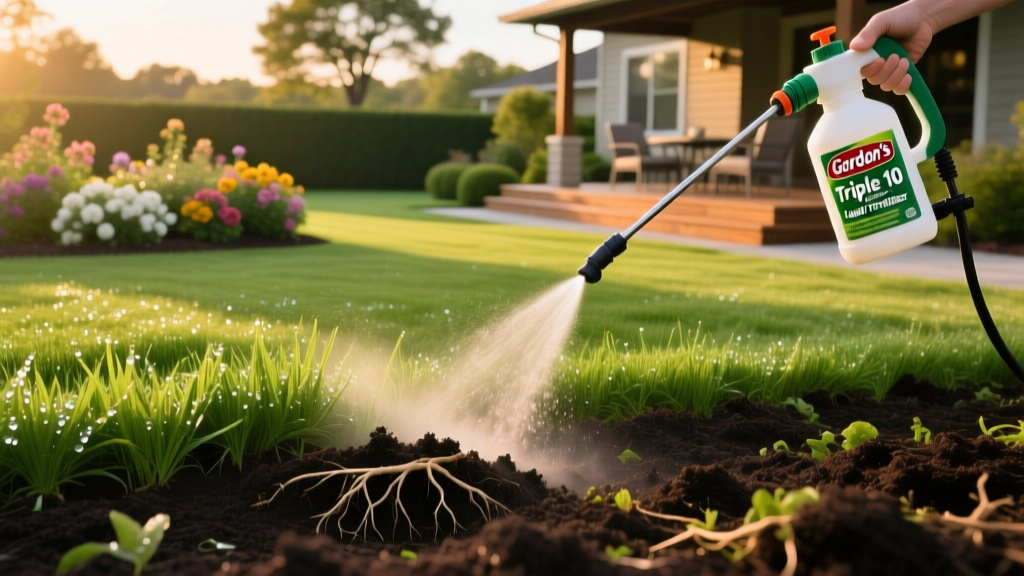
Gordon's Triple 10 Liquid Fertilizer: Application & Soil Guide
The NPK Breakdown: What 10-10-10 Actually Does for Your Soil
Gordon's Triple 10 liquid fertilizer provides a balanced 10-10-10 NPK (Nitrogen-Phosphorus-Potassium) ratio. Unlike high-nitrogen formulations (such as 32-0-4) designed strictly for rapid blade growth, a balanced 10-10-10 profile addresses the entire turfgrass ecosystem. Nitrogen drives chlorophyll production and vegetative growth, phosphorus stimulates deep root development and energy transfer, and potassium fortifies cell walls against drought, disease, and foot traffic stress.
Because this is a liquid formulation, the nutrients are immediately available for foliar absorption. According to turfgrass researchers at the University of Minnesota, liquid fertilizers bypass the soil microbial breakdown process required by granular options, delivering nutrients directly through the leaf stomata within 24 to 48 hours. This makes Gordon's Triple 10 an exceptional choice for rapid correction of multi-nutrient deficiencies or for giving cool-season grasses a fast green-up during early spring transitions.
Quick Specs: Gordon's Triple 10 Liquid
- NPK Ratio: 10-10-10 (Balanced Macro-Nutrients)
- Coverage: ~1,500 to 2,000 sq. ft. per gallon (depending on dilution)
- 2026 Retail Price Range: $32.00 - $45.00 per gallon jug
- Best Grass Types: Kentucky Bluegrass, Tall Fescue, Bermuda, Zoysia
- Primary Use Case: Spring green-up, establishment of new seed, and correcting broad-spectrum soil deficiencies.
Gordon's Liquid vs. Granular 10-10-10: Absorption & Efficiency
Choosing between liquid and granular 10-10-10 fertilizers depends heavily on your soil's current health and your application equipment. While granular fertilizers offer slow-release capabilities, Gordon's liquid formulation excels in immediate bioavailability. Below is a direct comparison of how these two delivery methods perform in residential lawn care.
| Feature | Gordon's Liquid 10-10-10 | Standard Granular 10-10-10 |
|---|---|---|
| Nutrient Availability | Immediate (Foliar & Soil) | Delayed (Requires water to dissolve) |
| Application Method | Hose-end sprayer or pump tank | Broadcast or drop spreader |
| Burn Risk | Moderate (if applied in high heat) | Low (if watered in properly) |
| Cost per 1,000 sq. ft. | $0.12 - $0.18 | $0.08 - $0.14 |
| Longevity in Soil | 2 to 4 weeks | 4 to 8 weeks |
Because liquid applications deplete faster from the soil profile, Gordon's Triple 10 is best utilized as a 'spoon-feeding' supplement every 3 to 4 weeks during peak growing seasons, rather than a standalone bi-annual treatment.
Step-by-Step Application Protocol
Applying liquid fertilizer requires precise calibration to prevent salt burn and nutrient runoff. Follow this protocol to maximize the efficacy of Gordon's Triple 10 while protecting your turf and local waterways—a critical consideration highlighted by the EPA's nutrient management guidelines.
1. Pre-Application Soil Testing
Before applying a balanced 10-10-10 fertilizer, verify your soil's phosphorus levels. Many established lawns already have excess phosphorus from years of starter fertilizer use. If your soil test shows high phosphorus (P), applying more can lead to nutrient lockout and environmental runoff. Use Gordon's Triple 10 primarily when a soil test confirms a deficiency in all three macronutrients, or when establishing a brand-new lawn from seed or sod.
2. Calibration and Mixing
For a standard hose-end sprayer application, set the dial to deliver 2 to 3 ounces of Gordon's Triple 10 per gallon of water. This dilution rate will safely cover approximately 1,000 square feet, delivering roughly 0.15 lbs of actual Nitrogen per 1,000 sq. ft. If using a backpack pump sprayer, mix 4 ounces of fertilizer per gallon of water and apply at a rate of 1.5 gallons per 1,000 square feet.
3. Timing and Environmental Conditions
- Temperature: Apply when daytime air temperatures are between 60°F and 80°F. Never apply liquid fertilizer when temperatures exceed 85°F, as the rapid evaporation concentrates the salts on the leaf blade, causing severe tip burn.
- Time of Day: Spray in the early morning (between 6:00 AM and 9:00 AM) when grass stomata are open and receptive to foliar feeding.
- Moisture: Ensure the lawn is not drought-stressed prior to application. If the soil is bone dry, water the lawn deeply 24 hours before applying the fertilizer.
Troubleshooting Common Failure Modes
Even with a high-quality product like Gordon's, user error can lead to suboptimal results. Here is how to diagnose and fix common issues associated with liquid 10-10-10 applications.
Symptom: Brown, crispy grass tips 48 hours after spraying
Cause: Fertilizer salt burn. This occurs when the liquid evaporates too quickly, leaving concentrated nutrient salts on the leaf tissue, or when the application rate exceeded 4 ounces per 1,000 sq. ft. without adequate carrier water.
Fix: Immediately water the lawn with 0.25 inches of irrigation to wash the remaining salts off the blades and into the soil. Reduce your dilution rate by 20% for the next application.
Symptom: Broadleaf weeds thriving alongside the grass
Cause: The balanced 10-10-10 ratio feeds all plants equally, including dandelions, clover, and plantain. Weeds are often more efficient at rapid nutrient uptake than turfgrass.
Fix: Spot-treat the lawn with a selective post-emergent herbicide (like 2,4-D or Dicamba) two weeks before your scheduled Gordon's Triple 10 application. Eliminating the weeds first ensures the turfgrass monopolizes the nutrient influx.
Integrating Gordon's Triple 10 into a Seasonal Soil Nutrition Plan
To build a resilient lawn, Gordon's Triple 10 should not be used in isolation. It must be integrated into a broader, season-specific nutrition framework. According to Penn State Extension, timing your nutrient delivery to match the grass's natural growth cycles is the most critical factor in lawn health.
Cool-Season Grasses (Fescue, Bluegrass, Ryegrass)
Apply Gordon's Triple 10 in early spring (when soil temperatures consistently hit 55°F) to support initial root and blade development. Follow up with a second application in early fall (September) to help the grass store carbohydrates for winter survival. Avoid using 10-10-10 in late spring or summer, as the nitrogen will push excessive top-growth during heat stress periods, depleting the plant's root reserves.
Warm-Season Grasses (Bermuda, Zoysia, St. Augustine)
Wait until late spring (when the grass has fully greened up and soil temperatures reach 65°F) to apply your first round of Gordon's Triple 10. The phosphorus and potassium will support the aggressive rhizome and stolon spreading typical of warm-season grasses. A second application in mid-to-late summer will bolster potassium levels, increasing the turf's drought tolerance during peak August heat.
Expert Insight: Liquid fertilizers are highly susceptible to leaching in sandy soils. If your lawn has a high sand content, split your Gordon's Triple 10 application into two half-doses applied 10 days apart. This prevents the phosphorus and potassium from washing past the root zone before the turf can absorb them.
By treating Gordon's Triple 10 liquid fertilizer as a precise, targeted tool rather than a blanket cure-all, homeowners can achieve a denser, more vibrant turf while maintaining optimal soil chemistry and minimizing environmental impact.

