
Lawn Care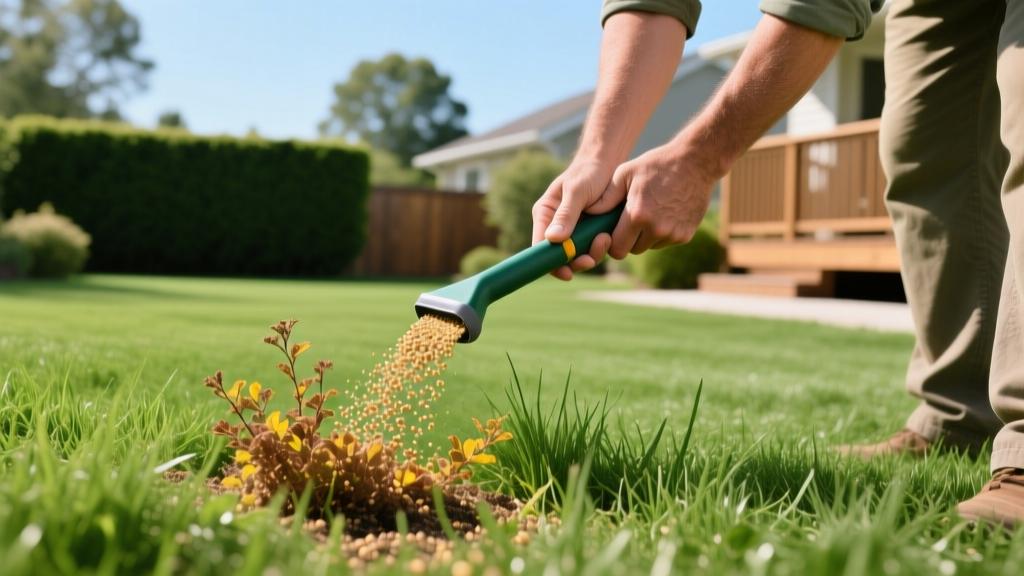
How to Use Granular Weed and Grass Killer for Lawn Spot-Treatment
When homeowners search for a granular weed and grass killer to spot-treat stubborn lawn invaders, they often stumble into a costly landscaping trap. The phrase 'weed and grass killer' traditionally denotes a non-selective herbicide designed to destroy all vegetation it touches. However, applying non-selective granular herbicides to a lawn for spot-treatment will not only kill the target weed but also sterilize the surrounding soil and destroy your desirable turf. To successfully spot-treat grassy weeds like crabgrass, dallisgrass, or Poa annua without sacrificing your lawn, you must pivot to selective granular formulations that target specific weed biology while leaving your turfgrass unharmed.
⚠️ CRITICAL WARNING: The Non-Selective Granular Trap
Products labeled as 'Vegetation Killer' or total 'Weed and Grass Killer' in granular or pellet form (often containing Imazapyr or Prometon) are soil sterilants. According to the Environmental Protection Agency (EPA), these active ingredients can persist in the soil for 6 to 12 months, preventing any grass seed or desirable plants from growing in the treated area. Never use these on or near your lawn.
Selective Granular Active Ingredients for Grassy Weeds
For true lawn spot-treatment, you need selective post-emergent or pre-emergent granular herbicides. These products utilize specific modes of action to disrupt weed cellular growth without harming monocot turfgrasses (like Bermuda, Zoysia, Fescue, or Kentucky Bluegrass). Below is a breakdown of the most effective selective granular active ingredients available to consumers and prosumers in 2026.
| Target Grassy Weed | Selective Granular Active Ingredient | Mode of Action | Estimated Cost (per 1,000 sq ft) |
|---|---|---|---|
| Crabgrass (Smooth & Hairy) | Quinclorac (e.g., BioAdvanced All-in-One Granules) | Synthetic Auxin (Group 4) | $2.50 - $3.20 |
| Dallisgrass | MSMA (Restricted use) / Quinclorac (Suppression) | Organic Arsenical / Auxin | $4.00 - $6.00 |
| Poa Annua (Annual Bluegrass) | Prodiamine (Pre-emergent) / Mesotrione (Post) | Root Inhibitor / HPPD Inhibitor | $1.80 - $2.50 |
| Nutsedge (Yellow & Purple) | Sulfentrazone (often blended in granular broadleaf mixes) | PPO Inhibitor (Group 14) | $3.50 - $4.50 |
Step-by-Step Spot-Treatment Application Protocol
Spot-treating with granulars requires different equipment and technique than liquid spraying. Because granular herbicides rely on soil contact and dissolution rather than foliar absorption, precision and watering are your primary variables. The University of Minnesota Extension emphasizes that improper calibration of granular spreaders is the leading cause of localized turf burn.
- Isolate the Treatment Zone: Map out the exact 3-to-5-foot radius around the weed cluster. Mark the perimeter with landscaping flags to prevent overlapping passes, which will double the application rate and cause phytotoxicity to your desirable grass.
- Select the Right Spreader: Do not use a large rotary broadcast spreader for spot-treatments. Use a handheld broadcast spreader (such as the Scotts Handy Green II or Earthway EV-N-Spred). These allow you to control the drop zone within a 2-foot radius.
- Calibrate the Setting: For standard Quinclorac-based granular weed killers, set your handheld spreader to a medium-low setting (typically Setting 3 or 4). You are aiming for a rate of roughly 2.5 to 3.0 lbs of product per 1,000 square feet. Walk at a steady pace of 3 feet per second.
- Apply to Dry Foliage: Apply the granular prills when the grass is completely dry. If the turf is wet from morning dew, the granules will stick to the desirable grass blades, causing localized chemical burn before they ever reach the soil.
- Activate with Precision Watering: Granular herbicides are encased in a clay or fertilizer binder. You must apply exactly 0.25 to 0.5 inches of water immediately after application. This dissolves the prill, releasing the active ingredient into the thatch and top 1-inch of soil where the weed's root crown and stolons reside. Use a sprinkler with a catch-can test to measure the exact water volume; over-watering will push the chemical past the root zone.
Phytotoxicity and Overseeding Recovery Windows
One of the most significant drawbacks of using selective granular weed and grass killers—specifically those containing Quinclorac—is the residual soil activity that interferes with turfgrass seed germination. If your spot-treatment results in bare dirt, you cannot immediately overseed the area. According to research published by NC State TurfFiles, Quinclorac mimics plant hormones, causing abnormal cell division in germinating seeds.
Mandatory Wait Times by Turf Species (Post-Quinclorac Application)
- Perennial Ryegrass: Wait a minimum of 21 days before overseeding.
- Tall Fescue & Kentucky Bluegrass: Wait a minimum of 28 days.
- Fine Fescues (Creeping Red, Chewings): Wait a minimum of 45 to 60 days. Fine fescues are highly sensitive to Quinclorac residues.
- Bermudagrass & Zoysiagrass (Sod/Stolons): Wait 14 days before laying sod or planting plugs.
Pro-Tip for Faster Recovery: If you need to overseed a spot-treated area immediately, avoid Quinclorac entirely. Instead, use a granular product containing Mesotrione (the active ingredient in Tenacity). Mesotrione is an HPPD inhibitor that provides pre- and post-emergent control of many grassy weeds while being completely safe to apply at the exact time of grass seed germination. It will temporarily bleach the target weeds white, making it easy to track your spot-treatment success.
Troubleshooting Granular Application Failures
Issue 1: The Granules Are Still Visible After Watering
Cause: Insufficient irrigation volume or heavy thatch buildup. If your lawn has more than 0.5 inches of thatch, the granules will dissolve in the thatch layer rather than reaching the soil. The weed's root crown remains unaffected.
Fix: Core aerate the spot-treated area before application to break through the thatch mat. Increase your post-application watering to a full 0.5 inches to ensure the chemical washes entirely through the thatch profile.
Issue 2: Desirable Turf is Turning Yellow (Chlorosis)
Cause: Spreader overlap or application during high heat. If temperatures exceed 85°F (29°C) at the time of application, the selective herbicide can cause temporary phytotoxicity to St. Augustinegrass or Centipedegrass, which are highly sensitive to 2,4-D and Quinclorac blends.
Fix: Restrict granular spot-treatments to early morning when temperatures are below 80°F. If chlorosis occurs, do not apply nitrogen fertilizer to 'push' it out; simply water deeply to help the turf metabolize the herbicide. The yellowing is usually cosmetic and will resolve in 10 to 14 days.
Issue 3: The Weed Turned Brown but Returned in 3 Weeks
Cause: You treated a perennial grassy weed (like Dallisgrass or Johnsongrass) with a standard contact-rate granular. Perennial grassy weeds store massive energy reserves in deep rhizomes and tubers. A single granular application rarely translocates enough active ingredient to kill the entire root system.
Fix: For perennial grassy weeds, granular spot-treatment is often insufficient. You must switch to a liquid systemic herbicide (like Fluazifop-p-butyl for broadleaf lawns, or Glyphosate for careful wick-application) to ensure the chemical travels down into the rhizomes. Alternatively, plan for two granular applications spaced 21 days apart to exhaust the weed's root reserves.

