
Lawn Care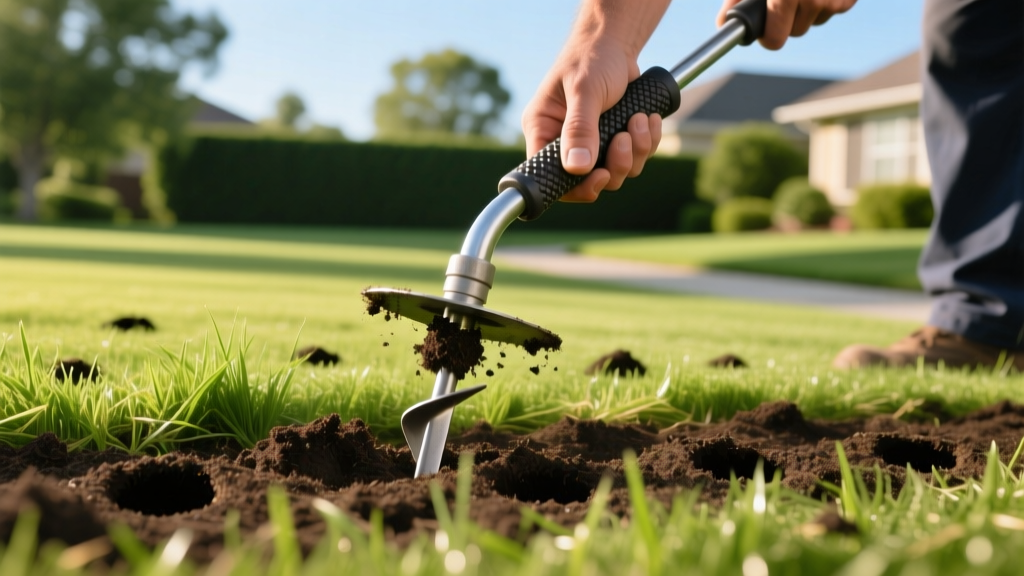
Grass Aeration Spikes: Step-by-Step Lawn Maintenance Guide
The Physics of Grass Aeration Spikes: When to Use Them
Grass aeration spikes (solid tines) are frequently misunderstood in the lawn care industry. Unlike core aerators that extract physical plugs of soil, spike aerators simply pierce the ground, creating narrow channels for air, water, and fertilizer to reach the root zone. While this method is faster and leaves no messy soil cores on the surface, it introduces a specific physical reaction in the soil profile: lateral compaction.
When a solid steel spike is driven into the earth, it displaces soil outward and downward. In sandy or loamy soils, this displacement creates beneficial micro-fractures that improve drainage. However, in heavy clay soils, this outward pressure compresses the clay particles tighter together, effectively worsening the compaction you are trying to fix. According to turfgrass researchers at the University of Minnesota Extension, solid spike aeration should be strictly reserved for non-clay soils or used as a lightweight maintenance tool between annual core aeration cycles.
⚠️ Critical Clay Soil Warning: If your lawn has heavy clay soil (identified by soil that forms a tight, sticky ribbon when squeezed), avoid grass aeration spikes entirely. The lateral smearing effect will create a hardpan layer just below the surface, leading to shallow root systems and increased drought stress. Use a hollow-tine core aerator instead.
Spike vs. Core Aeration Decision Matrix
Before renting equipment or buying attachments, use this matrix to determine if grass aeration spikes are the correct agronomic choice for your specific lawn conditions.
| Lawn Condition | Grass Aeration Spikes (Solid Tine) | Core Aeration (Hollow Tine) |
|---|---|---|
| Soil Type | Sandy, Loamy, or Silt-based | Heavy Clay or Compacted Fill Dirt |
| Primary Goal | Quick water infiltration, fertilizer delivery | Relieving deep lateral compaction, thatch reduction |
| Frequency | 2-3 times per growing season | 1 time per year (Fall or Spring) |
| Surface Cleanup | None required | Requires mowing over plugs or raking |
Step-by-Step Grass Aeration Spike Procedure
If your soil profile is suitable for solid tines, follow this precise procedure to maximize root zone benefits without damaging the turf crown.
Step 1: Calibrate Soil Moisture (The Squeeze Test)
Spiking dry soil will bend the tines and fracture the turf crown. Spiking saturated soil will cause severe smearing and rutting. You need the soil at field capacity, specifically a Volumetric Water Content (VWC) of roughly 20% to 25%. Dig a 4-inch test hole and grab a handful of soil. Squeeze it tightly in your fist. If it forms a ball that holds its shape but crumbles easily when you poke it with a finger, the moisture is perfect. If water drips out, wait 48 hours. If it turns to dust, run your sprinklers for 45 minutes the night before.
Step 2: Mow and Clear the Canopy
Mow your lawn to a height of 1.5 to 2 inches. This shorter cut prevents the grass blades from wrapping around the rolling spike cylinders or catching on tow-behind drag mats. Rake the lawn thoroughly to remove fallen branches, stones, and excessive thatch. Debris larger than 0.5 inches can snap the welds on cheaper spike tines.
Step 3: Execute the Overlap Pattern
Whether you are using push spikes, tow-behind attachments, or manual step-on spikes, a single pass is insufficient. You must use a grid overlap pattern to ensure uniform soil fracturing.
- Pass 1 (North-South): Walk or drive in straight, parallel lines spaced exactly half the width of your aerator. If using a 40-inch Agri-Fab tow-behind, overlap each pass by 20 inches.
- Pass 2 (East-West): Repeat the process perpendicular to your first passes. This cross-hatching ensures the spikes intersect beneath the surface, creating a 3D network of micro-channels rather than isolated vertical holes.
- Target Density: Aim for 15 to 20 spike holes per square foot. For a standard 5,000 sq. ft. lawn, this cross-hatching method will yield the necessary density.
Step 4: Post-Aeration Topdressing and Hydration
The holes created by grass aeration spikes begin to collapse within 48 hours due to foot traffic and natural soil settling. To keep these channels open, immediately apply a thin layer of topdressing. For sandy soils, use a 70/30 compost-to-sand mix. Spread it at a rate of 1 cubic yard per 1,000 square feet (roughly a 1/8-inch layer). Use a heavy drag mat or a piece of chain-link fence weighted with two 40-pound bags of soil to work the topdressing down into the spike holes. Follow this with a deep watering cycle of 0.5 inches to settle the material and activate any applied fertilizers.
Equipment Tiers and Pricing Breakdown
Selecting the right spiking tool depends on your lawn size and physical capability. Below is a breakdown of current market options and their specific use cases.
- Manual Spike Shoes ($25 - $45): Strapped to your boots with 2-inch plastic or metal spikes. Verdict: Highly inefficient. The human foot does not provide enough downward force to penetrate beyond 1.5 inches in most soils, and they frequently tear the turf crown. Not recommended for lawns over 1,000 sq. ft.
- Push Rolling Aerators ($60 - $130): Models like the Yard Butler Rolling Spike Aerator feature a weighted drum with 3-inch steel tines. Verdict: Excellent for small, flat urban lawns (under 3,000 sq. ft.). Requires significant upper body strength to push when the drum is filled with water for ballast.
- Tow-Behind Spike Aerators ($120 - $220): The Agri-Fab 45-0544 (40-inch width) or Brinly SA-40BH are industry standards for riding mower owners. Verdict: The most efficient choice for suburban lawns. The weight tray allows you to add up to 150 lbs of cinder blocks or sand, ensuring the 3-inch spikes penetrate to their full depth.
Troubleshooting Common Spiking Failures
Failure Mode 1: Tines Bending or Snapping
If your steel spikes are bending backward, you are either pulling the aerator backward, turning sharply while the tines are engaged, or hitting subsurface bedrock. Always disengage or lift the aerator before making turns. If hitting rock is a persistent issue, switch to a core aerator, which features a shear-pin mechanism designed to break safely upon impact with solid stone.
If your steel spikes are bending backward, you are either pulling the aerator backward, turning sharply while the tines are engaged, or hitting subsurface bedrock. Always disengage or lift the aerator before making turns. If hitting rock is a persistent issue, switch to a core aerator, which features a shear-pin mechanism designed to break safely upon impact with solid stone.
Failure Mode 2: Shallow Penetration (Under 1.5 Inches)
If the spikes are only piercing the top inch of soil, your ballast weight is insufficient, or the soil is hydrophobic. Add 50 lbs of weight to your aerator tray. If penetration remains shallow, the soil surface has likely developed a hydrophobic thatch layer. Apply a liquid surfactant (such as a yucca-based soil penetrant) 24 hours before spiking to break the surface tension and allow the tines to glide into the subsoil.
If the spikes are only piercing the top inch of soil, your ballast weight is insufficient, or the soil is hydrophobic. Add 50 lbs of weight to your aerator tray. If penetration remains shallow, the soil surface has likely developed a hydrophobic thatch layer. Apply a liquid surfactant (such as a yucca-based soil penetrant) 24 hours before spiking to break the surface tension and allow the tines to glide into the subsoil.
Seasonal Timing for Spike Aeration
Timing your spiking procedure to align with your grass type's peak growth cycle is critical for rapid hole recovery. As noted by the Texas A&M AgriLife Extension, aerating during dormancy invites weed invasion into the open holes.
- Cool-Season Grasses (Kentucky Bluegrass, Fescue, Ryegrass): Perform spike aeration in early fall (late August to mid-September) when soil temperatures drop below 70°F. Spring spiking is acceptable but secondary, as it can disrupt pre-emergent herbicide barriers.
- Warm-Season Grasses (Bermuda, Zoysia, St. Augustine): Execute spiking in late spring to early summer (May through June) once the turf has fully greened up and is entering its aggressive vegetative growth phase.
"Grass aeration spikes are an excellent micro-maintenance tool, but they are not a substitute for the deep soil fracturing provided by hollow tines. Use spikes to maintain soil porosity in the years between your core aeration schedule."
By understanding the specific soil mechanics required for solid tines and following a disciplined, cross-hatched application pattern, you can effectively utilize grass aeration spikes to improve water infiltration and nutrient delivery without the cleanup hassle of traditional coring.

