
Lawn Care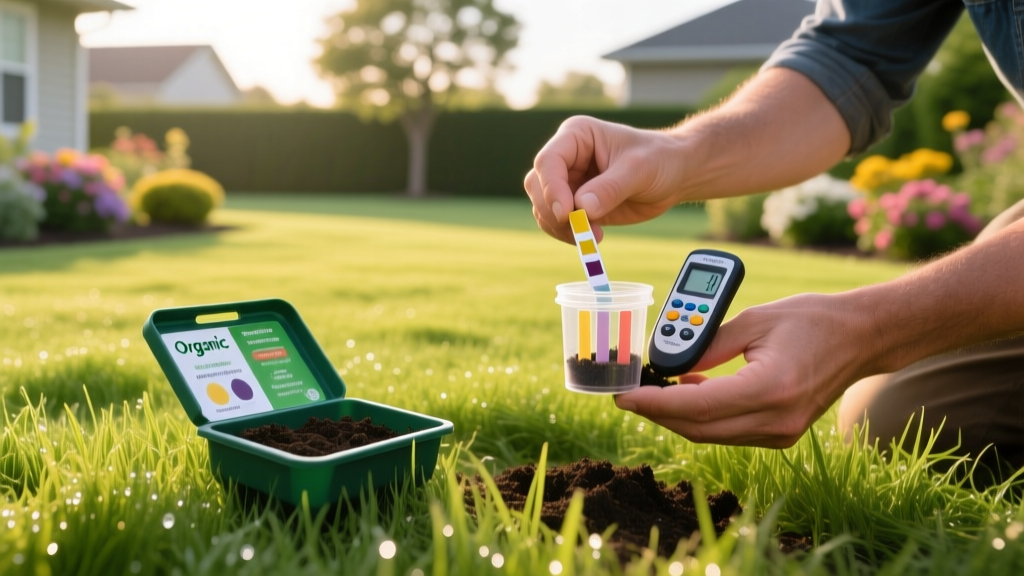
How to Choose the Right Grass Fertilizer Based on Soil Tests
Selecting the correct grass fertilizer is not about grabbing the brightest bag at the garden center; it is a calculated decision based on soil chemistry, turf species, and nitrogen release rates. Applying the wrong nutrient ratio can lead to excessive thatch buildup, increased susceptibility to fungal diseases like brown patch, and severe groundwater contamination. This guide breaks down the exact metrics you need to interpret soil tests and match them with the appropriate grass fertilizer formulations for optimal turf density and root depth.
Decoding the N-P-K Ratio on Grass Fertilizer Bags
Every commercial grass fertilizer displays a three-number N-P-K ratio representing the percentage by weight of Nitrogen (N), Phosphorus (P2O5), and Potassium (K2O). Understanding how these macros interact with your specific soil profile is the first step in turf nutrition.
The 3-1-2 and 4-1-2 Golden Rules:
For established lawns with adequate soil phosphorus and potassium, agronomists recommend a 3-1-2 or 4-1-2 ratio (e.g., 15-5-10 or 24-8-16). According to the University of Minnesota Extension, mature turfgrass requires high nitrogen for foliar growth, but excess phosphorus in established soils contributes to nutrient runoff without improving turf quality.
For established lawns with adequate soil phosphorus and potassium, agronomists recommend a 3-1-2 or 4-1-2 ratio (e.g., 15-5-10 or 24-8-16). According to the University of Minnesota Extension, mature turfgrass requires high nitrogen for foliar growth, but excess phosphorus in established soils contributes to nutrient runoff without improving turf quality.
- Nitrogen (N): Drives chlorophyll production and vegetative shoot growth. Deficiencies present as uniform chlorosis (yellowing) and thinning.
- Phosphorus (P): Critical for seedling establishment and root energy transfer (ATP). Only required in high amounts during new lawn installation or overseeding.
- Potassium (K): Regulates stomatal opening, water retention, and cold/drought stress tolerance. Crucial for late-fall winterizer applications.
Quick-Release vs. Slow-Release Nitrogen: A Cost-Benefit Breakdown
The source of nitrogen in your grass fertilizer dictates how quickly the turf greens up, how long the feeding lasts, and the risk of fertilizer burn. As of 2026, polymer-coated and sulfur-coated technologies have become the industry standard for professional-grade results.
| Nitrogen Source | Release Time | Burn Risk | Est. Cost per 1,000 sq ft | Common Product Examples |
|---|---|---|---|---|
| Urea (Quick-Release) | 1–2 Weeks | High | $2.50 - $3.50 | Generic 46-0-0 |
| Methylene Urea (Slow) | 6–8 Weeks | Low | $5.00 - $6.50 | Scotts Turf Builder |
| Polymer-Coated Urea (PCU) | 12–16 Weeks | Very Low | $7.00 - $9.00 | Lesco PolyPlus, Harrell's |
| Biosolids / Organic | 8–10 Weeks | None | $8.50 - $10.00 | Milorganite (6-4-0) |
For high-traffic lawns requiring consistent color without the labor of monthly applications, a grass fertilizer containing at least 50% slow-release nitrogen (like PCU or SCU) is highly recommended. Quick-release urea causes rapid flush growth, requiring more frequent mowing and increasing the lawn's water demand.
Matching Grass Fertilizer to Your Specific Turf Type
Cool-season and warm-season grasses have vastly different metabolic peaks, dictating when and how much fertilizer should be applied.
Cool-Season Grasses (Fescue, Kentucky Bluegrass, Ryegrass)
These grasses thrive in temperatures between 60°F and 75°F. The UMass Amherst Soil and Plant Tissue Testing Laboratory recommends applying 2.0 to 4.0 pounds of nitrogen per 1,000 square feet annually. The heaviest applications should occur in the fall (September and November) to promote deep root storage for winter survival. Spring applications should be light (0.5 to 0.75 lbs N/1,000 sq ft) to avoid excessive top growth at the expense of root development before summer heat stress.
Warm-Season Grasses (Bermuda, Zoysia, St. Augustine)
Warm-season turf grows aggressively when soil temperatures exceed 70°F. According to Texas A&M AgriLife Extension, these grasses require 1.0 to 3.0 pounds of nitrogen per 1,000 square feet annually, applied strictly between late spring and late summer. Fertilizing warm-season grasses in the fall delays dormancy and severely increases the risk of winter kill from early frost events.
Warning: Centipedegrass Exception
Centipedegrass is highly sensitive to excess nitrogen and phosphorus. Apply only 1.0 to 1.5 pounds of nitrogen per 1,000 sq ft annually, and use a high-potassium, low-phosphorus grass fertilizer (like 15-0-15) to prevent centipede decline and iron chlorosis.
Centipedegrass is highly sensitive to excess nitrogen and phosphorus. Apply only 1.0 to 1.5 pounds of nitrogen per 1,000 sq ft annually, and use a high-potassium, low-phosphorus grass fertilizer (like 15-0-15) to prevent centipede decline and iron chlorosis.
How to Read Your Soil Test to Adjust Grass Fertilizer
Blindly applying a standard grass fertilizer without a soil test is a waste of capital. A standard Mehlich-3 or Bray P-1 soil test will reveal your soil's pH, Cation Exchange Capacity (CEC), and baseline nutrient levels.
- Check the pH First: If your soil pH is below 5.5 (highly acidic) or above 7.5 (alkaline), the grass roots cannot absorb nutrients, regardless of how much fertilizer you apply. Apply pelletized calcitic lime to raise pH, or elemental sulfur to lower it, before fertilizing.
- Evaluate Phosphorus (P): If your soil test shows Phosphorus levels above 50 ppm (Mehlich-3), switch to a zero-phosphorus grass fertilizer (e.g., 32-0-4). Many municipalities legally prohibit the use of phosphorus-containing fertilizers on established lawns to protect local watersheds from algal blooms.
- Assess Potassium (K): Sandy soils typically have low CEC and leach potassium rapidly. If your test shows K below 100 ppm, incorporate a fertilizer with a higher potassium ratio, especially ahead of summer drought or winter freezes.
Real-World Application: Step-by-Step Spreader Calibration
The most common cause of fertilizer burn and striping is an uncalibrated rotary spreader. Do not rely solely on the settings printed on the grass fertilizer bag, as wear and tear on your spreader's gears will alter the output rate.
- Measure a Test Area: Mark off exactly 1,000 square feet in your driveway or on a tarp (e.g., a 20 ft x 50 ft area).
- Calculate Target Weight: If your grass fertilizer is 32-0-4 and you want to apply 0.9 lbs of Nitrogen per 1,000 sq ft, divide 0.9 by 0.32. You need 2.81 lbs of product per 1,000 sq ft.
- Weigh the Product: Place your empty spreader on a digital scale, zero it out, and add exactly 2.81 lbs of fertilizer.
- Test the Spread: Walk the 1,000 sq ft area at your normal, consistent walking pace (usually 3.0 mph) with the spreader engaged.
- Adjust and Re-test: Weigh the remaining fertilizer. If you have product left over, open the dial setting. If you ran out too early, close the dial. Repeat until exactly 2.81 lbs is dispersed over 1,000 sq ft.
FAQ: Grass Fertilizer Troubleshooting
Why is my lawn turning yellow after applying grass fertilizer?
If the yellowing occurs in distinct streaks matching your spreader's wheel tracks within 24 to 48 hours of application, you have likely experienced fertilizer burn from quick-release nitrogen. Water the lawn deeply (1 inch of water) immediately to dissolve the salt concentration and push the nitrogen below the root zone. If the yellowing is uniform and occurs weeks after application, you may have an iron deficiency induced by high soil pH, requiring a chelated iron foliar spray rather than more nitrogen.
Can I mix grass fertilizer with broadleaf weed killers?
Yes, many professional turf managers use 'weed and feed' combinations, but timing is critical. Broadleaf herbicides like 2,4-D and Dicamba require the weeds to be actively growing to absorb the chemical. However, applying high-nitrogen grass fertilizer simultaneously can sometimes cause the turf to outcompete the herbicide uptake or increase volatility in high heat. For best results, apply the herbicide first, wait 48 hours, and then apply your grass fertilizer.

